


When Do You Need a Knee Replacement? Signs, Timing, and Decision Factors
Persistent knee pain rarely announces the exact day surgery becomes necessary. Patients often ask when do you need a knee replacement instead of just pushing through another year of pain relievers, and the honest answer comes down to three converging signals: imaging that shows advanced joint damage, conservative treatment that has stopped working, and a daily life that has shrunk around the pain.
Key Takeaways
- Persistent knee pain, stiffness, and swelling that don’t improve with physiotherapy or anti-inflammatory medication are the primary indicators for knee replacement surgery.
- Most candidates have moderate-to-severe arthritis (Kellgren-Lawrence grades 3–4) visible on X-rays, with significant cartilage loss confirmed by imaging.
- Failure of conservative treatment — typically 6 to 12 months of physiotherapy, anti-inflammatories, and injections — is the standard surgeons look for before recommending surgery.
- Age is not a limiting factor; overall health, bone density, and your ability to commit to post-operative rehabilitation matter more than the number on your birth certificate.
- Recovery typically spans 3 to 6 months for mobility restoration, with many patients returning to light activities within 6 to 8 weeks.
Contents
- When Do You Need a Knee Replacement for Arthritis?
- What Are the Early Signs You Might Need a Knee Replacement?
- What Pain Level Means It’s Time for a Knee Replacement?
- When Do You Need a Knee Replacement, According to Doctors?
- Is There an Age Limit for Having a Knee Replacement Done?
- What Happens If You Ignore the Need for a Knee Replacement?
- How Long Can You Delay Knee Replacement Surgery Safely?
- Total Knee vs Partial Knee Replacement: Which Matches Your Damage?
- How to Know If You’re a Good Candidate for Knee Replacement
- What Happens After You Decide to Move Forward?
When Do You Need a Knee Replacement for Arthritis?
You typically need a knee replacement for arthritis once X-rays show Kellgren-Lawrence grade 3 or 4 changes — bone-on-bone contact, significant cartilage loss, and bone spurs — combined with pain that limits daily function. Earlier-stage arthritis (grades 1–2) is usually managed with physiotherapy, weight management, and medication rather than surgery.
The Kellgren-Lawrence scale is the reference system most orthopaedic surgeons use to grade arthritis severity from imaging. Grade 3 shows moderate joint-space narrowing and multiple bone spurs; grade 4 shows severe narrowing where the bones are effectively grinding against each other.
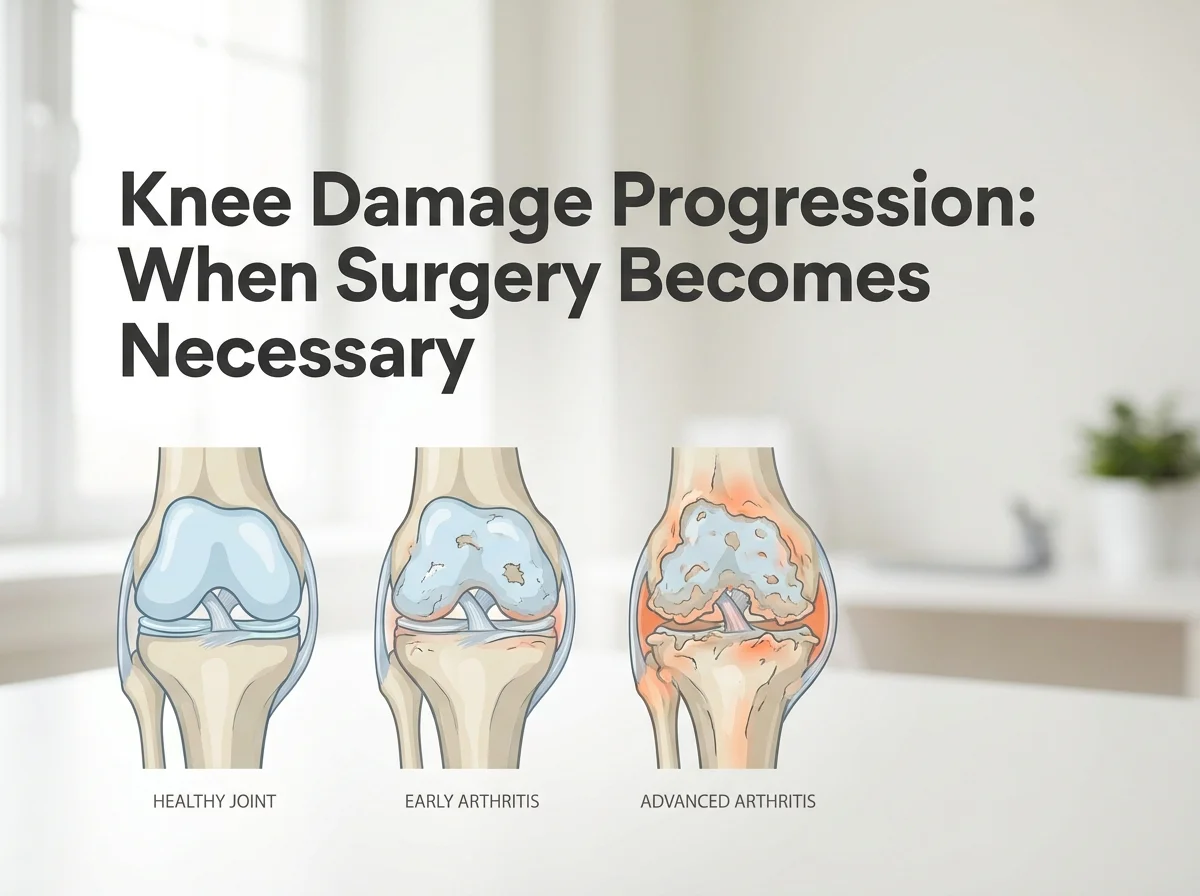
By the numbers: Grade 3–4 Kellgren-Lawrence changes, confirmed on X-ray, are the imaging threshold most surgical teams use before recommending knee replacement over continued conservative management.
What Are the Early Signs You Might Need a Knee Replacement?
The earliest signs are pain that worsens with activity and eases with rest, morning stiffness lasting more than 30 minutes, and a knee that feels unstable on stairs or uneven ground. These symptoms tend to progress gradually rather than appearing overnight.
Watch for this cluster of symptoms together, since any single one alone rarely justifies surgery:
- Pain that disrupts sleep or wakes you at night
- Visible swelling that doesn’t fully resolve between flare-ups
- A grinding or clicking sensation during movement
- Reduced range of motion compared to a year ago
- Reliance on a cane, brace, or handrail for stability
Any one of these on its own is worth mentioning to a doctor. Several together, especially alongside imaging changes, point more strongly toward surgical evaluation.
What Pain Level Means It’s Time for a Knee Replacement?
It’s typically time for a knee replacement when pain scores 7 or higher on a 10-point scale during daily activities, or when pain persists at rest despite medication. Surgeons weigh reported pain alongside function, not as a number in isolation.
A knee that hurts only after a long run is a different problem to one that hurts while getting out of a chair. The second pattern — pain during basic, low-load movements — is the stronger signal that the joint itself, not just activity level, has changed.
When Do You Need a Knee Replacement, According to Doctors?
Doctors generally recommend a knee replacement once six to twelve months of conservative treatment — physiotherapy, anti-inflammatory medication, and often corticosteroid or hyaluronic acid injections — has failed to provide lasting relief. Imaging confirmation and functional impact are assessed alongside this treatment history.
Body mass index is also part of the conversation. Many surgical teams review BMI as part of pre-operative risk assessment, since higher values raise anaesthetic and wound-healing risk and may prompt weight-management guidance before a surgery date is confirmed — not as a blanket exclusion, but as a factor in planning a safer procedure.
At KCM Clinic, the international patient team reviews recent imaging and a summary of prior treatment before the consultation, so the surgical team can confirm candidacy without asking patients to repeat months of tests they’ve already done.
Worth knowing: A failed course of conservative treatment isn’t a formality — it’s the clinical evidence surgeons rely on to justify surgery over continued non-operative management.
Is There an Age Limit for Having a Knee Replacement Done?
There is no strict upper age limit for knee replacement; overall health, bone density, and cardiovascular fitness matter more than chronological age. Patients in their 80s with good general health are routinely approved, while younger patients with severe joint damage may also qualify.
The main age-related consideration works the other way: implants have a finite lifespan, so surgeons weigh the likelihood of needing a second (revision) procedure decades later against the benefit of relieving pain now.
What Happens If You Ignore the Need for a Knee Replacement?
Ignoring the need for a knee replacement typically means worsening cartilage loss, progressive joint deformity, and compensatory strain on the hip and opposite knee. Muscle weakness from reduced activity often compounds the problem.
Delaying surgery doesn’t preserve the joint — it usually just changes what the surgeon is working with by the time you go ahead. Bone loss and deformity that develop while waiting can make the eventual procedure more complex and extend recovery.
Reality check: Waiting past the point where imaging and symptoms both point to surgery rarely spares the joint further damage — it usually just delays relief while the damage continues.
How Long Can You Delay Knee Replacement Surgery Safely?
You can usually delay knee replacement safely for as long as pain is manageable with conservative treatment and daily function hasn’t seriously declined — but delaying after conservative care has failed tends to complicate rather than protect the joint. There’s no fixed countdown; timing is a clinical judgement, not a calendar deadline.
The framing that matters most is avoiding both extremes. Operating too early, before cartilage is genuinely spent, trades away joint tissue you can’t get back. Waiting too long, once imaging shows severe damage and treatment has failed, tends to mean more bone loss, weaker surrounding muscle, and a longer road back afterward. The window between those two points — conservative care exhausted, imaging confirms significant wear, quality of life is genuinely affected — is when surgery typically makes the most sense.
Total Knee vs Partial Knee Replacement: Which Matches Your Damage?
Not everyone who needs a knee replacement needs the whole joint replaced. Where arthritis is confined to one compartment of the knee, a partial knee replacement can be an option instead of a total reconstruction.
| Factor | Total Knee Replacement | Partial Knee Replacement |
|---|---|---|
| Extent of arthritis | Multiple compartments affected | Single compartment only |
| Typical recovery | 3–6 months to full mobility | Often 4–8 weeks to light activity |
| Bone preserved | Less — full joint resurfaced | More — healthy bone and ligaments kept |
| Revision likelihood | Lower over implant lifetime | Slightly higher; often revisable to total |
The decision depends on how much of the joint imaging shows is damaged, not patient preference alone. A detailed comparison of outcomes for each approach is covered in our guide to total knee vs partial knee replacement.
How to Know If You’re a Good Candidate for Knee Replacement

Good candidates share a specific combination: imaging confirming grade 3–4 arthritis, documented failure of at least six months of conservative treatment, and pain that genuinely limits work, sleep, or mobility. General health stable enough to tolerate anaesthesia and commit to rehabilitation matters as much as the knee itself.
For UK and Canadian patients, timing is complicated further by access. NHS referral-to-surgery pathways for elective orthopaedic procedures commonly stretch well past a year, and provincial wait lists in Canada follow a similar pattern for non-urgent joint surgery. KCM Clinic, operating under the same EU medical regulations as Germany and Sweden, typically offers consultation-to-surgery scheduling within one to two weeks once imaging and pre-operative assessments confirm candidacy.
Outcomes matter as much as access. Our breakdown of knee replacement success rates covers what the published data actually shows for patients meeting these criteria.
What Happens After You Decide to Move Forward?

Once imaging and treatment history confirm you’re a candidate, the next steps are pre-operative assessment, the procedure itself, and a structured rehabilitation programme. Recovery typically spans 3 to 6 months for full mobility restoration, though what to expect immediately after surgery and during the first week at home is worth understanding before you commit to a date.
Patients researching this stage often also compare NHS-specific pathways, including partial knee replacement options within the NHS system, against private and international alternatives — many choose surgery abroad specifically to avoid the waiting-list delays described above. Our companion guide to knee replacement surgery covers the procedure, implant options, and recovery timeline in full detail.
Get Started with KCM Clinic’s Orthopaedic Team
If the signs above match what you’re experiencing — imaging changes, failed conservative treatment, and pain that’s shrinking your daily life — a consultation is the next practical step, not a commitment to surgery. KCM Clinic’s international patient team reviews your imaging and history to confirm candidacy before scheduling anything.
Book a Free Consultation with KCM Clinic
Frequently Asked Questions
What are the symptoms of needing a knee replacement?
The main symptoms are persistent pain during daily activities, morning stiffness lasting over 30 minutes, visible swelling, reduced range of motion, and a grinding sensation during movement. When these persist despite physiotherapy and medication, they typically warrant a surgical evaluation.
Where does the knee hurt if you need a knee replacement?
Pain from arthritis severe enough to need replacement is usually felt throughout the joint, worsening with weight-bearing activities like walking or climbing stairs. Some patients also notice pain radiating slightly into the thigh or calf as surrounding muscles compensate for joint instability.
How does a doctor determine if you need a knee replacement?
Doctors combine X-ray or MRI imaging showing arthritis severity, a review of prior treatment (physiotherapy, medication, injections) and how well it worked, and an assessment of how much pain limits daily function. All three factors, not just one, inform the recommendation.
How bad does a knee need to be before replacement?
Most surgeons look for Kellgren-Lawrence grade 3–4 arthritis on imaging, alongside six to twelve months of failed conservative treatment and pain that significantly limits daily activities. Mild-to-moderate arthritis is usually managed non-surgically rather than with replacement.
Can younger patients get a knee replacement?
Yes. Age alone doesn’t disqualify a candidate — overall health, bone density, and imaging findings matter more. Younger patients with severe joint damage from injury or aggressive arthritis are approved when conservative treatment has genuinely failed, the same standard applied to older patients.
How long does a knee replacement last?
Modern knee implants typically last 15 to 25 years, with many lasting even longer depending on activity level and implant type. This is one reason surgeons weigh timing carefully — replacing the joint too early can mean facing a second, more complex revision surgery sooner than necessary.