
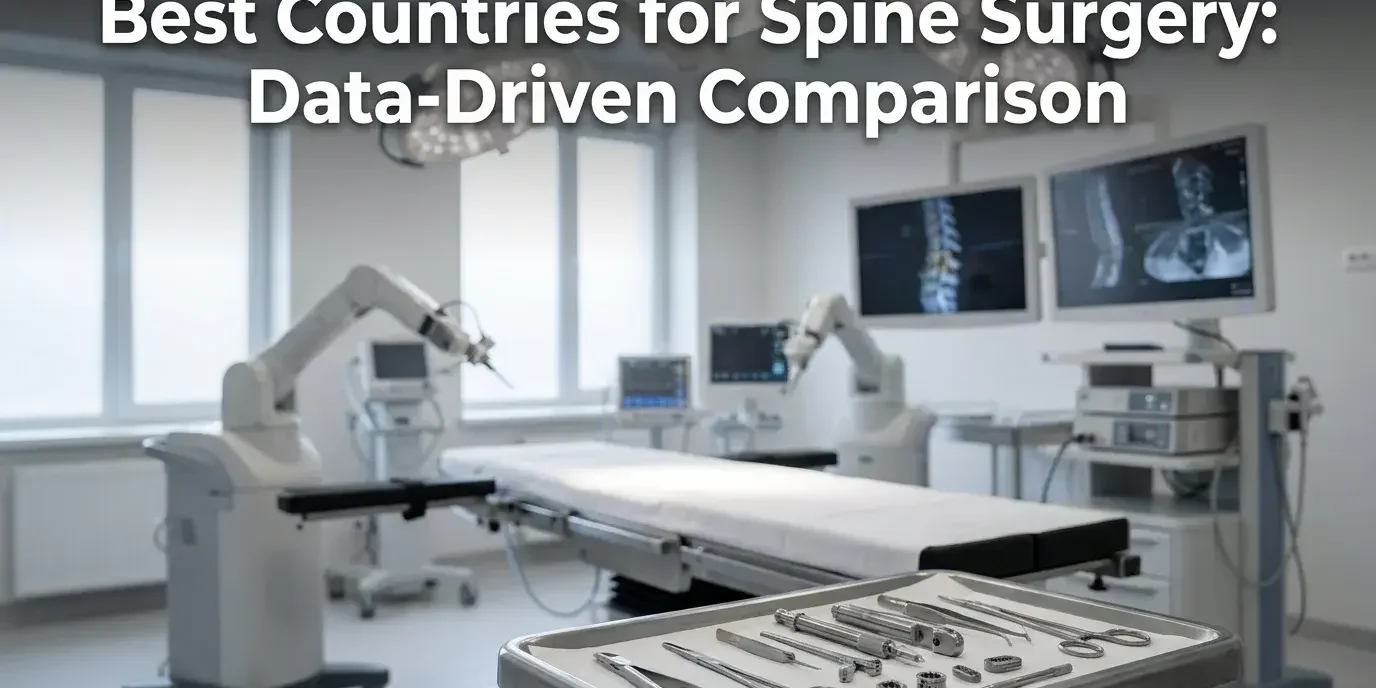
Best Country for Spine Surgery: A Data-Driven Comparison
UK and Canadian patients researching the best country for spine surgery usually shortlist the same five names: Germany, Poland, Turkey, India, and the United States. Only two of those operate under the European Union’s medical device regulation — the framework that governs which spinal implants a surgeon is legally allowed to use, and how closely those implants are tracked after surgery.
Key Takeaways
- EU countries operate under the same medical device regulation and surgical accreditation standards as Germany and France — a real advantage over destinations outside the EU regulatory framework.
- Success rates for minimally invasive spine procedures (laminectomy, discectomy, microdiscectomy) in specialised European centres run 85–95%, comparable to or exceeding published US outcome data.
- Spine surgery abroad in Europe typically costs 40–60% less than the equivalent private procedure in the UK — but savings only matter alongside verified outcomes and surgeon credentials.
- All-inclusive European packages (consult, surgery, hospital stay, physiotherapy, aftercare) coordinate care across disciplines, which reduces post-operative complications compared with booking surgery alone.
- European spine surgery is a realistic alternative to 12–24 month NHS and provincial waiting lists for patients with active disc herniation or spinal stenosis.
What Is the Best Country for Spine Surgery for UK and Canadian Patients?
For UK and Canadian patients, the best country for spine surgery is typically one inside the European Union, where spinal implants and surgical devices are regulated under the same framework used in Germany and France. That regulatory alignment, not a destination’s marketing copy, is what actually predicts consistent surgical outcomes and post-operative safety.
Most comparison articles rank countries by hospital accreditation badges or star ratings. Those signals matter, but they don’t tell you which implants a surgeon is legally permitted to use, or how a device is tracked if something goes wrong years later.
The regulatory question is worth asking first, because it applies to every procedure performed in that country — not just the one a clinic’s homepage highlights.
By the numbers: The EU’s medical device framework, Regulation (EU) 2017/745, requires every spinal implant to pass independent Notified Body assessment and ongoing post-market surveillance — a standard Turkey and India do not apply in the same form.
How Do EU Countries Compare for Spine Surgery Outcomes and Success Rates?
EU countries report success rates of 85–95% for minimally invasive spine procedures such as laminectomy, discectomy, and microdiscectomy, figures comparable to or exceeding published US outcome data. Turkey and India can offer individually skilled surgeons, but neither runs the EU’s unified device-regulation and accreditation framework that those numbers sit on top of.
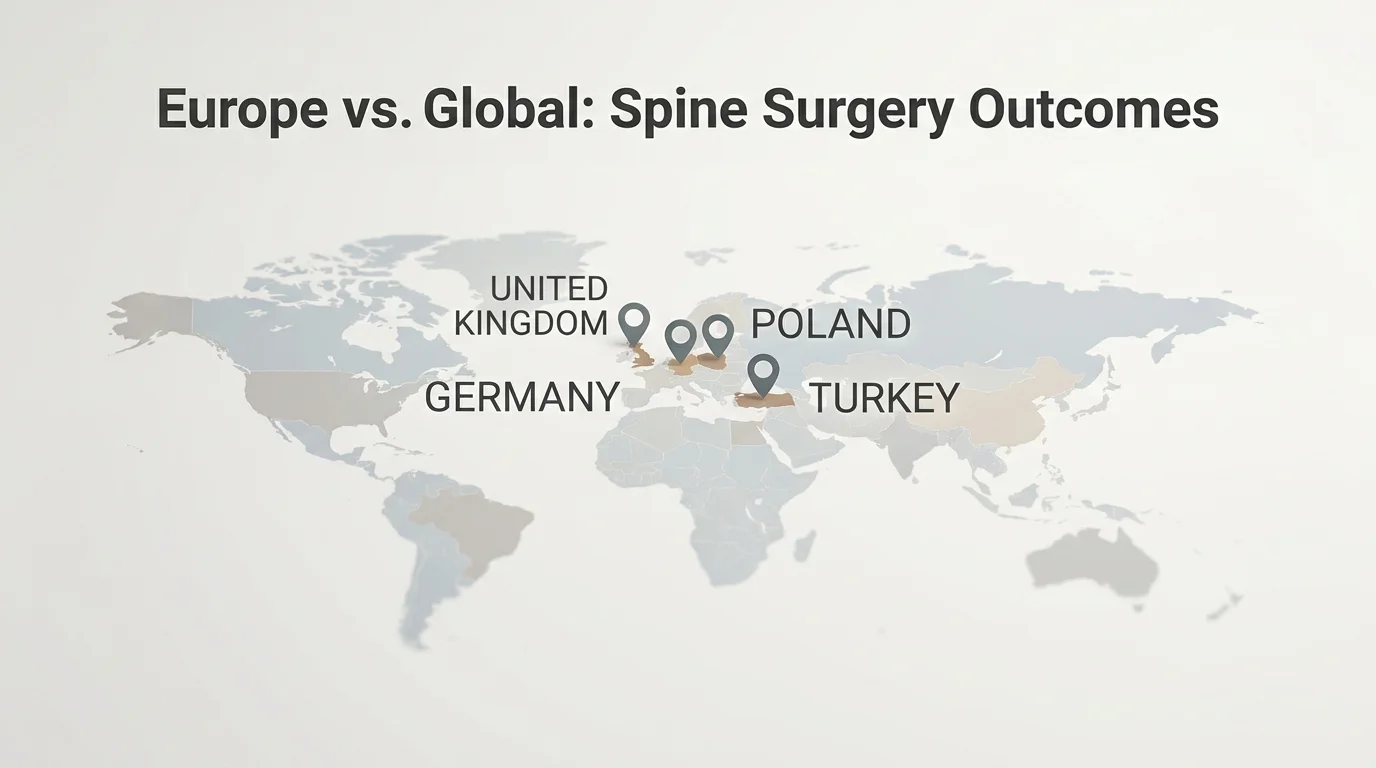
The table below compares the regulatory and care-model differences that sit behind the headline success-rate figures.
| Region | Device Regulation | Certification Standard | Typical Care Model |
|---|---|---|---|
| Poland, Germany, France (EU) | EU Medical Device Regulation (2017/745) | CE-marked, assessed by an EU Notified Body | Consult, surgery, hospital stay, and physiotherapy bundled together |
| United Kingdom | UK medical device framework (post-Brexit, still widely recognises CE marking) | UKCA / CE marking | Public system; private option available separately |
| Turkey | National device registration outside EU MDR | Varies by manufacturer and importer | Surgery-focused booking; aftercare often arranged separately |
| India | National device registration outside EU MDR | Varies by manufacturer and importer | Surgery-focused booking; aftercare often arranged separately |
A country’s regulatory framework doesn’t guarantee a good surgeon. It does guarantee that the implant placed in your spine was independently assessed before it ever reached an operating table.
What Does the Best Country for Spine Surgery Actually Cost, Abroad vs. the UK?
Spine surgery abroad in Europe typically costs 40–60% less than the same procedure at a private UK hospital, while still including aftercare that lower-priced destinations often charge for separately. The lowest sticker price usually belongs to Turkey or India, but that figure frequently excludes physiotherapy, follow-up imaging, and transfers.
- UK private hospital: highest baseline cost; surgery plus limited, separately billed aftercare
- Poland and other EU specialised centres: roughly 40–60% lower than UK private pricing; consult, surgery, hospital stay, physiotherapy, and aftercare bundled into one package
- Turkey and India: lowest quoted price; surgery-only bookings are common, with rehab and travel typically arranged independently
That gap matters most once you add up the hidden costs of a surgery-only booking — return flights for follow-up, private physiotherapy at home, and imaging your travel insurer may not cover.
Which Countries Offer the Best Minimally Invasive Spine Surgery?
Poland and Germany currently lead minimally invasive spine surgery in Europe, using 3D-guided endoscopic techniques alongside implants from established manufacturers such as Stryker and Zimmer Biomet. Both countries pair that equipment with EU-wide device tracking, so a specific implant can be traced back to its manufacturing batch years after surgery.
At KCM Clinic, minimally invasive procedures — endoscopic discectomy, microdiscectomy, and laminectomy — use Stryker and Zimmer Biomet implant systems, the same manufacturers many UK private hospitals already work with. Patients following an L5-S1 microdiscectomy rehab protocol typically follow a similar structured timeline to laminectomy recovery, often returning to light activity within two to four weeks.
Patients researching L5-S1 discectomy scar healing and wound care will find the same supervised-recovery model applies across most minimally invasive spine procedures, not just discectomy specifically.
What this means for you: If a clinic can’t tell you the implant manufacturer by name, that’s usually a sign the device isn’t tracked the way EU regulation requires.
What Qualifications and Certifications Should an International Spine Surgeon Have?
An international spine surgeon operating in the EU should hold specialist neurosurgery or orthopaedic-spine accreditation recognised by their national medical board, plus hospital privileges at a facility audited under EU surgical-accreditation standards. Ask specifically which implant manufacturer they use and whether the device is CE-marked under EU MDR — vague answers to either question are worth treating as a warning sign.
Before booking, verify:
- Specialist neurosurgery or orthopaedic-spine board certification, not a general surgery licence
- A named surgeon profile with a published case history, not just hospital branding
- Confirmation the implant is CE-marked under EU MDR (or FDA-cleared, for US destinations)
- A post-operative care plan that includes physiotherapy, not just discharge paperwork
KCM Clinic’s neurosurgery and spine team operates from KCM Clinic in Jelenia Góra, inside the EU regulatory zone described above, with named surgeon credentials published rather than aggregated review scores. Finding qualified minimally invasive spine specialists abroad starts with that kind of checkable, named credential.
Why Choose European Spine Surgery?

European spine surgery is worth choosing over lower-priced alternatives because the same regulatory framework that approves an implant also requires ongoing monitoring of it — something Turkey and India’s device frameworks don’t run in the same form. That combination of regulation, technique, and structured aftercare is what produces the 85–95% success-rate range cited earlier, not price alone.
KCM Clinic’s spine programme bundles pre-op consultation, surgery, hospital stay, physiotherapy, and aftercare into a single package rather than billing each stage separately — the same all-inclusive model used across its bariatric and orthopaedic programmes. That coordination is also what the recovery from spine surgery timeline in our clinical guide depends on: a physiotherapist working from the same operative notes as the surgeon, not receiving a patient with no clinical history.
Independently published spinal surgery success rate data from European registries backs this pattern, tracked across specialised centres rather than self-reported testimonials.
Why Do UK Patients Choose European Spine Surgery Over NHS Waiting Lists?
UK patients increasingly choose European spine surgery because elective NHS waiting times for procedures like discectomy and laminectomy commonly extend into the second year, while a comparable European procedure can often be scheduled within weeks. For someone with active nerve compression, that gap isn’t just inconvenient — untreated pressure on a nerve root can worsen over months of waiting.
Patients weighing slipped disk treatment options, from conservative care to endoscopic surgery against a long NHS wait often find that the European pathway resolves both the delay and the technique question in a single decision.
Get Started with KCM Clinic
If NHS or provincial waiting times are the main reason you’re comparing countries, the deciding factor should still be the surgical and regulatory standard behind the operation, not just how soon you can be seen. Book a consultation to discuss your diagnosis, implant options, and an all-inclusive recovery plan before you travel.
Book a Spine Surgery Consultation with KCM Clinic
Frequently Asked Questions
Which Country Has the Best Spine Surgeons?
No single country holds a monopoly on skilled spine surgeons, but EU countries combine surgeon skill with unified device regulation and mandatory post-market implant tracking. That combination, rather than any one “best surgeon” claim, is what most consistently predicts safe, well-documented outcomes for international patients.
Is Spine Surgery More Affordable Abroad, and What Are the Quality Tradeoffs?
Spine surgery in Europe typically costs 40–60% less than the same private procedure in the UK, and it’s usually bundled with aftercare rather than billed separately. The main tradeoff outside the EU is regulatory — devices and follow-up care aren’t always covered by the same independent oversight.
What Is the Hardest Spine Surgery to Recover From?
Multi-level spinal fusion generally has the longest recovery, taking 3 to 6 months because the vertebrae need time to fuse solidly rather than just heal soft tissue. Minimally invasive procedures like microdiscectomy and endoscopic discectomy recover considerably faster, often within 4 to 6 weeks.
How Risky Is L4-L5 or L5-S1 Spine Surgery?
Minimally invasive surgery at the L4-L5 or L5-S1 level carries the same general risks as other spine procedures — nerve irritation, infection, and, rarely, recurrence — but published success rates at these levels in specialised European centres run 85–95%. Choosing a surgeon who performs this specific level regularly meaningfully lowers that risk.