


Oxford Knee Replacement: Survivorship, Recovery, and Who Qualifies
Not every arthritic knee needs a full replacement. Oxford Knee replacement is the partial alternative built for patients whose damage is confined to one compartment — an implant with clinical data spanning more than four decades and one of the most studied survivorship records in orthopaedics.
Key Takeaways
- Oxford Knee is a partial knee replacement system that preserves more of your natural knee bone and soft tissue than traditional total knee replacement.
- The Oxford Knee works best for patients with isolated medial (inner) compartment osteoarthritis and good ligament function.
- With proper patient selection, Oxford Knee implants have demonstrated survival rates exceeding 95% at 10 years and 85% at 20 years.
- Recovery from Oxford Knee surgery is typically faster than total knee replacement, with patients returning to daily activities sooner.
- At KCM Clinic, Oxford Knee replacement combines Zimmer Biomet’s proven implant technology with minimally invasive surgical expertise and comprehensive aftercare protocols.
What Is the Oxford Knee Replacement System?
The Oxford Knee is a unicompartmental (partial) knee replacement system, originally designed by John Goodfellow and John O’Connor at Oxford University and now manufactured by Zimmer Biomet. Its defining feature is a meniscal-bearing mobile platform: a free-floating polyethylene insert that moves with the joint instead of sitting fixed in place, which spreads load more evenly and reduces wear compared with earlier rigid designs.
Most knee replacements resurface all three compartments of the joint — medial, lateral, and patellofemoral. The Oxford system resurfaces only the damaged medial compartment, leaving the anterior and posterior cruciate ligaments, the lateral cartilage, and roughly twice as much native bone untouched.
That distinction matters for how the knee moves afterward. Because the ligaments stay intact, the joint retains more of its natural kinematics than a fully resurfaced knee does.
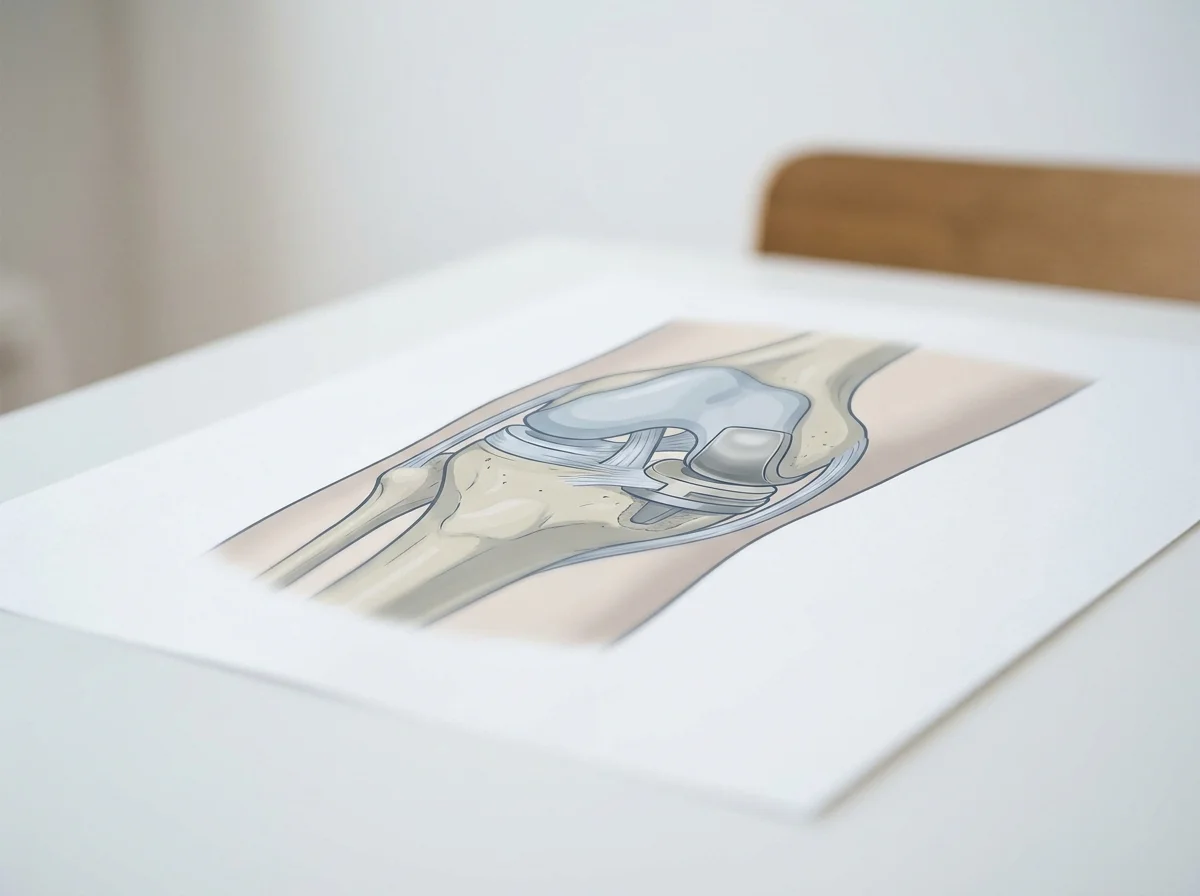
By the numbers: The current mobile-bearing generation of the Oxford implant — often called Phase 3 — is among the latest partial knee systems on the market, and has been the standard version used worldwide since the late 1990s, following two earlier design iterations dating back to 1976.
How Does Oxford Knee Compare to Total Knee Replacement?
Oxford partial knee replacement preserves both cruciate ligaments and roughly double the bone stock of a total knee replacement, and published series report faster early mobilisation and shorter hospital stays. Total knee replacement resurfaces all three compartments and remains the better option once arthritis has spread beyond the medial side.
The two procedures solve different problems, and the right choice depends entirely on how much of the joint is actually damaged.
| Factor | Oxford Partial Knee | Total Knee Replacement |
|---|---|---|
| Joint damage treated | Medial compartment only | All three compartments |
| Ligaments preserved | ACL and PCL retained | Both cruciate ligaments typically sacrificed |
| Bone removed | Minimal — resurfaces one compartment | Full resurfacing of femur and tibia |
| Typical hospital stay | Often 1–2 days shorter than TKR | Standard primary TKR protocol |
| If revision is later needed | Usually converts to a primary total knee | Revision surgery is more complex |
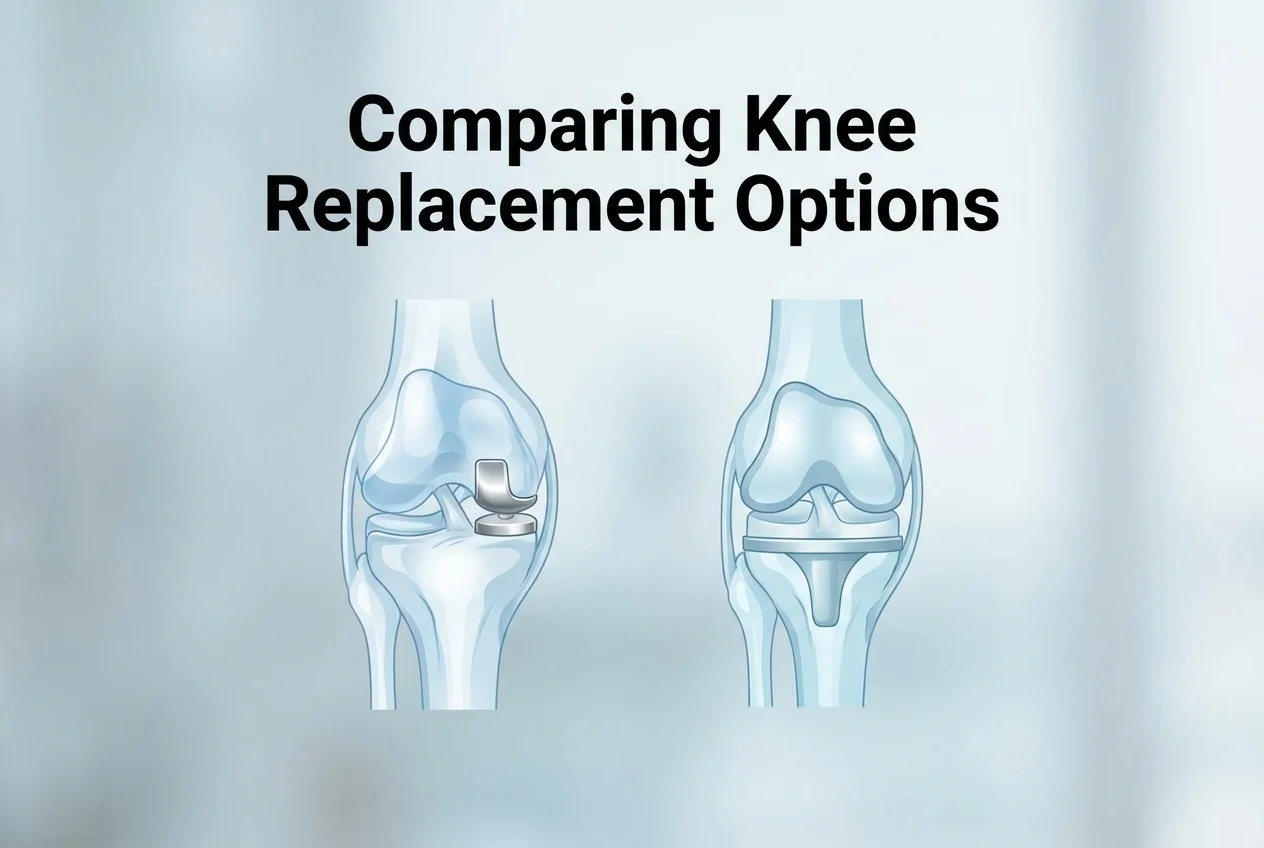
A total knee vs partial knee replacement comparison is worth reading in full if your arthritis pattern isn’t yet confirmed by imaging — the right answer depends on which compartments are actually affected, not on patient preference alone.
Who Is a Good Candidate for Oxford Knee Replacement
Not every patient with knee arthritis is a candidate for a partial implant, and being clear about this upfront avoids a wasted consultation. Among the partial knee replacement options available today, Oxford is specifically indicated for anteromedial osteoarthritis — damage confined to the front and inner part of the knee.
Surgeons assess three things before recommending it:
- Compartment pattern. Damage must be isolated to the medial compartment on imaging, with the lateral compartment and cartilage under the kneecap still healthy.
- Ligament function. The anterior cruciate ligament needs to be intact or only mildly deficient — the implant relies on it for stability.
- Correctable deformity. Any varus (bow-legged) alignment should passively correct under examination, confirming the damage hasn’t progressed into the lateral compartment.
Patients with inflammatory arthritis, fixed deformity, or damage across multiple compartments are steered toward total knee replacement instead — the knee replacement surgery pathway covers that broader decision in full.
How Long Do Oxford Knee Replacements Last?
Published lifetable survivorship studies — most notably the single-surgeon series by Price and Svärd in Clinical Orthopaedics and Related Research — report Oxford Knee survival rates above 95% at 10 years and around 85% at 20 years when patient selection criteria are followed closely. Registry-level data across all surgeons tends to run somewhat lower, underlining why correct indication is the biggest variable in long-term success.
That gap between specialist-series and registry-wide numbers isn’t a flaw in the implant — it reflects how much patient selection and surgical technique influence the outcome. The knee replacement success rate breakdown looks at how these figures compare across implant types.
Worth knowing: Because so much bone and both cruciate ligaments are preserved, a failed Oxford Knee typically converts to a standard primary total knee replacement rather than a complex revision procedure — a real advantage for younger patients weighing their options decades out.
What Do Recovery Times and Success Rates Look Like?
Recovery from Oxford Knee replacement is generally faster than total knee replacement because less soft tissue is disturbed during surgery. Many patients mobilise the same day or the day after surgery, with most returning to normal daily activities within four to six weeks rather than the two to three months typical after a total knee replacement.
Physiotherapy still matters — the muscles around the knee need rebuilding regardless of which implant was placed. But patients consistently report the joint “feels more like their own knee” during early recovery, a function of the preserved ligaments rather than the smaller incision alone.
- Same-day or next-day mobilisation is common with modern minimally invasive technique.
- Most patients walk without support within two to three weeks.
- Return to low-impact sport (cycling, swimming, golf) is typically cleared by three months.
A full partial knee recovery timeline, week by week, is more useful than averages alone — it’s the piece most patients want before they commit to a surgery date.
How Much Does Oxford Knee Replacement Cost?
Oxford Knee replacement cost varies by implant, hospital stay length, and the rehabilitation package included, so any figure quoted without a clinical assessment should be treated cautiously. The most reliable way to understand true out-of-pocket cost is to compare a full private surgical package rather than a headline implant price.
UK patients researching this procedure are usually comparing it against NHS waiting times or existing private quotes. The private knee replacement cost breakdown covers what a UK private pathway typically includes, which is a useful benchmark before requesting a KCM Clinic quote.
At KCM Clinic, pricing is confirmed after your imaging and consultation, because implant selection and aftercare needs genuinely differ patient to patient — not because the number is hidden.

Why Choose KCM Clinic for Oxford Knee Replacement?
KCM Clinic performs Oxford Knee replacement using Zimmer Biomet’s implant technology within an EU-regulated hospital in Jelenia Góra, Poland — operating under the same medical device regulations as Germany and France. Patients from the UK and Canada choose this route to bypass multi-year elective surgery waiting lists without leaving the EU regulatory framework.
The all-inclusive package covers your consultation, surgery, hospital stay, physiotherapy, and aftercare as one coordinated plan — not a series of separate invoices. That matters for patients weighing knee replacement abroad against a longer wait at home, since the total cost and timeline are known before you travel.
Bottom line: A named surgical team, transparent all-inclusive pricing, and Zimmer Biomet implant technology are the same standard KCM Clinic applies across every orthopaedic procedure — Oxford Knee replacement included.
Get Started with KCM Clinic
If imaging has confirmed your arthritis is limited to the medial compartment, an Oxford Knee replacement consultation at KCM Clinic can confirm whether you’re a candidate within a single visit. You’ll get a clear implant recommendation and a fixed treatment timeline before you commit to travel.
Book an Oxford Knee Consultation with KCM Clinic
FAQ
Is Oxford Knee replacement the same as partial knee replacement?
Oxford Knee is a specific brand and design of partial (unicompartmental) knee replacement, not a separate category of surgery. It’s distinguished by its meniscal-bearing mobile-platform design, manufactured by Zimmer Biomet, and is one of the most widely used and longest-studied partial knee systems available.
How long does Oxford Knee replacement surgery take?
Oxford Knee replacement surgery typically takes around 60 to 90 minutes, shorter than the average total knee replacement because only one compartment is resurfaced. Actual duration depends on the surgical approach used and any additional preparation your surgeon determines is necessary during the procedure.
Can you kneel after an Oxford Knee replacement?
Many patients regain the ability to kneel after Oxford Knee replacement more successfully than after total knee replacement, since less soft tissue around the kneecap is disturbed. Comfort varies by patient, and your surgical team will guide when kneeling is safe during your specific recovery.
What happens if an Oxford Knee replacement eventually fails?
Because the Oxford implant preserves substantial bone stock and both cruciate ligaments, a failed Oxford Knee replacement usually converts to a standard primary total knee replacement rather than a complex revision. This is one of the design’s recognised long-term advantages over some other partial knee systems.