


Titanium Knee Replacement: What It Is and Why Surgeons Use It
A titanium knee replacement uses titanium alloy — instead of, or alongside, cobalt-chromium — in the implant components that anchor to bone. Surgeons choose it primarily for two reasons: it bonds directly to living bone and it carries almost no risk of metal allergy. More than 790,000 knee replacements are performed in the United States each year, and implant material is now one of the first questions patients raise once they’ve decided on surgery.
What Is a Titanium Knee Replacement?
A titanium knee replacement is a knee implant in which the bone-contacting surfaces — typically the tibial baseplate and femoral fixation pegs — are made from titanium alloy, most commonly Ti-6Al-4V, rather than cobalt-chromium. The alloy is prized in orthopaedics for a stiffness that sits closer to natural bone than cobalt-chrome does, which helps distribute load more evenly around the implant.
Titanium is not usually the only metal in a modern knee system. Manufacturers such as Zimmer Biomet, one of the implant partners KCM Clinic works with, pair titanium fixation surfaces with a cobalt-chromium femoral bearing surface in many total knee designs, because cobalt-chrome resists the scratching that repeated joint movement causes far better than titanium alone.
That combination — titanium where the implant meets bone, harder metal where it articulates — is why “titanium knee replacement” usually describes a hybrid system rather than an all-titanium joint.
Key Takeaways
- Titanium alloy is used mainly in the bone-fixation surfaces of a knee implant — the tibial baseplate and fixation pegs — rather than the entire joint.
- Titanium bonds directly to bone through osseointegration, giving cementless implants a stable, long-term hold without surgical adhesive.
- Titanium alloys contain no nickel, making them the standard choice for the roughly 10-15% of patients with a documented metal sensitivity.
- Zimmer Biomet is among the manufacturers supplying titanium implant components used at KCM Clinic for both cemented and cementless knee systems.
- Titanium components typically add a modest cost premium over an all-cobalt-chrome system, offset for many patients by lower revision risk over 15-20 years.
Titanium Bonds Directly to Bone Through Osseointegration
Titanium implants achieve osseointegration — a direct structural bond between living bone and the implant surface — because bone cells recognise titanium’s oxide layer as biocompatible and grow directly onto it rather than forming scar tissue around it. Manufacturers roughen or plasma-spray the titanium surface to create a porous texture that bone can grow into over the following weeks.
This mechanism is what makes cementless (press-fit) knee implants possible. Instead of bone cement locking the implant in place immediately, the patient’s own bone gradually fuses to the titanium surface over roughly six to twelve weeks, creating a bond that can outlast the mechanical grip of cement in younger, more active patients.
Surgeons weigh this against a trade-off: osseointegration takes time to mature, so cementless titanium fixation is usually reserved for patients with good bone density rather than those with osteoporosis, where a cemented approach still performs more reliably.
Titanium vs Cobalt-Chrome and Polyethylene: How the Materials Compare
Every modern knee implant is really a system of three materials working together, and each one is chosen for a different job.
| Material | Role in the implant | Main advantage | Main limitation |
|---|---|---|---|
| Titanium alloy | Bone-fixation surfaces, cementless stems | Bonds to bone; nickel-free; low stiffness mismatch with bone | Softer surface, prone to scratching if used as a bearing |
| Cobalt-chromium | Femoral bearing (articulating) surface | Hard, highly polished, wear-resistant against polyethylene | Contains nickel and cobalt, unsuitable for some allergy patients |
| Polyethylene | Tibial insert, the “cushion” between metal parts | Absorbs impact, low-friction against metal | Wears gradually; wear debris is a leading cause of revision |
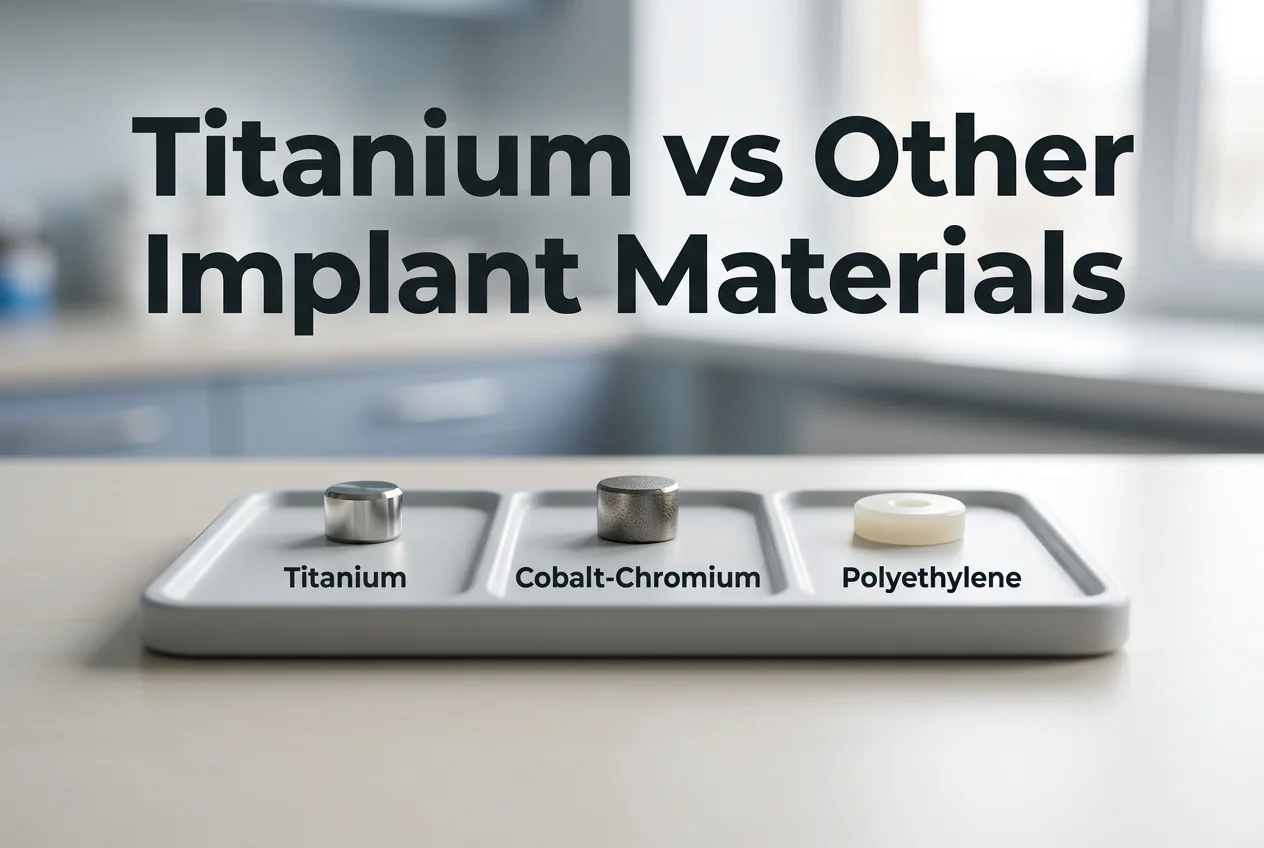
Worth knowing: A fully titanium bearing surface is rarely used precisely because titanium scratches more easily under repeated motion — the metal shines in fixation, not in the moving joint surface.
Among knee implant types, the practical decision usually isn’t “titanium or cobalt-chrome” but which combination of the two, plus the polyethylene insert, best fits a patient’s bone quality, activity level, and any documented metal sensitivity.
How Long Do Titanium Knee Replacements Last?
Knee implants using titanium fixation components report survival rates broadly in line with, or slightly ahead of, standard cobalt-chrome systems — commonly cited at 15 to 20 years or longer for the majority of patients, according to national joint registry data. Longevity depends more on implant positioning, patient weight, and activity level than on the specific metal alloy alone.
Where titanium shows a clearer edge is in younger, more active patients receiving cementless fixation, where the bone-bonding mechanism described above can outlast a cemented bond over decades of use. Readers weighing implant survival more broadly against knee replacement success rate data will find registry figures point the same direction regardless of which manufacturer’s system is used.
Precision of implant placement also matters as much as material choice — a well-positioned implant of either material tends to outlast a poorly aligned one, which is part of the case for robotic-guided implant positioning now used alongside titanium fixation systems in many hospitals.

Why KCM Clinic Chooses Titanium Implants for Knee Replacement
KCM Clinic’s orthopaedic team fits titanium-fixation knee systems from Zimmer Biomet and other established manufacturers, selected against a patient’s bone density and imaging rather than a single house preference. As an EU-registered hospital, KCM Clinic operates under the same implant sourcing and surgical regulatory standards applied across Germany and the wider EU — a distinction UK and Canadian patients researching options abroad tend to check for early.
Every knee replacement is booked as one all-inclusive package: pre-operative consultation, the surgery itself, hospital stay, physiotherapy, and structured aftercare, rather than a stack of itemised add-ons. For patients with a documented nickel or metal allergy, titanium fixation components are discussed at consultation stage, before any implant is selected.
That evidence-led selection process is also why titanium implant durability isn’t just a manufacturer’s claim here — it’s a factor built into how the surgical team plans each case, including where revision-resistant implant materials matter most for younger, more active patients.
How Much Does a Titanium Knee Replacement Cost?
There is no single published figure for titanium knee replacement cost, because price depends on the specific implant system, whether fixation is cemented or cementless, and what’s bundled into the surgical package. Titanium-fixation components typically carry a modest premium over an all-cobalt-chrome system, reflecting the added manufacturing process for the porous bonding surface.
That premium is easiest to evaluate against what it’s actually buying: for the right patient, the longer expected implant life reduces the likelihood of a second, more complex revision surgery years later. Patients comparing headline numbers, including those researching private UK knee replacement pricing, often find that all-inclusive packages — covering consultation, surgery, hospital stay, and rehabilitation — give a more accurate comparison than the implant cost alone.
KCM Clinic provides a personalised quote at consultation once imaging and implant choice are confirmed, rather than publishing a generic starting price that may not reflect an individual case.
Can You Have a Titanium Knee Replacement on the NHS?
Yes — the NHS funds knee replacement surgery for eligible patients, and implant material, including titanium fixation systems, is selected by the treating surgeon based on clinical need rather than patient request. Waiting times for elective procedures like knee replacement on the NHS commonly extend well beyond a year in many regions, which is the primary reason self-funding patients look at private and international options.
Private and international providers, including KCM Clinic, typically offer faster access to a consultation and surgery date, along with more scope for the patient to discuss implant material and manufacturer directly with the surgeon before booking. For patients already researching total knee vs partial knee replacement as a decision point, implant material is usually the next conversation once the procedure type itself is settled.
Get Started with KCM Clinic
If a metal allergy, bone density concern, or simply a preference for a specific implant system is shaping your decision, KCM Clinic’s orthopaedic team can review your imaging and discuss titanium fixation options within one consultation. The all-inclusive package covers consultation, surgery, hospital stay, physiotherapy, and aftercare as a single coordinated plan.
Book a Knee Replacement Consultation with KCM Clinic
FAQ
Are titanium knee replacements better than cobalt-chrome implants?
Neither material is universally “better” — most modern knee systems use both, with titanium in the bone-fixation surfaces and cobalt-chrome in the bearing surface. Titanium is the clearer choice specifically for patients with a metal allergy or those receiving cementless fixation.
Can you kneel comfortably after a titanium knee replacement?
Most patients can kneel after full recovery, though comfort varies by individual healing and any residual scar tissue over the kneecap, not by implant material specifically. Surgeons generally advise a gradual return to kneeling, cushioned initially, rather than avoiding it indefinitely.
What is the lifespan of a titanium knee replacement?
Titanium-fixation knee implants commonly last 15 to 20 years or longer, in line with standard cobalt-chrome systems, according to national joint registry data. Individual results depend more on implant positioning, weight, and activity level than on the metal alloy alone.
Do titanium knee implants set off metal detectors?
Titanium is metallic and can trigger airport and security metal detectors, so patients are generally advised to carry documentation of their implant when travelling. This applies to any metal knee implant, not titanium specifically.