
NHS Rhinoplasty Before and After: What UK Results Really Look Like
Before and after photos of a rhinoplasty rarely say which day the “after” shot was taken — and that missing detail is where most disappointment starts. A nose photographed at week three still carries swelling that will keep changing for months.
Key Takeaways
- The NHS funds rhinoplasty only for documented medical need, such as breathing problems or trauma; cosmetic-only requests are almost never approved.
- Visible swelling drops substantially within two to three weeks, but final NHS rhinoplasty before and after results take six to twelve months to settle fully.
- UK private rhinoplasty typically costs £8,000–£15,000 for surgery alone; all-inclusive European packages such as KCM Clinic’s bundle aftercare into one quote.
- Open technique leaves a small, fading scar between the nostrils; closed technique leaves no visible external scar at all.
- Ethnic rhinoplasty results depend heavily on skin thickness and cartilage strength, which is why technique and surgeon experience matter more than any single “before and after” photo.
Contents
- Can You Get Rhinoplasty on the NHS?
- What Does NHS Rhinoplasty Before and After Actually Look Like?
- What Happens During Rhinoplasty Surgery?
- How Long Does It Take to See Final Rhinoplasty Results?
- What Is the Recovery Timeline for Nose Surgery?
- Why Choose KCM Clinic for Rhinoplasty?
- How Much Does NHS Rhinoplasty Cost vs Private Surgery?
- Can You See Rhinoplasty Scars After Healing?
- What Are Realistic Expectations for Rhinoplasty Before and After?
- Why Do Some Rhinoplasty Results Look Better Than Others?
- Frequently Asked Questions About NHS Rhinoplasty Before and After
Can You Get Rhinoplasty on the NHS?
Rhinoplasty is funded on the NHS only when there is a documented medical need — breathing obstruction, trauma, or a congenital condition such as a cleft deformity. Purely cosmetic requests, where the goal is appearance rather than a health problem, are almost never approved by NHS England or local Integrated Care Boards.
That distinction catches a lot of people out. Searching “NHS rhinoplasty before and after” often turns up patients who were treated for a deviated septum or breathing obstruction, not a cosmetic reshape.
Worth knowing: even when a functional rhinoplasty is approved, it follows the same general elective-surgery backlog as other non-urgent NHS procedures — commonly a wait measured in months rather than weeks.
If your goal is purely aesthetic — narrowing a bridge, refining a tip, correcting asymmetry — the NHS route isn’t available to you at all, regardless of how long you’re willing to wait.
What Does NHS Rhinoplasty Before and After Actually Look Like?
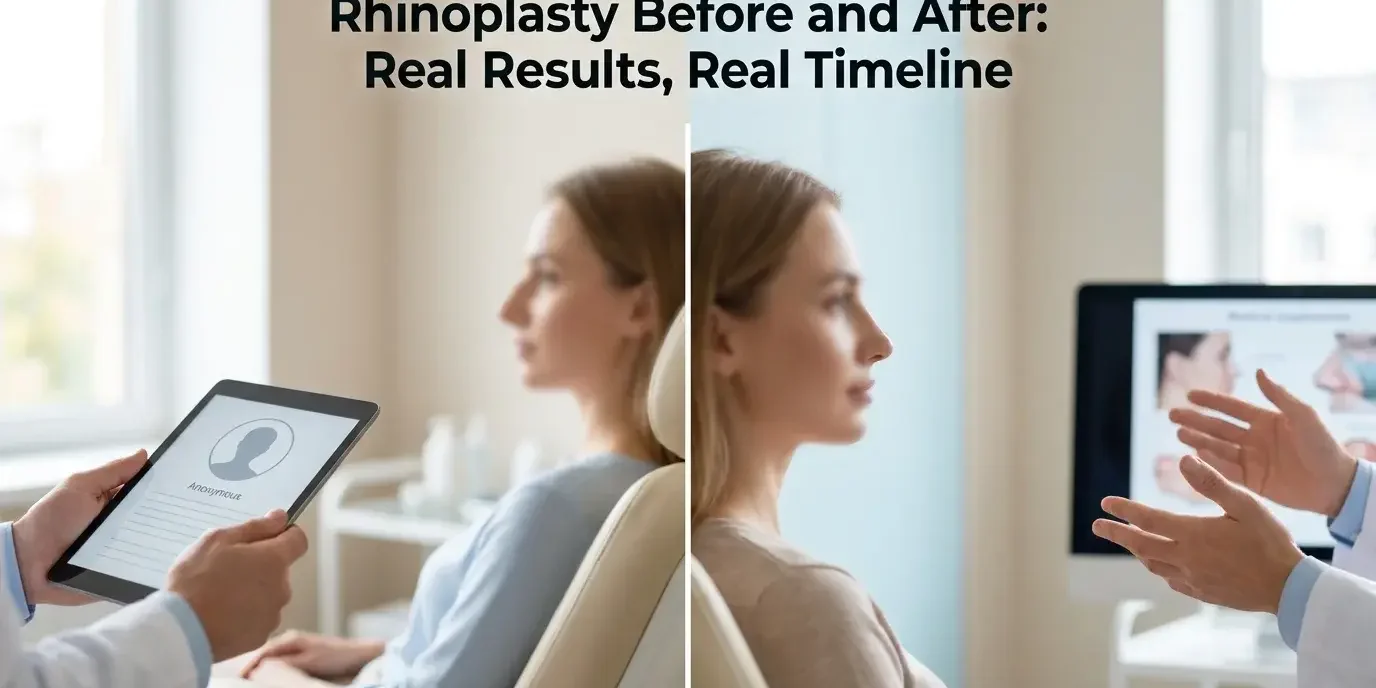
A genuine rhinoplasty before and after comparison shows three distinct stages: a swollen, bandaged nose in week one, a socially presentable but still-refining shape by week three, and a settled final result somewhere between month six and month twelve. Photos taken too early inflate expectations in both directions — sometimes making results look more dramatic than they’ll end up, sometimes hiding a good outcome under lingering swelling.
The most reliable before/after sets state the exact time elapsed since surgery. Any gallery that doesn’t is asking you to compare an early result to someone else’s late one.
A few things separate a credible comparison from a marketing photo:
- Identical camera angle, lighting, and distance in both shots
- A stated time interval (not just “before” and “after”)
- No filters, retouching, or selective cropping around the nose
What Happens During Rhinoplasty Surgery?
Rhinoplasty reshapes nasal bone, cartilage, or both under general anaesthesia, using either an open technique (a small external incision across the columella) or a closed technique (all incisions inside the nostril). The choice depends on how much structural change is needed, not just patient preference — more complex tip work usually calls for the open approach.
A full explanation of how rhinoplasty reshapes bone and cartilage — including anaesthesia, operating time, and complication rates — is worth reading before your consultation. Most procedures run 1.5 to 3 hours, and many surgeons now use 3D imaging beforehand to model the likely outcome against your actual anatomy.
How Long Does It Take to See Final Rhinoplasty Results?
Final rhinoplasty results typically take six to twelve months to fully emerge, even though most visible bruising and swelling clear within two to three weeks. The nasal tip is usually the slowest area to settle, since it involves thinner, more mobile tissue that continues remodelling long after bone has healed.
Patients with thicker skin tend to see the longest resolution windows. This is one reason a three-week “after” photo and a nine-month “after” photo of the same nose can look meaningfully different — both are real, just at different points on the same curve.
What Is the Recovery Timeline for Nose Surgery?
Recovery from rhinoplasty follows a fairly predictable arc: a splint and heavy swelling for the first week, social readiness by week two to three, light exercise by week four, and full sensation plus final contour refinement by month six to twelve. Strenuous activity, contact sports, and glasses resting on the bridge are typically restricted for four to six weeks.

Reality check: the gap between “healed” and “fully finished” is the single biggest source of patient anxiety after rhinoplasty — most of what looks unfinished at week four is normal, not a warning sign.
One real KCM Clinic patient case illustrates how tightly a private surgical pathway can run: a Thursday consultation, Saturday surgery, and Monday discharge — a full pre-op assessment, procedure, and hospital stay compressed into a single long weekend. That kind of turnaround is only possible when the surgical team, hospital capacity, and aftercare plan are coordinated under one roof, which is exactly the model behind KCM’s fast-track scheduling for UK and Canadian patients.
Why Choose KCM Clinic for Rhinoplasty?
KCM Clinic operates as an EU-regulated multidisciplinary hospital in Jelenia Góra, Poland, under the same Medical Devices Regulation framework that governs surgical standards in Germany and France. For rhinoplasty specifically, that means recognised surgeon qualifications, name-brand surgical equipment, and a coordinated aftercare pathway rather than a one-off procedure booked through a broker.
The all-inclusive package covers the pre-operative consultation, surgery, hospital stay, and structured follow-up — coordinated in English by a dedicated international patient team. For UK and Canadian patients weighing cosmetic surgery abroad against a domestic private clinic, the combination of EU regulatory oversight and rapid scheduling is the practical differentiator, not just the price.
How Much Does NHS Rhinoplasty Cost vs Private Surgery?
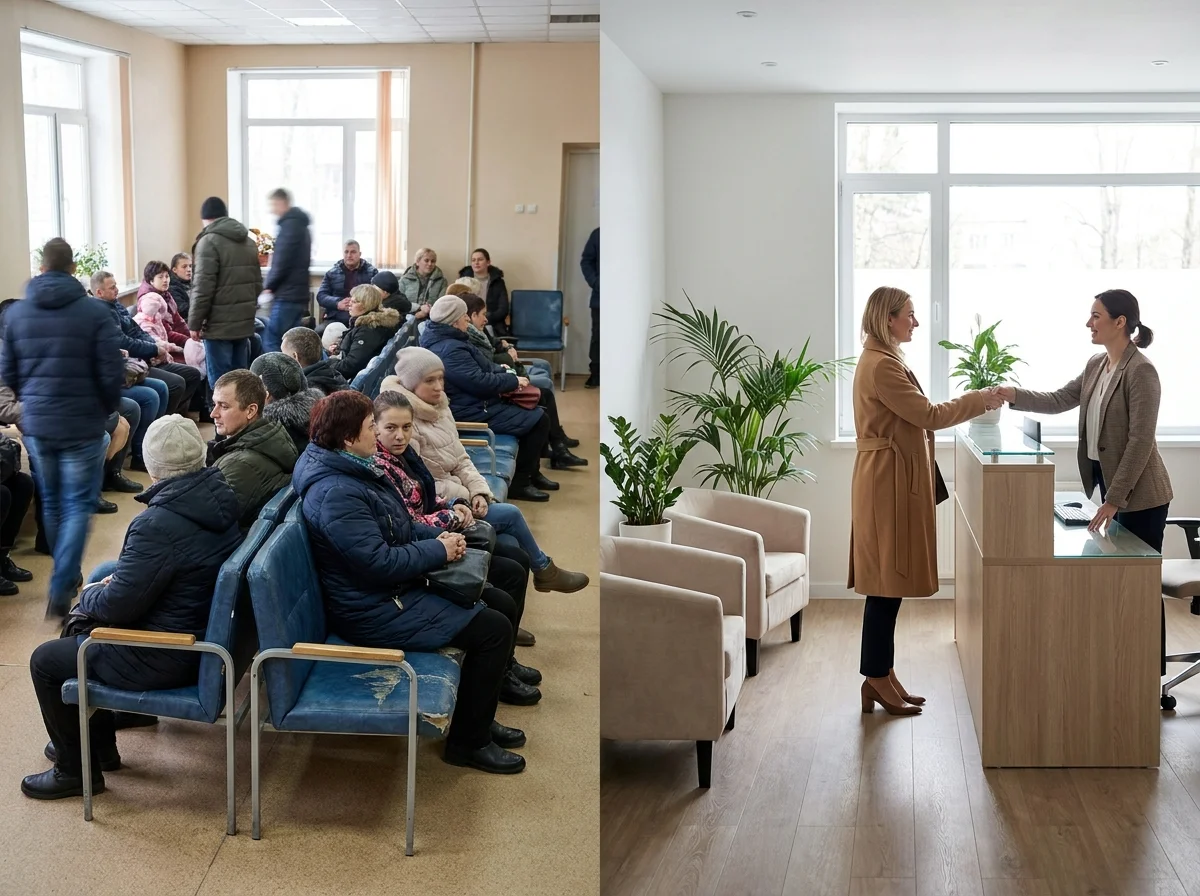
NHS rhinoplasty carries no direct cost when approved for medical need, but approval is narrow and the wait follows the standard elective backlog. UK private rhinoplasty for surgery alone typically runs £8,000–£15,000, with aftercare and physiotherapy often billed separately. European all-inclusive packages fold consultation, surgery, hospital stay, and aftercare into a single quote confirmed before you travel.
| Route | Cosmetic availability | Typical wait | What’s included |
|---|---|---|---|
| NHS | Rarely approved; medical need only | Standard elective backlog | Surgery only, if approved |
| UK private clinic | Widely available | 2–6 weeks | Surgery; aftercare often separate |
| KCM Clinic (EU) | Widely available | Days to a few weeks | Surgery, hospital stay, aftercare, transfers in one fee |
The short version: the NHS isn’t a slower version of private rhinoplasty — for cosmetic goals, it usually isn’t an option at all.
Can You See Rhinoplasty Scars After Healing?
Closed rhinoplasty leaves no visible external scar, since every incision sits inside the nostril. Open rhinoplasty leaves a thin scar across the columella, the strip of skin between the nostrils, which typically fades to barely noticeable within six to twelve months.
Scar visibility depends more on skin type and surgical technique than on surgeon skill alone. Patients considering the open approach for complex tip work should ask specifically how the surgeon closes the columellar incision, since suture technique affects the final scar line.
What Are Realistic Expectations for Rhinoplasty Before and After?
Realistic rhinoplasty expectations account for asymmetry, skin thickness, and the honest limits of what reshaping bone and cartilage can achieve — a good result looks natural and proportionate to your face, not identical to a reference photo of someone else’s nose. Surgeons work from your anatomy, not a template.
Patients who want change without surgery, or who are unsure how much correction they actually need, often start by comparing surgical results against rhinoplasty without surgery using dermal fillers — a reversible option that suits minor refinements but can’t reduce nasal size or fix breathing structure.
A few expectation resets worth stating plainly:
- Perfect symmetry isn’t a realistic surgical goal for any nose, operated or not
- Final results depend on your existing bone and cartilage, not a photo you bring in
- Breathing function can improve alongside appearance, but only if it’s addressed during planning
Why Do Some Rhinoplasty Results Look Better Than Others?
Rhinoplasty results vary most because of surgical planning, skin thickness, and technique choice — not luck. Thinner skin shows more surgical definition; thicker skin hides subtle changes and takes longer to fully settle. Surgeon experience with your specific anatomy matters more than the number of before/after photos in a gallery.
This is especially true for ethnic rhinoplasty, where preserving culturally significant features while addressing structural concerns requires a different technique selection than a standard Western rhinoplasty template. A surgeon who treats every nose identically will produce inconsistent before/after outcomes across different patients — which is a technique problem, not a patient problem.
Get Started with KCM Clinic
If NHS timelines and eligibility rules have already ruled out the cosmetic result you want, a private consultation is the fastest way to find out what’s realistic for your anatomy. KCM Clinic’s international patient team can talk through technique, timeline, and an all-inclusive quote before you commit to anything.
Book a Rhinoplasty Consultation with KCM Clinic
Frequently Asked Questions About NHS Rhinoplasty Before and After
Will the NHS give me a nose job?
Only if there’s a documented medical need, such as breathing obstruction, trauma, or a congenital deformity. Cosmetic-only requests are almost never approved, regardless of how long you’re prepared to wait on a list.
How long does it take to see final rhinoplasty results?
Most swelling and bruising resolve within two to three weeks, but the nasal tip keeps refining for six to twelve months. Photos taken before month six rarely show the true final shape.
Will my nose look smaller months after rhinoplasty?
Yes — a nose photographed at four months typically looks smaller and more defined than at four weeks, since deeper swelling continues resolving gradually. Full refinement can still continue for several more months after that.
What happens to rhinoplasty results years later?
Well-performed rhinoplasty results are generally stable long-term, since the underlying bone and cartilage structure has been permanently reshaped. Ageing can subtly alter tip position over decades, independent of the surgery itself.
Can I get non-surgical rhinoplasty instead of surgery?
Non-surgical rhinoplasty uses dermal fillers to smooth bumps or improve symmetry without incisions, but results are temporary and can’t reduce nasal size or fix breathing problems. It suits minor cosmetic refinements only.
How much does private rhinoplasty cost in the UK?
UK private rhinoplasty for surgery alone typically costs £8,000–£15,000, often with aftercare billed separately. All-inclusive European packages bundle consultation, surgery, hospital stay, and follow-up into a single quote.
Does ethnic rhinoplasty need a different surgical technique?
Yes — ethnic rhinoplasty accounts for skin thickness, cartilage strength, and culturally significant features that a standard technique can flatten or over-correct. Surgeon experience with diverse anatomies directly affects how natural the final result looks.