


Total Knee Replacement Medical Abbreviation: What TKR Means
TKR is the total knee replacement medical abbreviation you’ll see on referral letters, consultation notes, and NHS waiting-list correspondence. It stands for Total Knee Replacement, a procedure that resurfaces all three compartments of the knee joint rather than just one section. The same operation also goes by TKA — Total Knee Arthroplasty — and clinicians switch between the two without warning, which is usually where the confusion starts.
Knee replacement sits among the highest-volume elective orthopaedic procedures performed across UK and Canadian public healthcare systems, which is part of why it has accumulated so much of its own shorthand.
What Is the Total Knee Replacement Medical Abbreviation?
TKR stands for Total Knee Replacement, a surgical procedure that removes damaged cartilage and bone from the femur, tibia, and patella and replaces the joint surfaces with metal and plastic implant components. Surgeons write it as shorthand in clinic letters, operation notes, and discharge summaries, and it appears the same way whether the surgery happens on the NHS, through a Canadian provincial system, or privately.
The abbreviation exists mostly for practicality. Typing “total knee replacement” dozens of times in a single patient file adds up, and TKR compresses the phrase without losing any of its meaning.
It’s also more accurate to think of TKR as a resurfacing procedure than a full swap. A surgeon caps the ends of the femur and tibia — and often the back of the patella — with implant components, rather than removing the entire bone. That distinction matters when you’re trying to picture what the surgery actually involves before a consultation.
For the fuller walkthrough of what happens before, during, and after the operation, our knee replacement surgery guide covers the procedure step by step.
Key Takeaways
- TKR stands for Total Knee Replacement, a procedure that resurfaces all three compartments of the knee joint — medial, lateral, and patellofemoral — with metal and plastic implant components.
- TKR and TKA (Total Knee Arthroplasty) describe the same operation; hospital records and surgeons use the two abbreviations interchangeably.
- TKR differs from PKR (Partial Knee Replacement), which resurfaces only the damaged compartment rather than the whole joint.
- Waiting times for TKR on the NHS and through Canadian provincial systems commonly extend well beyond a year, which is why many patients start researching private international options.
- KCM Clinic’s all-inclusive TKR programme bundles pre-operative assessment, surgery, hospital stay, physiotherapy, and aftercare into one package, coordinated in English, German, and Arabic.
TKR and TKA Describe the Same Surgery
Nothing clinically separates a TKR from a TKA — they’re the same procedure named two different ways. In practice, TKA turns up more often in US medical literature and specialist orthopaedic journals, while NHS paperwork and UK private clinics tend to default to TKR in everyday correspondence.
That inconsistency is exactly why the acronym trips people up. A patient might receive a referral letter that says TKR, read a research paper that says TKA, and reasonably wonder whether they’re being offered two different operations. They aren’t. If a document uses either term without qualifying it further, it’s describing a full knee replacement, not a partial one.
Why Do Surgeons Use the Abbreviation TKR Instead of Writing Out the Full Term?
Surgeons default to TKR because orthopaedic records rely on standardised shorthand for speed, consistency, and coding accuracy across referrals, operation notes, and insurance or NHS billing systems. Once an abbreviation is established across a specialty, spelling out the full term repeatedly adds friction without adding clarity for anyone already familiar with it.
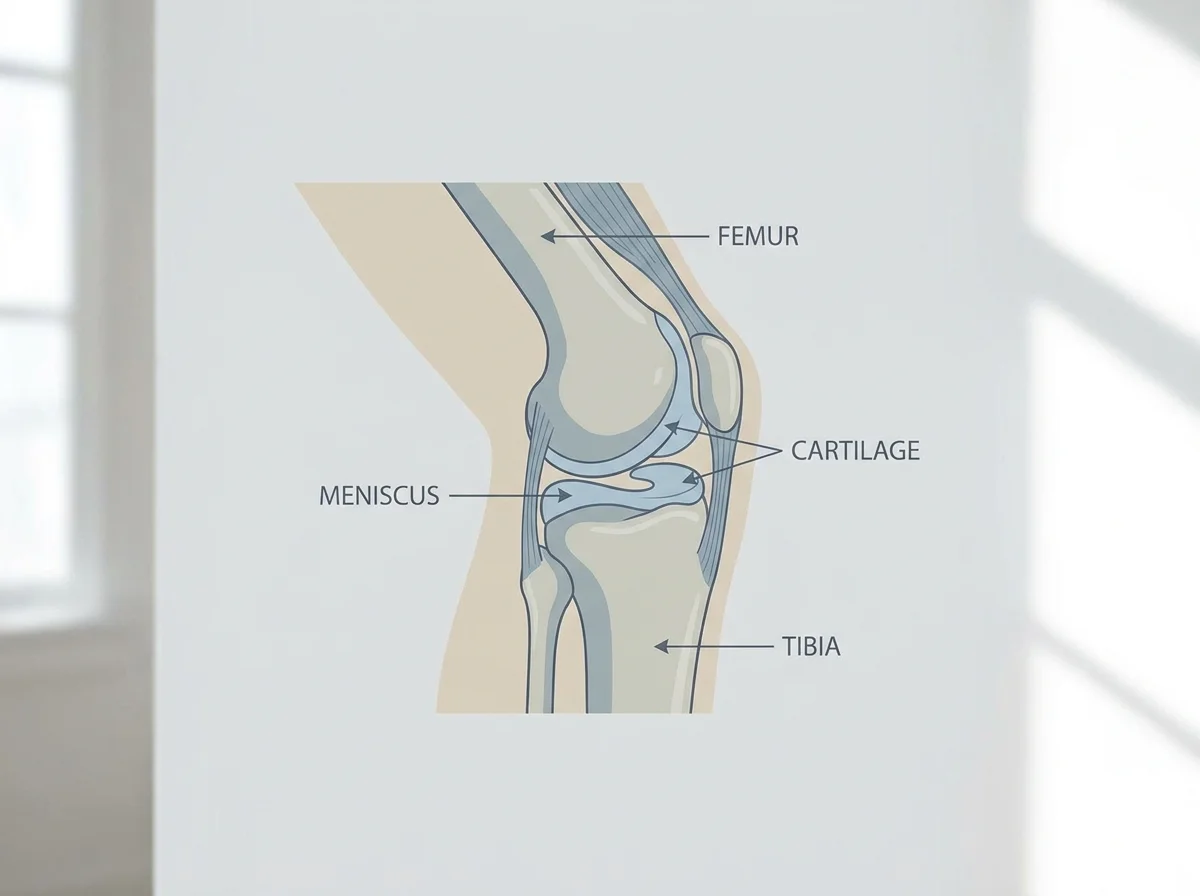
The three compartments — medial, lateral, and patellofemoral — are what distinguish a total from a partial knee replacement.
This is also why so many related abbreviations cluster around the same paperwork. A discharge summary might reference TKR alongside ROM (range of motion), WBAT (weight-bearing as tolerated), or DVT prophylaxis in the same paragraph — all shorthand built for clinicians writing quickly, not for patients decoding a letter at home.
What Is the Difference Between TKR and PKR (Partial Knee Replacement)?
TKR replaces all three compartments of the knee joint, while PKR (Partial Knee Replacement, sometimes called a unicompartmental replacement) resurfaces only the single compartment that’s damaged, leaving healthy cartilage and ligaments untouched. Which one a surgeon recommends depends on how much of the joint has worn down, not on patient preference alone.
PKR tends to suit patients whose arthritis is confined to one compartment — usually the medial side — with the rest of the joint still functioning well. TKR becomes the recommendation once damage has spread across multiple compartments, or once ligament stability is compromised enough that a partial resurfacing wouldn’t hold up.
Our half knee replacement guide goes deeper into PKR recovery timelines and how outcomes compare against a full TKR over the longer term.
Other Terms You’ll See Alongside TKR
A few related abbreviations show up in the same records and are worth recognising:
- L TKR / R TKR — laterality notation specifying which knee (left or right) the procedure applies to, standard on any surgical consent form or operative report.
- Bilateral TKR — both knees replaced, either in the same operation or as staged procedures weeks apart.
- ICD-10 coding — total knee arthroplasty has its own diagnostic and procedure codes, used for billing and statistical tracking rather than anything a patient needs to memorise.
Conditions like osteoarthritis, rheumatoid arthritis, and chondrocalcinosis knee can each wear down cartilage across multiple compartments over time. Once that damage is widespread rather than localised, a surgeon typically recommends TKR over a partial alternative.
Why Should UK and Canadian Patients Learn the Total Knee Replacement Medical Abbreviation?
Understanding what TKR means lets patients read their own referral letters accurately, compare NHS or provincial waiting-list timelines against private options, and ask surgeons more specific questions instead of nodding along to unfamiliar shorthand. That clarity becomes especially useful once someone starts weighing a private international pathway against staying on a public waiting list.
Worth knowing: Waiting times for elective procedures like TKR on the NHS commonly extend into the second year for many patients, and provincial wait lists in Canada follow a similar pattern for non-urgent orthopaedic surgery.
Once the terminology is clear, the more useful question usually isn’t “what does TKR mean” — it’s “how much longer am I willing to wait for one.”
How KCM Clinic’s TKR Programme Compares to NHS Waiting Lists

KCM Clinic’s international patient team coordinates the full TKR journey rather than leaving patients to manage referrals alone.
KCM Clinic, based in Jelenia Góra, Poland, operates as an EU member-state hospital under the same regulatory standards as Germany or France. For patients accustomed to NHS or provincial Canadian systems, that regulatory equivalence — not a lower price point — is the actual reason a private international TKR is worth considering.
A TKR package at KCM Clinic is built as one all-inclusive programme: pre-operative assessment, the surgery itself, hospital stay, physiotherapy, psychology support, and follow-up aftercare, all coordinated by an international patient team working in English, German, and Arabic. Implants come from established manufacturers — Zimmer Biomet, Stryker, and Johnson & Johnson among them — the same brands used in NHS operating theatres.
Reality check: All-inclusive KCM Clinic packages are scoped and quoted before surgery, so patients aren’t left reconciling a stack of itemised hospital bills after the fact.
None of this changes what TKR stands for. It changes how long a patient has to live with the condition before someone operates.
Get Started with KCM Clinic
If you’ve confirmed you need a TKR and the wait on your local system is longer than you’re willing to accept, KCM Clinic’s international patient team can talk through timelines, implant options, and what an all-inclusive package covers for your specific case.
Book a Free Consultation with KCM Clinic
FAQ
Is TKR the same as TKA?
Yes. TKR (Total Knee Replacement) and TKA (Total Knee Arthroplasty) describe the identical surgical procedure. UK and Canadian clinical paperwork tends to favour TKR, while US and international journals more often use TKA.
What does TKR stand for on a hospital form?
On a hospital form, TKR stands for Total Knee Replacement — a procedure resurfacing all three compartments of the knee joint. It may appear alongside laterality notation like “L TKR” or “R TKR” specifying which knee.
How is TKR different from PKR?
TKR replaces all three compartments of the knee joint. PKR (Partial Knee Replacement) resurfaces only the single damaged compartment, leaving the rest of the joint’s original cartilage and ligaments in place.
Why do NHS and Canadian waiting times for TKR take so long?
Elective orthopaedic procedures like TKR are triaged behind urgent and emergency care on public systems, and demand for joint replacement has grown faster than surgical capacity — pushing many non-urgent waits past a year.