
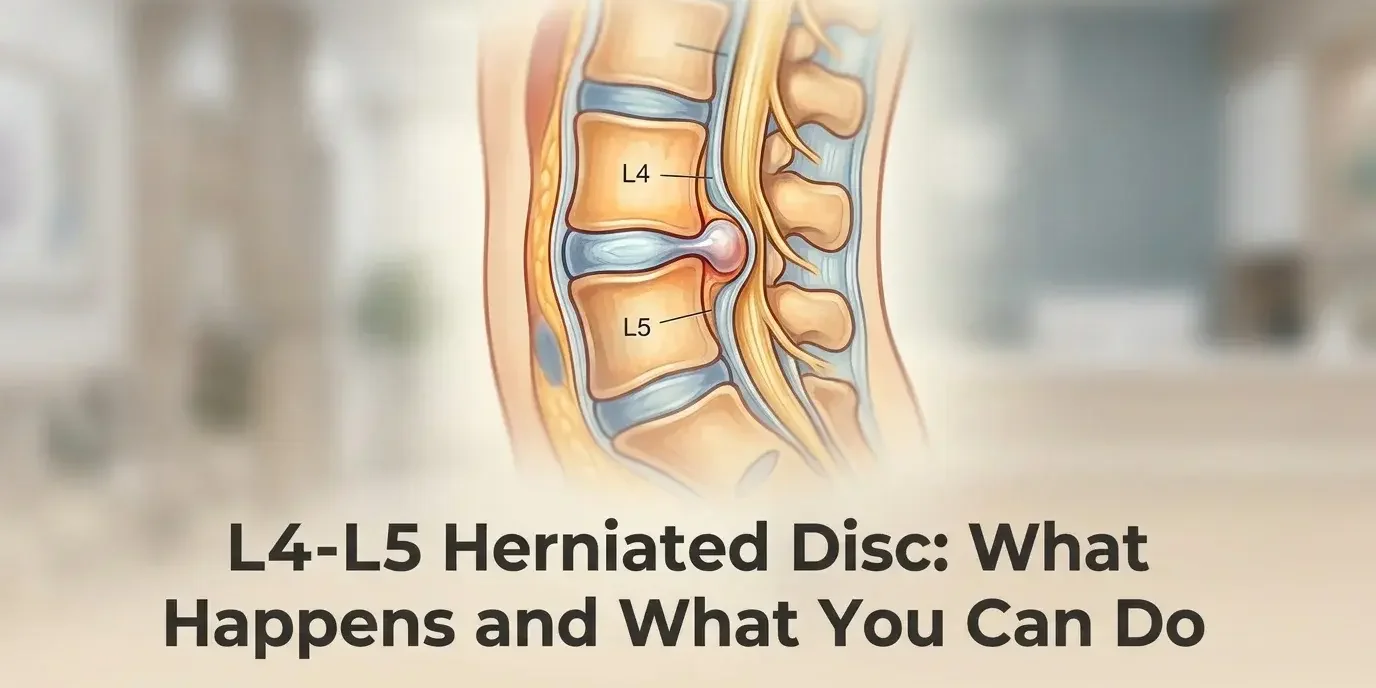
L4-L5 Herniated Disc Disability UK: What the Diagnosis Actually Means
Search “l4-l5 herniated disc disability uk” and the results aren’t dominated by hospitals or the NHS — they’re Reddit threads and benefits forums where patients compare notes on PIP claims. That says something important: for most people with this diagnosis, the question of how to survive financially is arriving before the question of how to get better.
Both questions deserve a real answer. The L4-L5 disc sits at the base of the spine, carries more mechanical load than any other lumbar segment, and when it herniates, the resulting nerve compression is a well-documented cause of leg pain, numbness, and reduced mobility — the kind of impairment that UK disability assessments are built to evaluate. This article covers the anatomy, the disability support system, and the surgical options, including a minimally invasive approach that changes the recovery timeline most patients are told to expect.
What Does L4-L5 Mean in Spinal Anatomy?
L4-L5 refers to the disc between the fourth and fifth lumbar vertebrae, the lowest mobile segment of the lower back, sitting just above the sacrum. It’s the busiest joint in the spine — it absorbs more compressive and rotational force than any level above it, which is exactly why it herniates more often than most other discs.
A few things make this level distinct:
- It sits close to the L5 nerve root, which supplies the outer shin, top of the foot, and big toe.
- It’s also near where the sciatic nerve’s contributing roots exit, so L4-L5 problems commonly present as classic sciatica.
- Because it’s a high-mobility segment, degeneration here tends to accelerate once disc height starts to drop.
Spinal stenosis L4-L5 — narrowing of the canal at this same level — often develops alongside or instead of a herniation, and produces a similar pattern of leg symptoms with a slower onset.
L4-L5 Herniated Disc Disability UK: How Nerve Compression Limits Movement
A disc herniation at this level pushes disc material against the adjacent nerve root or the thecal sac. The nerve doesn’t tolerate that pressure quietly — it responds with pain, then with the more disabling symptoms: numbness, tingling, and measurable weakness in the muscles that nerve controls.
For an L4-L5 herniation affecting the L5 root, that usually means:
- Weakness lifting the foot upward (foot drop, in more severe cases)
- Numbness down the outer calf and across the top of the foot
- Pain radiating from the lower back through the buttock and down the leg
- Difficulty standing or walking for more than a short distance without symptoms worsening
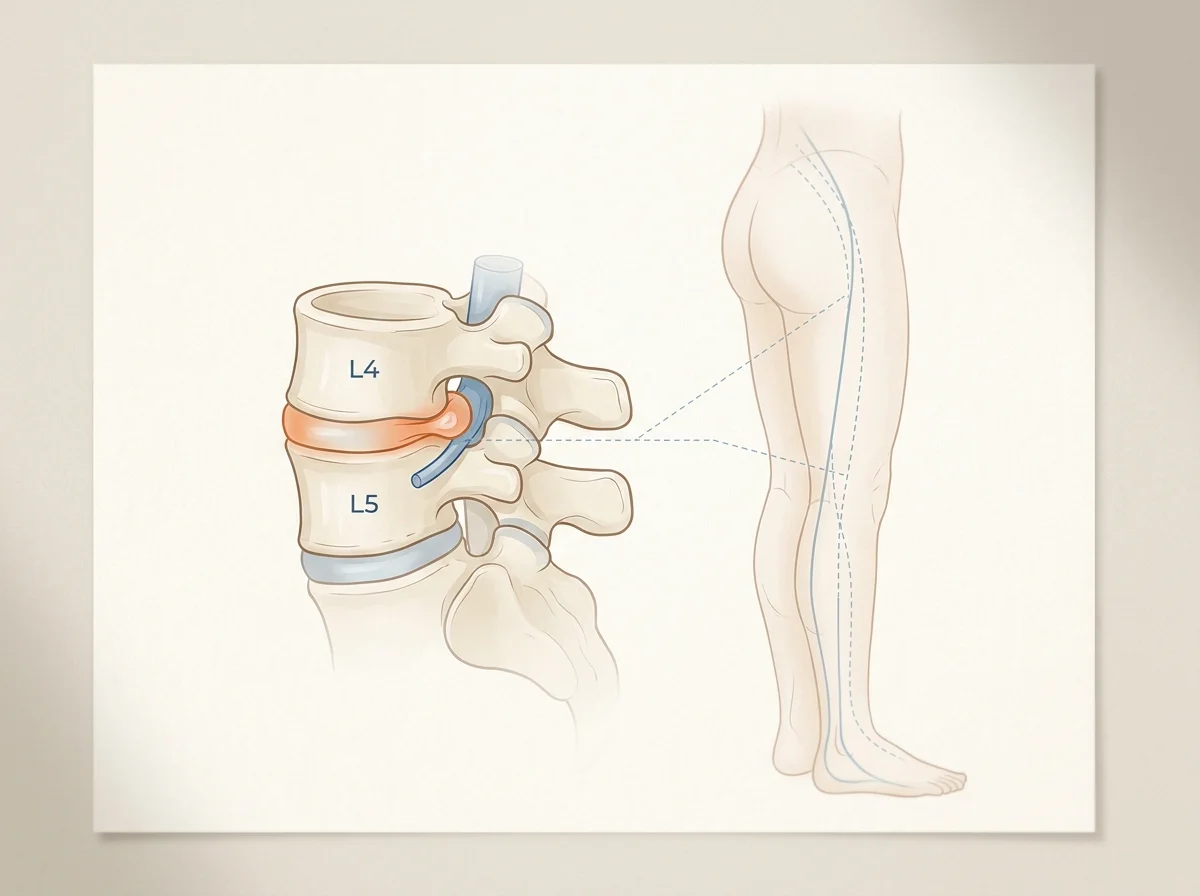
Nerve compression at L4-L5 follows a predictable pathway — buttock, leg, foot — which is why the symptom pattern is so consistent across patients.
Reality check: Herniated disc at L4-L5 doesn’t automatically mean permanent damage. Most nerve root compression is reversible once the pressure is relieved — the disability risk comes from how long that pressure is left untreated, not from the herniation itself.
Cauda equina syndrome — loss of bladder or bowel control, saddle numbness, bilateral leg weakness — is the one presentation that needs same-day emergency assessment, not a GP appointment booked for next week.
Conservative Care Comes First — But It Has a Ceiling
Most L4-L5 herniations respond to non-surgical management in the first six to twelve weeks: physiotherapy, targeted core strengthening, anti-inflammatory medication, and sometimes an epidural steroid injection to calm the nerve root. This is the correct first step, and no responsible surgeon skips it.
The ceiling shows up when symptoms plateau rather than improve. If weakness is progressing, if pain hasn’t shifted after three months of proper conservative treatment, or if leg symptoms are now worse than the back pain that started it, that’s the point where continuing conservative care mostly just delays a decision rather than avoiding one.
Our guide to slipped disk treatment walks through the full spectrum from physiotherapy to endoscopic surgery in more depth, including how to judge when it’s time to escalate.
L4-L5 Herniated Disc Disability UK: Can You Claim PIP or ESA?
Yes — an L4-L5 herniated disc can qualify for Personal Independence Payment (PIP) or Employment and Support Allowance (ESA) if it measurably limits daily activities like walking, dressing, or standing, but the diagnosis alone isn’t enough. Assessors evaluate functional impact against fixed descriptors, not the MRI report itself.
PIP specifically scores mobility against activities like how far you can walk before pain, fatigue, or breathlessness stops you — a distance under roughly 50 metres, done reliably and repeatedly, tends to be the threshold assessors weigh most heavily for higher mobility scoring. Under the Equality Act 2010, a herniated disc can also count as a disability if its effects are substantial and expected to last twelve months or more, which is separate from PIP eligibility and matters for workplace protections.
What tends to strengthen a claim:
- A clear diagnostic record (MRI report, consultant letters, physiotherapy notes)
- A documented pattern of how symptoms affect daily tasks — not just “back pain,” but specifics
- Evidence of ongoing or attempted treatment, since assessors weigh functional trajectory, not just current symptoms
Disability allowance for a herniated disc is rarely instant, and mandatory reconsiderations are common — several of the top-ranking pages for this exact search are patients walking each other through that appeals process, which tells you how often the first decision doesn’t land where it should.
The NHS Pathway: Referral, Waiting Lists, and What’s Realistic
A GP referral for suspected L4-L5 herniation typically routes through physiotherapy first, then an MRI, then a spinal surgery outpatient appointment if conservative care hasn’t worked. Each of those steps has its own queue.
Waiting times for elective spinal surgery on the NHS commonly extend well into the second year from initial referral to operation date, particularly outside the most urgent presentations. That’s not a criticism of the clinicians involved — it’s a capacity problem, and it’s the reason so many patients start researching disability support and private options simultaneously rather than sequentially.
What this means for you: the NHS pathway and the disability benefits system often run on parallel tracks. Applying for PIP or ESA doesn’t mean giving up on treatment — for many patients it’s simply what bridges the income gap while they decide what to do next.
Why Consider Private or Abroad Surgery for Your L4-L5 Condition?
Once conservative care has plateaued, the practical question becomes timing. Private UK spinal surgery is available, generally at a cost that reflects UK private healthcare pricing, with waits measured in weeks rather than the NHS’s typical eighteen-plus months. For patients who’ve already lost income during the assessment and referral process, that gap matters.
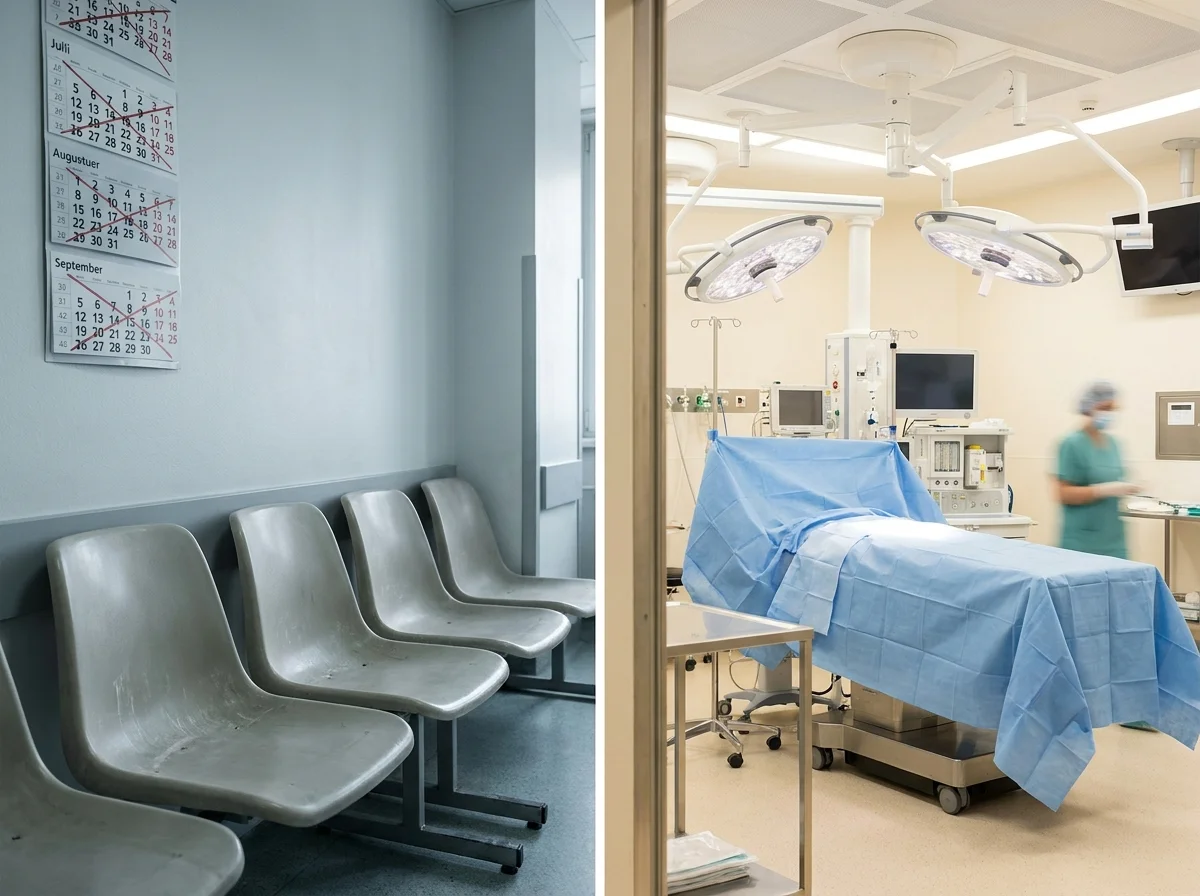
The choice most patients face isn’t surgery versus no surgery — it’s how many months of disability they’re willing to wait through first.
This is where surgery within the EU becomes a genuine third option alongside “wait on the NHS” and “pay UK private rates.” Poland operates under the same EU Medical Devices Regulation and clinical governance standards as Germany or France — a materially different proposition from destinations outside the EU regulatory framework. KCM Clinic treats L4-L5 herniation and spinal stenosis under neurosurgeon Dr. Stanisław Kwiek, with consultation, surgery, hospital stay, and structured aftercare bundled into a single coordinated pathway rather than a series of separately booked appointments.
Inside KCM’s 3D Laparoscopic Approach to L4-L5 Disc Herniation
Traditional open decompression for L4-L5 herniation involves a larger incision, more muscle retraction to reach the disc space, and a recovery period built around that tissue disruption healing. It works, and it’s still the right call for some presentations — but it isn’t the only option anymore.
KCM Clinic’s endoscopic technique for L4-L5 uses 3D laparoscopic visualisation to access the disc space through a significantly smaller incision, removing the herniated material under direct high-definition magnification rather than through a wider open field. Less tissue disruption at the point of access is what drives most of the downstream recovery difference — there’s simply less for the body to repair before it can bear weight and move again.
Worth knowing: 3D laparoscopic access isn’t the same as standard single-camera endoscopic spine surgery. The added depth perception changes how precisely the surgeon can work around the nerve root, which is exactly the structure you don’t want disturbed more than necessary.
Recovery Timelines: Endoscopic Surgery vs Traditional Open Decompression
The gap between the two approaches is most visible in how soon a patient is back on their feet and back at work — the two things that matter most to someone who’s already been managing disability for months.
| Recovery milestone | Traditional open decompression | KCM 3D laparoscopic endoscopic |
|---|---|---|
| Hospital stay | 2–4 nights typical | Often 1–2 nights |
| First unassisted walk | Day 2–3 | Same day or day 1 |
| Return to desk-based work | 6–8 weeks | 2–4 weeks |
| Return to physical work | 3–4 months | 6–10 weeks |
| Incision size | Several centimetres, open field | Minimal access, single small port |
For the fuller week-by-week picture of what recovery actually feels like — not just the milestones — our week-by-week guide to recovery from spine surgery and our laminectomy recovery guide both cover the physiotherapy progression in detail.
Quick recap
- L4-L5 is the lowest mobile spinal segment and the one most prone to herniation because of the load it carries.
- Nerve compression at this level causes the leg weakness, numbness, and walking limitation that UK disability assessments specifically evaluate.
- PIP and ESA eligibility depends on documented functional impact, not the diagnosis alone — expect to build a case, not just submit a report.
- NHS waiting times for spinal surgery commonly stretch past a year, which is why private and EU pathways are worth evaluating in parallel, not as a last resort.
- Minimally invasive endoscopic surgery, including KCM’s 3D laparoscopic approach, generally cuts recovery time roughly in half compared with traditional open decompression.
Frequently Asked Questions
Is a herniated disc considered a disability in the UK?
It can be, under both the Equality Act 2010 (if effects are substantial and expected to last 12+ months) and for PIP/ESA purposes (based on functional impact on mobility and daily living). Neither is automatic — assessors and employers look at documented functional limitation, not the MRI alone.
How hard is it to get disability benefits for a herniated disc?
It depends heavily on documentation. Claims backed by consistent GP records, a clear diagnostic report, and specific examples of daily-task limitation succeed more often than claims relying on the diagnosis alone. Many initial decisions are overturned at mandatory reconsideration or appeal.
What’s the difference between L4-L5 herniation and spinal stenosis at the same level?
A herniation is disc material pushing outward onto a nerve; spinal stenosis L4-L5 is narrowing of the spinal canal itself, often from bone or ligament changes. They can occur together and produce overlapping leg symptoms, but they’re treated somewhat differently depending on severity.
Do all L4-L5 herniated discs need surgery?
No. Most respond to physiotherapy, activity modification, and time within six to twelve weeks. Surgery becomes the reasonable option when conservative care plateaus, when weakness is progressing, or when leg symptoms are significantly limiting daily function.
How much faster is recovery with minimally invasive endoscopic surgery?
Patients undergoing 3D laparoscopic endoscopic surgery for L4-L5 herniation typically return to desk-based work in 2–4 weeks, compared with 6–8 weeks after traditional open decompression, largely because the smaller access point means less tissue trauma to heal.
Get Started with KCM Clinic
If conservative care hasn’t moved the needle on your L4-L5 symptoms, it’s worth a consultation before the next NHS appointment rolls around — not instead of it, but alongside it. KCM Clinic’s neurosurgical team can review your imaging and explain whether minimally invasive endoscopic surgery is a realistic option for your case.
Learn more about KCM Clinic’s minimally invasive spine surgery programme