


Hair Transplant Poland Reviews: What UK and Canadian Patients Actually Say
Marketing pages promise natural results and a smooth trip. Independent hair transplant Poland reviews tell a more useful story — where patients were satisfied, where they weren’t, and what actually happened once the anaesthetic wore off. This guide works through what those reviews show, alongside the cost, safety, and recovery data behind them.
Key Takeaways
- Hair transplants in Poland typically cost 40–60% less than equivalent private procedures in the UK, with prices commonly ranging from £3,500–£7,000 depending on graft count and technique.
- Independent review platforms report satisfaction rates above 85% for Polish hair transplant clinics, with visible regrowth appearing 3–6 months after FUE or FUT surgery.
- EU-regulated clinics in Poland typically bundle consultation, surgery, accommodation, transfers, and aftercare into one package — costs that UK self-funders often pay for separately.
- Recovery allows a return to light activity within 7–10 days, though full density and final results take 12–18 months to fully develop.
- FUE (Follicular Unit Extraction) is the technique most UK patients choose for its scar-free result; FUT (strip method) is faster and less expensive but leaves a linear scar.
Contents
- What Do Hair Transplant Poland Reviews Actually Say?
- FUE vs FUT: Which Hair Transplant Technique Works Best in Poland?
- How Much Does a Hair Transplant Cost in Poland?
- Why Choose Hair Transplant in Poland?
- How Safe Are Hair Transplants Performed in Polish Clinics?
- What Is the Recovery Timeline After Hair Transplant in Poland?
- How Long Do Hair Transplant Results Last?
- How Do You Choose a Hair Transplant Clinic in Poland?
What Do Hair Transplant Poland Reviews Actually Say?
Independent review platforms such as Trustpilot and WhatClinic host a growing number of verified patient reviews for Polish hair transplant clinics, with satisfaction rates commonly reported above 85% and recurring praise for communication, all-inclusive pricing, and result quality. Complaints, where they appear, tend to cluster around rushed consultations rather than the surgery itself.
That pattern matters more than any single five-star review. Patients researching surgery abroad are usually more sceptical of glossy before-and-after galleries than of a platform where anyone can leave one star and explain exactly why.
- Recurring praise: transparent all-inclusive pricing, English-speaking coordination, and visible density by month six.
- Recurring criticism: short pre-op consultation windows at high-volume clinics, and unclear separation between surgeon-led and technician-led stages.
- A frequent theme across UK-patient reviews: comparing the total abroad cost against a UK private quote that only covered the procedure itself.
Worth knowing: A clinic’s own testimonial page is marketing copy by definition. Third-party platforms — where reviews can’t be edited or removed by the clinic — are the more reliable signal.
Patients weighing this decision against other procedures often compare notes with hair transplant abroad, which covers the same review patterns across a wider set of destination countries.
FUE vs FUT: Which Hair Transplant Technique Works Best in Poland?
FUE (Follicular Unit Extraction) is the technique most reviewers rate highest for cosmetic outcome, since it removes individual follicular units rather than a strip of scalp and leaves no linear scar; FUT (Follicular Unit Transplantation) is faster and better suited to very high graft counts, but recovery is longer and the donor scar is permanent. Most Polish clinics now offer both and recommend based on donor density.
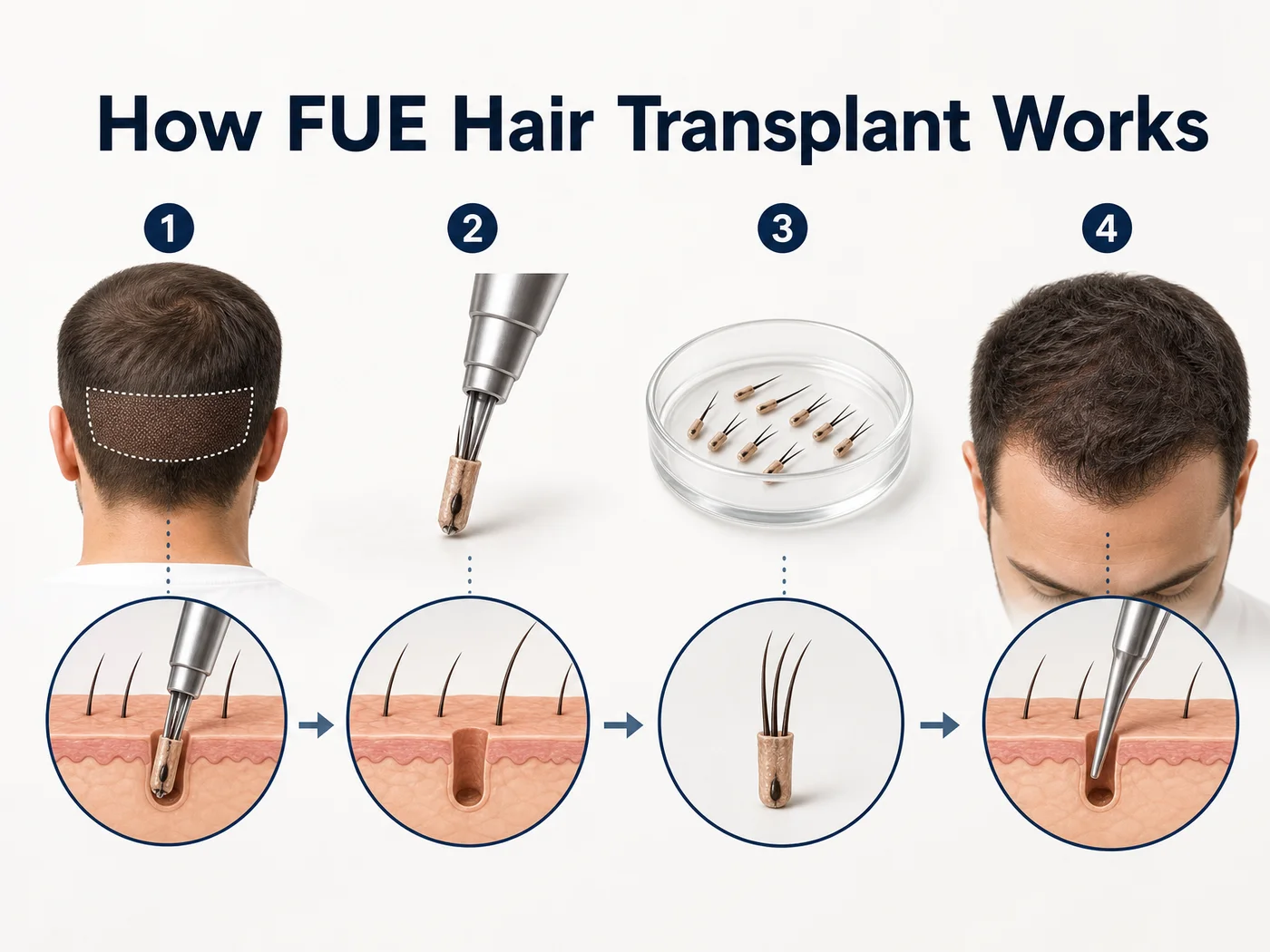
FUE extracts individual follicular units one at a time, which is why reviewers consistently rate it above the strip method for visible scarring.
A rotary micro-punch lifts each follicular unit from the donor area — usually the back of the scalp — before a surgeon implants them one at a time along the patient’s natural hair direction. No scalpel, no strip, no single line of stitches to heal.
FUT still has a place. Surgeons occasionally recommend it when a patient needs a very high graft count in one session and has donor scalp with enough laxity to suit strip harvesting. An upcoming article in this cluster will cover fue hair transplant poland recovery and cost data in more depth, including how graft survival compares between the two techniques.
How Much Does a Hair Transplant Cost in Poland?
A hair transplant in Poland typically costs £3,500–£7,000 all-inclusive, against £6,000–£10,000 or more at a UK private clinic for a comparable graft count. The gap tends to widen once UK add-on costs — consultation fees, medication, follow-up visits — are counted separately rather than bundled.
| UK Private Clinic | Turkey | Poland (EU-regulated) | |
|---|---|---|---|
| Typical price | £6,000–£10,000+ | Often the lowest headline price | £3,500–£7,000 all-inclusive |
| Regulation | UK CQC-regulated | Varies by clinic | EU medical device regulation |
| What’s included | Usually procedure only | Varies widely | Consultation, surgery, accommodation, transfers, aftercare |
| Review transparency | Moderate | High volume, mixed reliability | Growing, EU consumer-protection backed |
By the numbers: UK clinics quote the procedure; Poland-based clinics typically quote the trip. That’s the single biggest reason headline prices aren’t directly comparable without checking what’s bundled.
Readers weighing a broader budget for the same trip may want to see how a hair transplant cost uk private quote is usually itemised, since that’s the baseline most patients compare against before booking abroad.
Why Choose Hair Transplant in Poland?
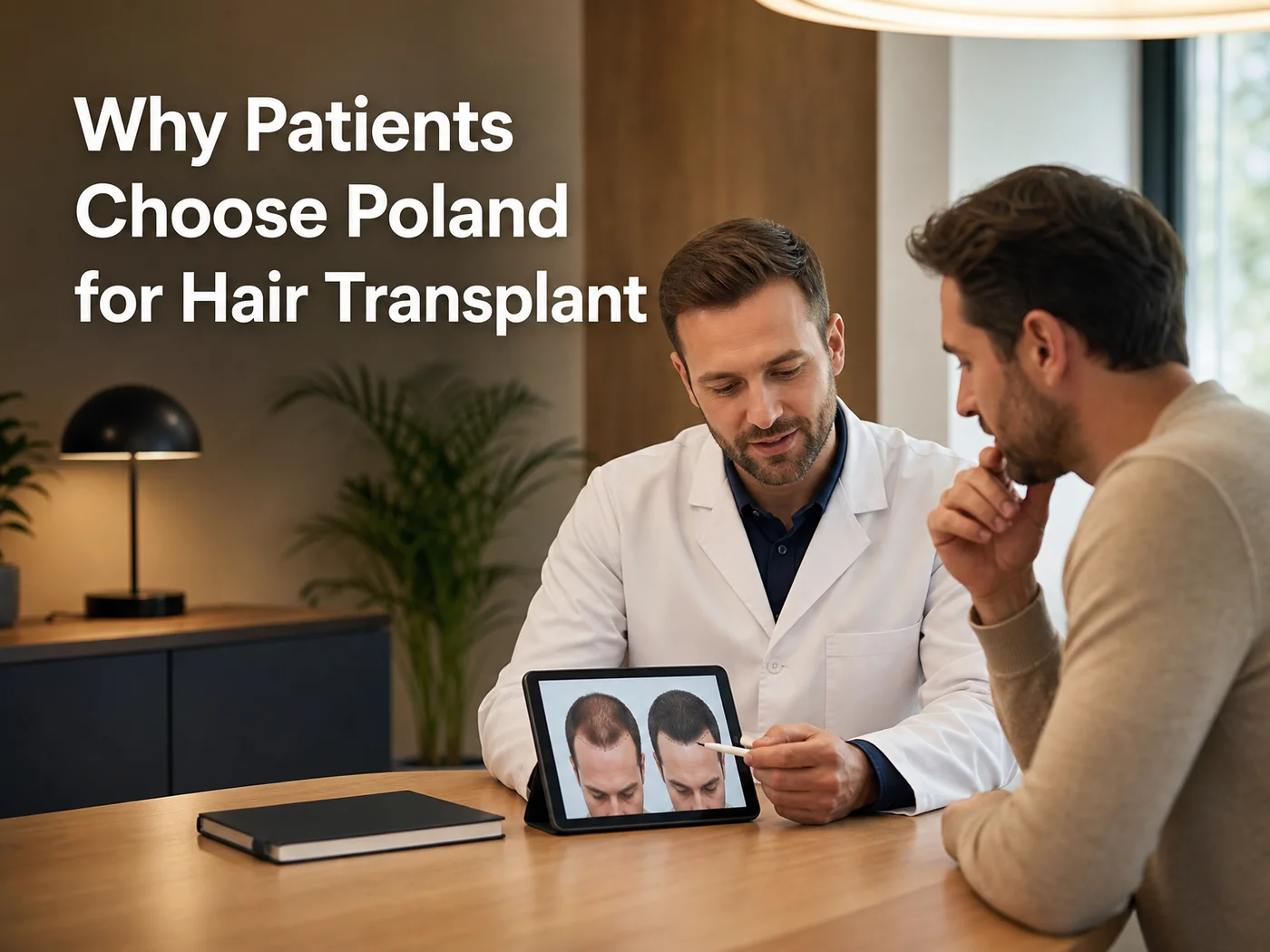
A pre-operative consultation covers graft estimate, technique, and total cost before the patient commits to travel — all folded into one package price.
Poland’s appeal over the UK and Turkey comes down to a specific combination: EU medical device regulation, transparent all-inclusive packages, and shorter waits than UK private clinics currently manage. It’s a middle position — not the lowest-priced option on the market, and not the slowest either.
KCM Clinic structures its hair transplant packages as a single bundle covering the pre-procedure consultation, the surgical technique itself, accommodation during recovery, transfer and airport logistics, and post-operative follow-up care. Nothing arrives as a separate invoice once the patient has landed.
- Pre-procedure consultation: graft-count estimate and technique recommendation before travel is booked.
- Surgical technique: FUE or FUT, chosen by the surgical team based on donor density.
- Accommodation during recovery: coordinated as part of the package, not booked separately by the patient.
- Transfer and logistics: airport pickup and clinic transport included.
- Post-operative follow-up: aftercare check-ins rather than a one-time procedure with no support afterward.
As an EU member state, Poland operates under the same medical device and clinical governance regulation as Germany or France — a structural difference from countries where oversight varies clinic by clinic. KCM was recognised with the BookingsMed 2024 Excellence in International Patient Service award, which speaks to the coordination side of a trip that, for most patients, is just as stressful as the surgery itself.
How Safe Are Hair Transplants Performed in Polish Clinics?
Hair transplants performed in EU-regulated Polish clinics follow the same clinical governance and medical device standards enforced in Germany, France, and Sweden — documented sterilisation protocols, traceable surgical equipment, and a legal requirement for licensed medical professionals to be involved in the surgical stages. That regulatory floor is the main structural difference between Poland and destinations where standards vary clinic to clinic.
Genuine complications from FUE are uncommon with an experienced surgical team; graft survival typically exceeds 90% when extraction and implantation are performed correctly. The variability patients should actually watch for sits in who performs each stage, not the technique itself.
Common mistake: Assuming a lower headline price signals lower quality automatically. The more reliable question is who performs the extraction and implantation — a licensed surgeon, or a technician working under loose supervision.
What Is the Recovery Timeline After Hair Transplant in Poland?
Most patients return to light activity within 7–10 days of an FUE or FUT hair transplant, once initial scabbing at the donor and recipient sites has resolved. Full clearance for strenuous exercise and swimming typically follows at the three-to-four-week mark.
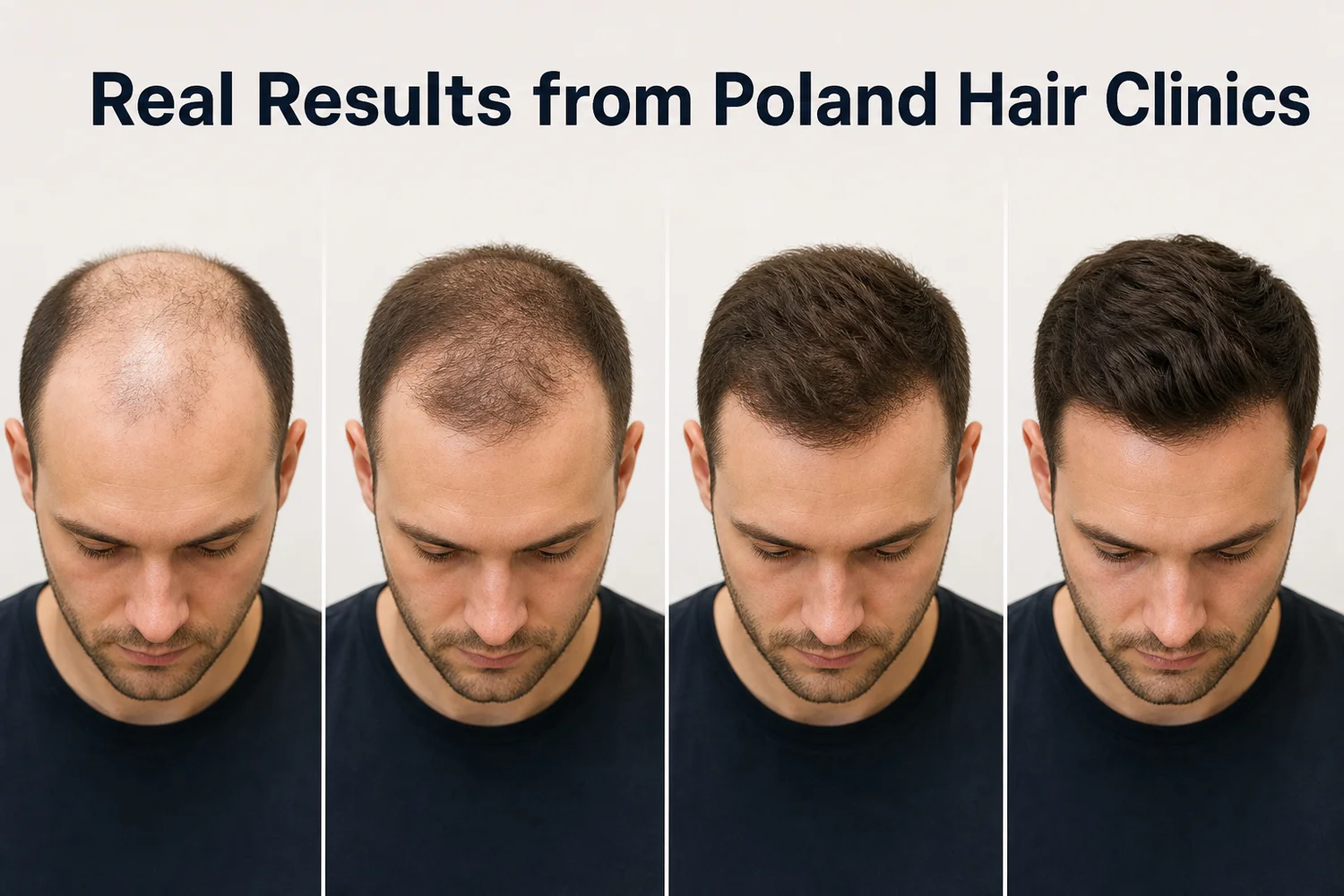
Transplanted hair follows a predictable cycle of shedding, dormancy, and regrowth — not a straight line from surgery to finished result.
The recovery sequence follows a fairly consistent pattern:
- Days 1–10: Scabbing at extraction and implant sites; most patients return to non-strenuous work within a week.
- Weeks 3–4: Transplanted hairs shed, which is expected and doesn’t indicate graft failure.
- Months 3–6: New growth becomes visible as follicles enter the active growth phase — the point most reviews reference when describing “first real results.”
- Months 12–18: Final density and texture, matching the surrounding hair.
Direct sun exposure to the scalp is usually restricted for the first month while extraction sites finish healing.
How Long Do Hair Transplant Results Last?
Transplanted follicles are typically taken from the back and sides of the scalp, an area genetically resistant to the hormone that causes male-pattern hair loss. Once those follicles are relocated and establish blood supply at the new site, they generally keep that resistance — which is why properly performed transplants are considered a long-term result rather than a temporary fix.
Reviewers occasionally note thinning in areas that weren’t transplanted, since a transplant addresses existing bald or thinning patches rather than future hair loss elsewhere on the scalp. Surgeons typically discuss this distinction during the pre-op consultation so it isn’t a surprise eighteen months later.
How Do You Choose a Hair Transplant Clinic in Poland?
Choosing a hair transplant clinic in Poland comes down to four checks: who performs the surgical stages, what the all-inclusive package actually covers, what independent reviews say beyond the clinic’s own site, and whether the clinic is EU-regulated rather than operating under a lighter national standard. Skipping any one of these is where most bad outcomes trace back to.
- Confirm which staff perform extraction and implantation — licensed surgeon or technician.
- Get the full package breakdown in writing before booking travel: consultation, surgery, accommodation, transfers, aftercare.
- Read reviews on Trustpilot or WhatClinic directly, not just the clinic’s own testimonials page.
- Check the clinic’s regulatory status — EU medical device regulation is a meaningfully different standard from unregulated private clinics elsewhere.
Patients considering more than one procedure on the same trip often review cosmetic surgery abroad data to see how hair restoration fits into a wider medical tourism decision, and those comparing KCM’s track record across procedures sometimes look at rhinoplasty poland cost as a second data point on package structure and pricing consistency.
Get Started with KCM Clinic
If UK private quotes or NHS waiting lists are the reason you’re comparing options abroad, KCM Clinic’s all-inclusive hair transplant packages are built around exactly that decision. A consultation costs nothing to arrange and gives you a graft-count estimate and firm price before you commit to travel.
Learn more about KCM Clinic’s hair transplant packages
Hair Transplant Poland Reviews: Frequently Asked Questions
Is Poland good for hair transplants?
Poland is a credible option for UK and Canadian patients, particularly for those who want EU medical device regulation rather than the lighter oversight found in some lower-cost destinations. Independent reviews consistently rate Polish clinics well on communication and package transparency.
Which country is better for hair transplants, Poland or Turkey?
Turkey offers higher clinic volume and often the lowest headline prices; Poland trades a marginally higher cost for EU clinical governance standards and more consistent aftercare provision. Neither is universally “better” — it depends on what the patient is prioritising.
How much does a hair transplant cost in Poland?
Hair transplants in Poland typically cost £3,500–£7,000 all-inclusive, depending on graft count and technique. That figure usually covers consultation, surgery, accommodation, transfers, and aftercare rather than the procedure alone.
What’s the difference between FUE and FUT hair transplants?
FUE extracts individual follicular units and leaves no linear scar; FUT removes a strip of scalp for dissection into grafts, which suits very high graft counts but leaves a permanent donor-area scar and a longer recovery.
How long do hair transplant results last?
Transplanted follicles are typically taken from a genetically resistant donor area, so results are generally long-term once the graft establishes. Final density and texture take 12–18 months to fully appear.
How do I choose a hair transplant clinic in Poland?
Check who performs the surgical stages, get the full package breakdown in writing, read independent reviews beyond the clinic’s own site, and confirm the clinic operates under EU medical device regulation before booking travel.


