

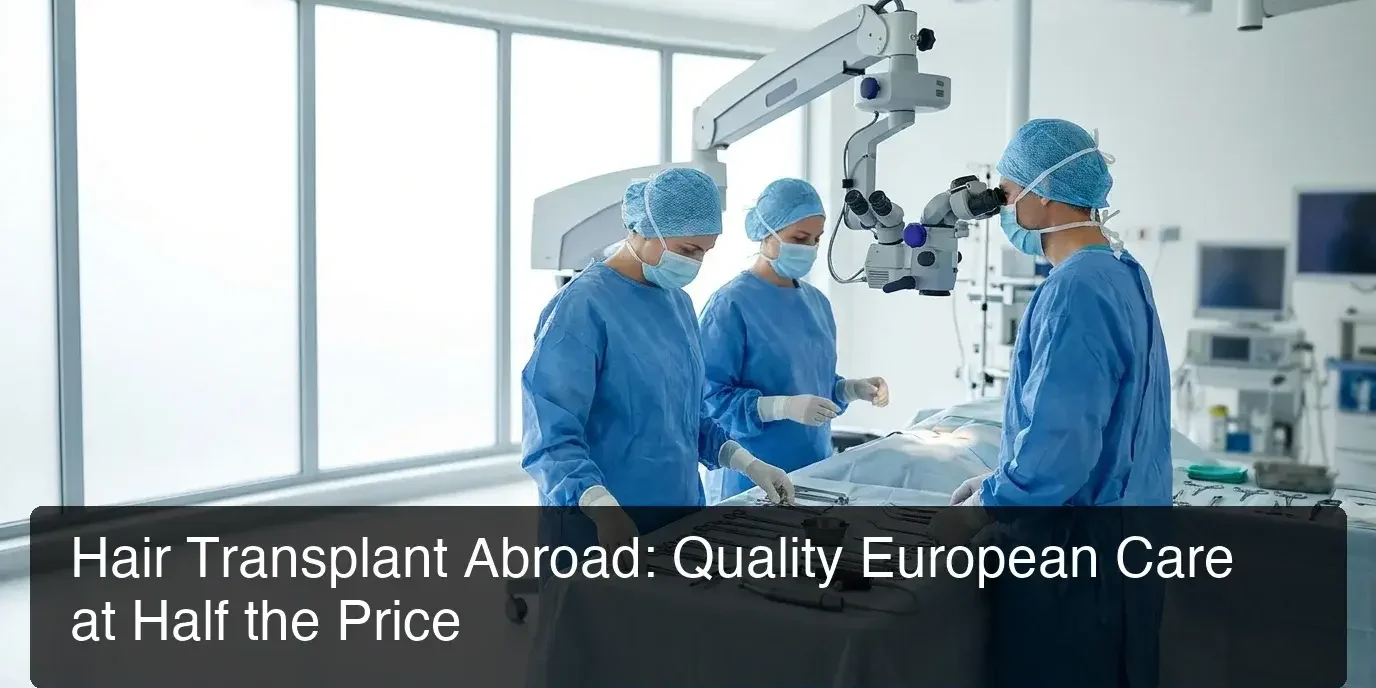
Hair Transplant Abroad: Cost, Safety, and Recovery Compared
Hair loss rarely arrives with a deadline. The decision to do something about it does — usually the moment a UK or Canadian patient gets a private quote and multiplies it by however many grafts they think they need.
Key Takeaways
- Hair transplant abroad combines modern FUE/FUT techniques with 40-50% cost savings compared to UK private clinics — KCM Clinic’s packages run €3,000-5,000 versus £6,000-10,000+ for equivalent UK private surgery.
- KCM Clinic operates in Poland under EU medical regulation, the same regulatory framework as Germany and France, not the lighter-touch rules that apply in Turkey or India.
- All-inclusive packages cover pre-op consultation, the FUE or FUT procedure itself, post-op care, accommodation coordination, and a dedicated international patient liaison — one price, not a bill assembled afterward.
- FUE (Follicular Unit Extraction) is the standard for natural-looking results because it removes individual follicular units rather than a strip of scalp; most patients fly home within 1-2 weeks, with visible growth at 3-4 months and full results by 12 months.
- KCM has run same-week turnarounds — Thursday consultation, Saturday surgery, Monday discharge — against UK NHS elective waiting lists that commonly run past two years.
Contents
- Why Are More People Travelling Abroad for a Hair Transplant?
- Which Countries Are Popular for Hair Transplants, and Why Does Poland Stand Out?
- What Is FUE Hair Transplant, and How Does the Procedure Work?
- Why Do Surgeons Prefer FUE Over FUT?
- How Much Does a Hair Transplant Cost Abroad vs a UK Private Clinic?
- What Are the Risks of a Hair Transplant Abroad, and How Does EU Regulation Reduce Them?
- KCM’s All-Inclusive Hair Transplant Packages
- How Long Is Hair Transplant Recovery, and When Can I Fly Home?
Why Are More People Travelling Abroad for a Hair Transplant?
UK and Canadian patients are increasingly booking hair transplants abroad because private prices at home are high and public healthcare systems don’t fund elective hair restoration at all. Add a long NHS wait for anything adjacent to dermatology, and a well-run clinic a few hours’ flight away starts to look like the more practical option, not the riskier one.
The frustration is rarely about the surgery itself. It’s the arithmetic: a UK private clinic quote, multiplied by the number of grafts a receding hairline actually needs, often lands well into five figures.
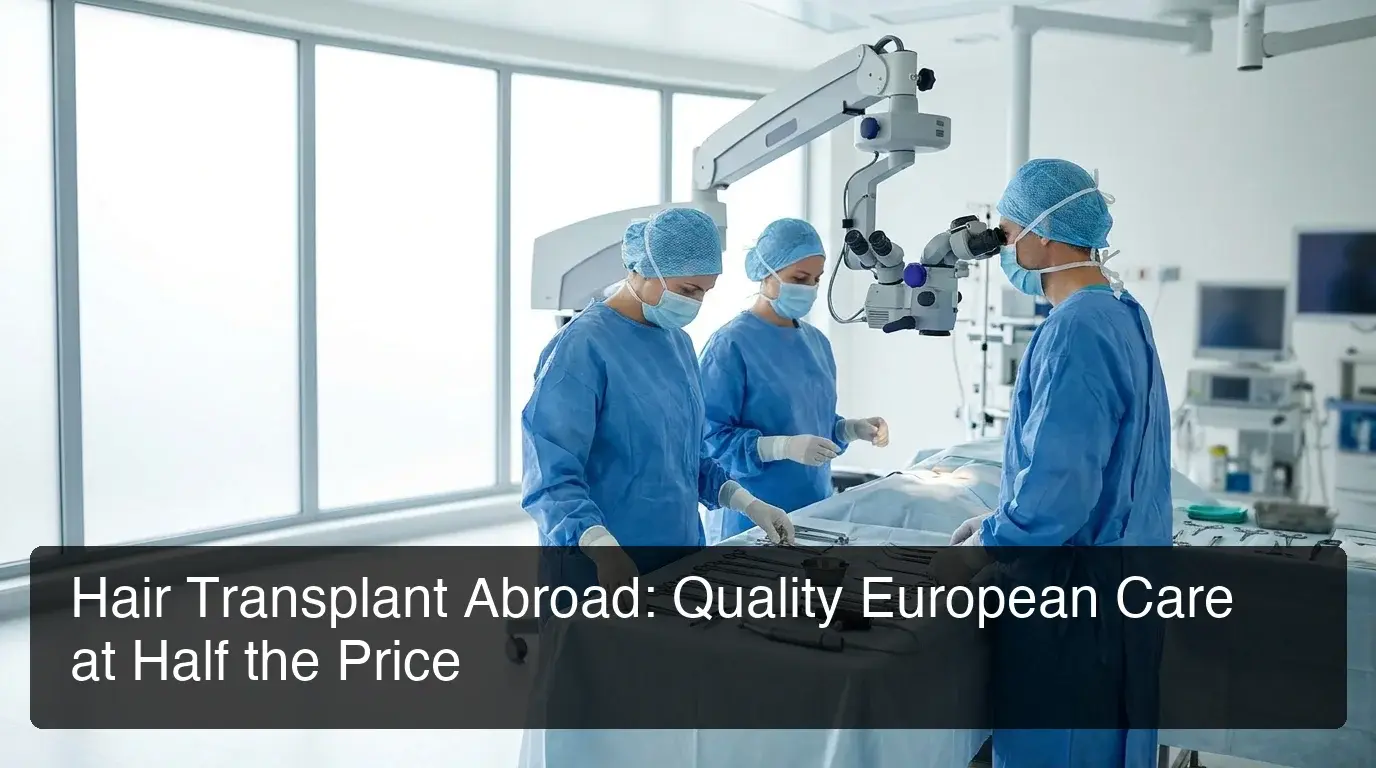
Search interest in hair transplant abroad has grown alongside wider medical tourism for cosmetic surgery abroad, and the same underlying drivers apply: cost, wait time, and a growing comfort with travelling for planned procedures.
Worth knowing: Most patients researching hair transplants abroad have already ruled out UK NHS referral — hair restoration isn’t classified as medically necessary, so it sits entirely outside public funding.
Which Countries Are Popular for Hair Transplants, and Why Does Poland Stand Out?
Turkey dominates hair transplant tourism on volume and price, with India close behind; Poland is a smaller but distinct category built on EU medical device regulation rather than the lowest quote available. The countries aren’t really competing on the same axis.
Turkey’s hair transplant industry is large, established, and highly price-competitive — hundreds of clinics in Istanbul alone compete for international patients. That scale brings genuine expertise, but oversight varies significantly between clinics, and international patient advocacy groups have flagged inconsistent aftercare standards as a recurring complaint.
India offers similarly low prices with wider variance in facility standards and surgeon-to-technician ratios during the procedure itself.
Poland sits in a different category. As an EU member state, every clinic operates under the same medical device and clinical governance regulation as Germany, France, or Sweden — not a separate national standard set independently. That’s a structural difference, not a marketing claim.
What Is FUE Hair Transplant, and How Does the Procedure Work?
FUE (Follicular Unit Extraction) is a hair restoration technique where a surgeon removes individual follicular units — each naturally containing one to four hairs — from a donor area, usually the back of the scalp, and implants them one at a time into thinning or bald areas. No strip of scalp is removed, and no linear scar results.
Each session runs in stages. First, the donor area is trimmed and locally anaesthetised. A rotary micro-punch extracts individual follicular units, which are kept viable in a holding solution while the surgical team prepares recipient sites using precise incision angles that match the patient’s natural hair direction.
Implantation follows, unit by unit, working from the hairline inward to build density where it’s most visible first. A typical session runs four to eight hours depending on graft count, entirely under local anaesthetic — patients are awake and can request a break.
Why Do Surgeons Prefer FUE Over FUT?
FUT (Follicular Unit Transplantation) removes a strip of scalp and dissects it into grafts under a microscope — faster for very high graft counts, but it leaves a linear scar and a longer, more uncomfortable recovery at the donor site.
FUE has become the preferred technique for most patients because the extraction leaves scattered pinpoint marks rather than a single scar, which matters for anyone who wears their hair short. Recovery at the donor site is also faster, since there’s no incision to heal along a line.
FUT still has a role for patients who need very high graft counts in a single session and have donor hair that suits strip harvesting. KCM’s surgical team assesses donor density and scalp laxity during the pre-op consultation to recommend whichever technique fits the individual case, not a default.
How Much Does a Hair Transplant Cost Abroad vs a UK Private Clinic?
A hair transplant abroad with KCM Clinic runs €3,000-5,000 all-inclusive, against £6,000-10,000 or more at a UK private clinic for a comparable graft count — a saving that typically covers flights and accommodation with room to spare. The gap widens further once UK add-on costs are counted separately.
| UK Private Clinic | Turkey | KCM Clinic (Poland) | |
|---|---|---|---|
| Typical price | £6,000-10,000+ | Often lowest headline price | €3,000-5,000 all-inclusive |
| Regulation | UK CQC-regulated | Varies by clinic | EU medical device regulation |
| Package inclusions | Usually procedure only | Varies widely | Consultation, surgery, aftercare, accommodation, patient liaison |
| Typical wait for consultation | Weeks to months | Days | Days |
Common mistake: Comparing a UK clinic’s headline procedure price against an all-inclusive quote elsewhere without checking what’s bundled. Aftercare visits, medication, and accommodation are frequently billed separately at home.
That UK figure covers the surgery alone in most cases; follow-up appointments, aftercare products, and any revision consultations are typically quoted separately. KCM’s all-inclusive structure is built to remove that separate-invoice pattern entirely.
What Are the Risks of a Hair Transplant Abroad, and How Does EU Regulation Reduce Them?
The real risks of a hair transplant abroad are inconsistent surgical oversight, technician-led rather than surgeon-led extraction, and unclear aftercare provision — all of which are harder to verify in countries without unified EU medical device and clinical governance regulation. These aren’t hypothetical concerns; they’re the most common complaints raised by patients who chose the lowest-priced clinic without checking who actually performs the procedure.
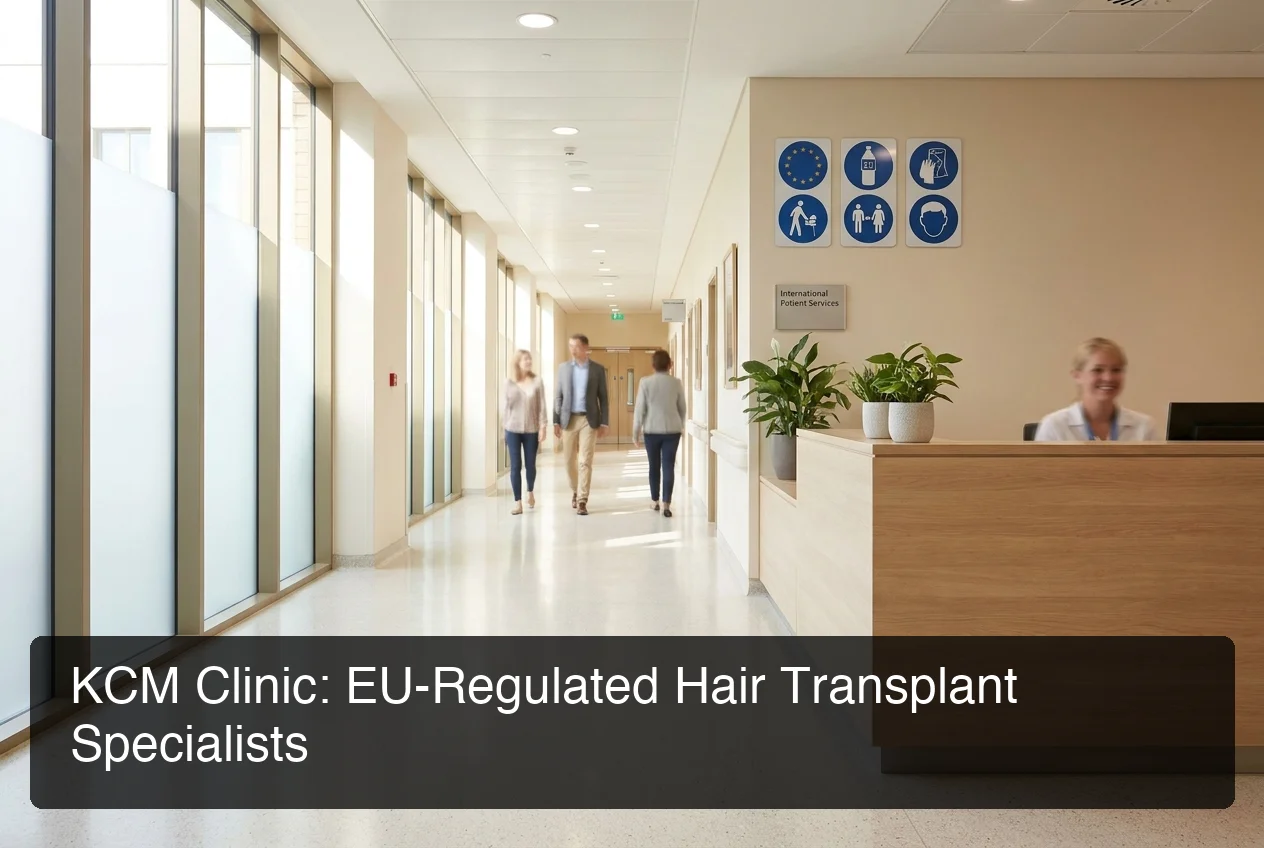
As an EU member state, Poland requires clinics to meet the same medical device and clinical governance standards enforced across the bloc. That includes documented sterilisation protocols, traceable surgical equipment, and a legal requirement for licensed medical professionals — not technicians alone — to be involved in the surgical stages of the procedure.
Reality check: A lower headline price abroad isn’t automatically a red flag, but a clinic that won’t confirm which staff perform the extraction and implantation stages is.
Genuine complications from FUE itself are uncommon with an experienced surgical team — infection rates are low when sterile technique is followed, and graft survival typically exceeds 90% in properly extracted and implanted units. The variability patients should watch for sits in clinic oversight, not the technique.
KCM’s All-Inclusive Hair Transplant Packages
KCM Clinic’s hair transplant packages are built as a single bundle: pre-op consultation, the FUE or FUT procedure itself, post-op care, accommodation coordination, and a dedicated international patient liaison who manages the visit from arrival to discharge. Nothing arrives as a separate invoice once the patient lands.
The international patient team coordinates in English, German, and Arabic, which matters more than it sounds — most patients are managing this alongside flights, time off work, and a recovery plan, not just a single appointment.
KCM was recognised with the BookingsMed 2024 Excellence in International Patient Service award, third-party validation of the coordination side of the process rather than the clinic’s own marketing claim.
Patients weighing multiple procedures on the same trip can review KCM’s broader cosmetic surgery abroad options, and those considering facial procedures alongside hair restoration often look at rhinoplasty surgery data as part of the same decision.
How Long Is Hair Transplant Recovery, and When Can I Fly Home?
Most patients fly home 1-2 weeks after an FUE hair transplant, once the transplanted grafts have secured and the risk of dislodging them during travel has passed. Full results take considerably longer, which surprises patients expecting an immediate change.

Recovery follows a fairly predictable timeline:
- Week 1-2: Scabbing at extraction and implant sites resolves; most patients return to non-strenuous work within a week.
- Weeks 3-4: Transplanted hairs shed — this is expected and doesn’t indicate graft failure, since the follicle itself remains in place.
- Months 3-4: New growth becomes visible as follicles re-enter the active growth phase.
- Months 6-9: Density fills in noticeably, though hair may still appear finer than its eventual texture.
- Months 12+: Full results, with transplanted hair matching the thickness and behaviour of surrounding hair.
Strenuous exercise and swimming are typically restricted for three to four weeks, and direct sun exposure to the scalp should be limited for the first month while the extraction sites fully heal.
Get Started with KCM Clinic
If NHS waiting lists or a UK private quote are the reason you’re reading this, KCM Clinic’s all-inclusive hair transplant packages are built specifically for patients weighing exactly that trade-off. A consultation costs nothing to arrange and gives you a graft-count estimate and firm price before you commit to travel.
Learn more about KCM Clinic’s hair transplant abroad packages
Hair Transplant Abroad: Frequently Asked Questions
Is it worth travelling abroad for a hair transplant?
For many UK and Canadian patients, yes — EU-regulated clinics like KCM offer comparable or better safety oversight than unregulated budget options, at a meaningfully lower all-inclusive price than UK private care, with a shorter wait for consultation and surgery.
Which country has the lowest hair transplant prices?
Turkey and India typically advertise the lowest headline prices, but oversight and aftercare provision vary significantly between clinics in both countries. Poland’s EU regulation trades a marginally higher price for consistent clinical governance standards.
What’s the difference between FUE and FUT hair transplants?
FUE extracts individual follicular units, leaving pinpoint marks and no linear scar; FUT removes a strip of scalp for dissection into grafts, which is faster for very high graft counts but leaves a linear donor scar and longer healing time.
How soon can I fly home after a hair transplant?
Most patients fly home 1-2 weeks after FUE surgery, once transplanted grafts have secured. KCM’s international patient team coordinates travel timing as part of the all-inclusive package.
Is a hair transplant in Poland safe?
Poland operates under the same EU medical device and clinical governance regulation as Germany and France. KCM Clinic is a licensed surgical hospital, not a standalone cosmetic clinic, and its surgical stages are performed by licensed medical professionals.
Does KCM Clinic’s package include accommodation and flights coordination?
Yes. KCM’s all-inclusive hair transplant packages bundle pre-op consultation, the procedure, post-op care, accommodation coordination, and a dedicated international patient liaison into one price.
How many grafts does a typical hair transplant need?
Graft count depends on the area of thinning and donor density, ranging from 1,500 grafts for hairline work to 3,000-4,000+ for more extensive coverage. KCM provides a graft-count estimate during the pre-op consultation, before any price is confirmed.