


Ethnic Rhinoplasty: Preserving Your Features, Explained
A rhinoplasty consultation for most patients starts with one question: what do you want to change? For patients researching ethnic rhinoplasty, the more urgent question is what they refuse to change — the bridge, the tip, the width that reads as unmistakably theirs. That distinction shapes every clinical decision that follows, from technique to surgeon selection.
Key Takeaways
- Ethnic rhinoplasty reshapes the nose while deliberately preserving culturally significant features — it is not a generic template applied to every patient.
- Surgeons choose between open (external incision) and closed (endonasal) techniques based on the complexity of the reshaping needed, not on patient preference alone.
- KCM Clinic’s surgical team operates within EU Medical Devices Regulation standards, serving UK, Canadian, and EU patients with all-inclusive recovery packages.
- Visible swelling reduces substantially within one to two weeks; final nasal shape and breathing function settle over three to six months.
- Total cost depends on surgical complexity and location — UK private clinics typically charge £8,000–£15,000; KCM’s Poland-based packages bundle aftercare into a single quote confirmed at consultation.
Contents
- What Is Ethnic Rhinoplasty?
- How Is Ethnic Rhinoplasty Different From Traditional Rhinoplasty?
- Which Ethnic Rhinoplasty Technique Is Right for You?
- Can Ethnic Rhinoplasty Preserve Your Ethnic Features?
- What’s the Recovery Time for Ethnic Rhinoplasty?
- How Much Does Ethnic Rhinoplasty Cost in the UK vs Poland?
- Why Do UK and Canadian Patients Choose KCM Clinic for Ethnic Rhinoplasty?
What Is Ethnic Rhinoplasty?
Ethnic rhinoplasty is nose surgery performed with an explicit goal of respecting the patient’s natural ethnic anatomy — refining shape, size, or function without imposing a single template nose shape. It applies the same underlying surgical techniques as any rhinoplasty; what differs is the planning philosophy behind them.
The term covers patients of African, Asian, Middle Eastern, South Asian, Hispanic, and mixed-heritage backgrounds — anyone whose nasal anatomy includes thicker skin, wider nostril span, lower bridge projection, or a fuller tip than the narrow, high-bridged shape historically used as the surgical “ideal” in Western training texts.
That older ideal is precisely what ethnic rhinoplasty pushes back against — a fixed template risks producing a nose that looks structurally out of place on the rest of the face.
- Works with existing bone and cartilage structure rather than replacing it wholesale
- Accounts for thicker or thinner skin, which changes how swelling resolves and how sharply definition can show
- Balances functional goals — breathing, symmetry — alongside aesthetic ones
How Is Ethnic Rhinoplasty Different From Traditional Rhinoplasty?
The surgical toolkit is identical to standard rhinoplasty; the difference is in pre-operative planning and technique selection. Ethnic rhinoplasty more often uses cartilage grafting to build structure rather than shaving it down, because many ethnic nasal profiles need added support at the tip or bridge rather than reduction.
Traditional Western rhinoplasty training historically focused on narrowing a prominent dorsal hump and refining a bulbous tip — problems more common in Caucasian nasal anatomy. Patients with thicker skin or lower cartilaginous support often need the opposite intervention: structural grafting, not removal.
Skin thickness matters more here than in most rhinoplasty planning. Thicker skin hides fine surgical definition and takes longer to “drape” over new structure, changing both the surgical plan and the timeline before results are fully visible.
Reality check: A surgeon who defaults to the same reduction-focused technique on every patient, regardless of their starting anatomy, is the single biggest cause of dissatisfaction in ethnic rhinoplasty outcomes.
This is also where surgical rhinoplasty as a category diverges most from cosmetic-tourism marketing pages that treat all noses as interchangeable. The planning conversation — not the incision — is where the real skill shows.
Which Ethnic Rhinoplasty Technique Is Right for You?
The choice between open and closed rhinoplasty is clinical, not cosmetic — it depends on how much structural work the nose needs, not on which technique sounds less invasive. Open rhinoplasty gives full visual access to cartilage and bone for grafting and reshaping; closed rhinoplasty works entirely through the nostrils for more contained adjustments.
Open rhinoplasty uses a small incision across the columella, the strip of tissue between the nostrils. It is the approach most often used in ethnic rhinoplasty because grafting cartilage to build bridge height or tip projection needs direct visual access to place and secure the graft precisely.
Closed — or endonasal — rhinoplasty keeps every incision inside the nostrils, leaving no visible external scar. It suits patients who need narrower, more contained adjustments: a slight tip refinement, or reducing a specific area of width without broader restructuring.
| Technique | Incision | Best Suited To | Initial Swelling |
|---|---|---|---|
| Open (external) rhinoplasty | Small incision across the columella | Cartilage grafting, bridge or tip building, complex structural change | Slightly longer resolution |
| Closed (endonasal) rhinoplasty | Entirely inside the nostrils, no visible scar | Targeted refinement, narrower adjustments | Faster initial resolution |
Neither approach is inherently better. The open incision approach — sometimes called simply open rhinoplasty — is chosen for access, not because closed techniques are inferior. Pre-operative imaging and physical assessment determine which technique fits the anatomy.
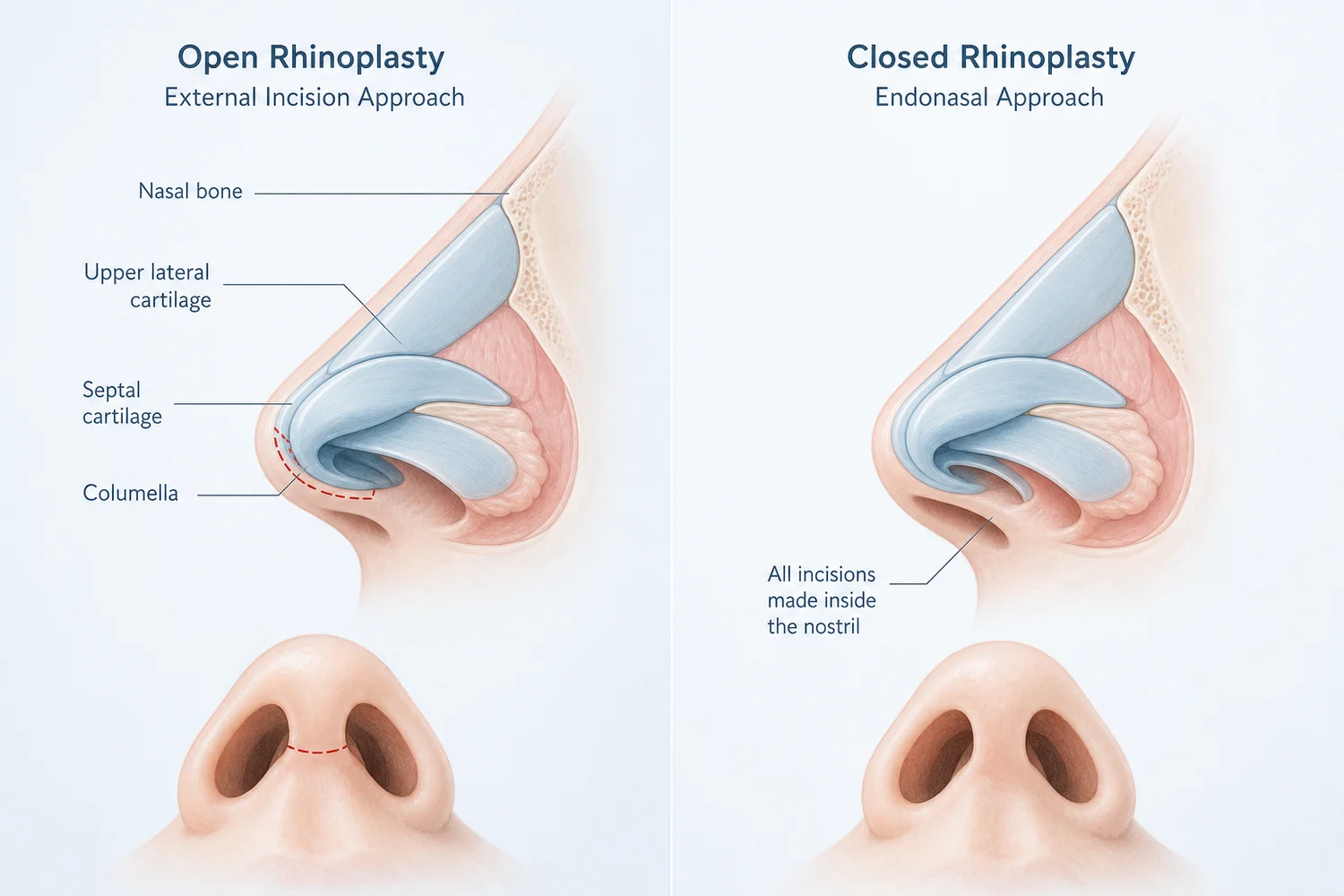
Open rhinoplasty gives direct access for cartilage grafting; closed rhinoplasty works through the nostrils for more contained changes.
Can Ethnic Rhinoplasty Preserve Your Ethnic Features?
Yes — preserving culturally significant features is the defining goal of ethnic rhinoplasty, not a side effect of it. A skilled surgeon plans around the patient’s specific anatomy and stated priorities, changing what the patient wants changed while leaving the features that read as their heritage intact.
What “preservation” means varies by patient and background, which is why a single before-and-after template photo is a poor way to judge a surgeon’s suitability for this work:
- Patients of African or Caribbean descent often want to refine width or tip definition while keeping the nose’s natural breadth and character
- Patients of East or South Asian descent frequently seek bridge augmentation via grafting rather than reduction, since the starting anatomy is often lower-profile
- Patients of Middle Eastern or Mediterranean descent commonly want dorsal hump reduction balanced against tip refinement, without over-narrowing the bridge
- Mixed-heritage patients may need a blended approach that doesn’t map neatly onto any single regional pattern
Common mistake: Assuming “preserve my features” means minimal surgical change. It usually means the opposite — more precise, more individualised planning than a standard reduction rhinoplasty requires.
None of this is achievable through a fixed surgical checklist. It requires a consultation where the surgeon listens to what the patient specifically doesn’t want to lose, then plans the technique around that boundary. Patients who want to explore a non-surgical route first — filler-based reshaping rather than an operation — can review how non-invasive rhinoplasty compares before committing to surgery; it suits minor refinements but can’t reduce nasal size or fix breathing structure the way surgical rhinoplasty can.
What’s the Recovery Time for Ethnic Rhinoplasty?
Recovery follows the same broad phases as standard rhinoplasty: a nasal splint for the first week, visible bruising and swelling reducing over two weeks, light exercise cleared around week four, and final shape settling over three to six months. Skin thickness — common in many ethnic nasal profiles — can extend the final-definition timeline slightly.
The splint comes off around day seven, at which point most of the visible bruising has faded. Social presentability generally returns within two weeks, though residual swelling at the tip is still detectable to the patient even when it’s no longer obvious to others.
| Recovery Phase | Timeframe | What to Expect |
|---|---|---|
| Acute | Days 1–7 | Nasal splint worn; bruising and swelling peak, then begin easing |
| Early healing | Week 2 | Splint removed; social activities resume |
| Active healing | Weeks 3–8 | Swelling reduces steadily; light exercise cleared around week 4 |
| Shape stabilisation | Months 3–6 | Final contour emerges; tip definition sharpens, particularly in thicker-skinned patients |
Thicker skin — a common feature across many ethnic nasal profiles — takes longer to “shrink-wrap” around the new underlying structure than thinner skin does. Patients should expect the tip specifically to keep refining for several months after the bridge has already settled.
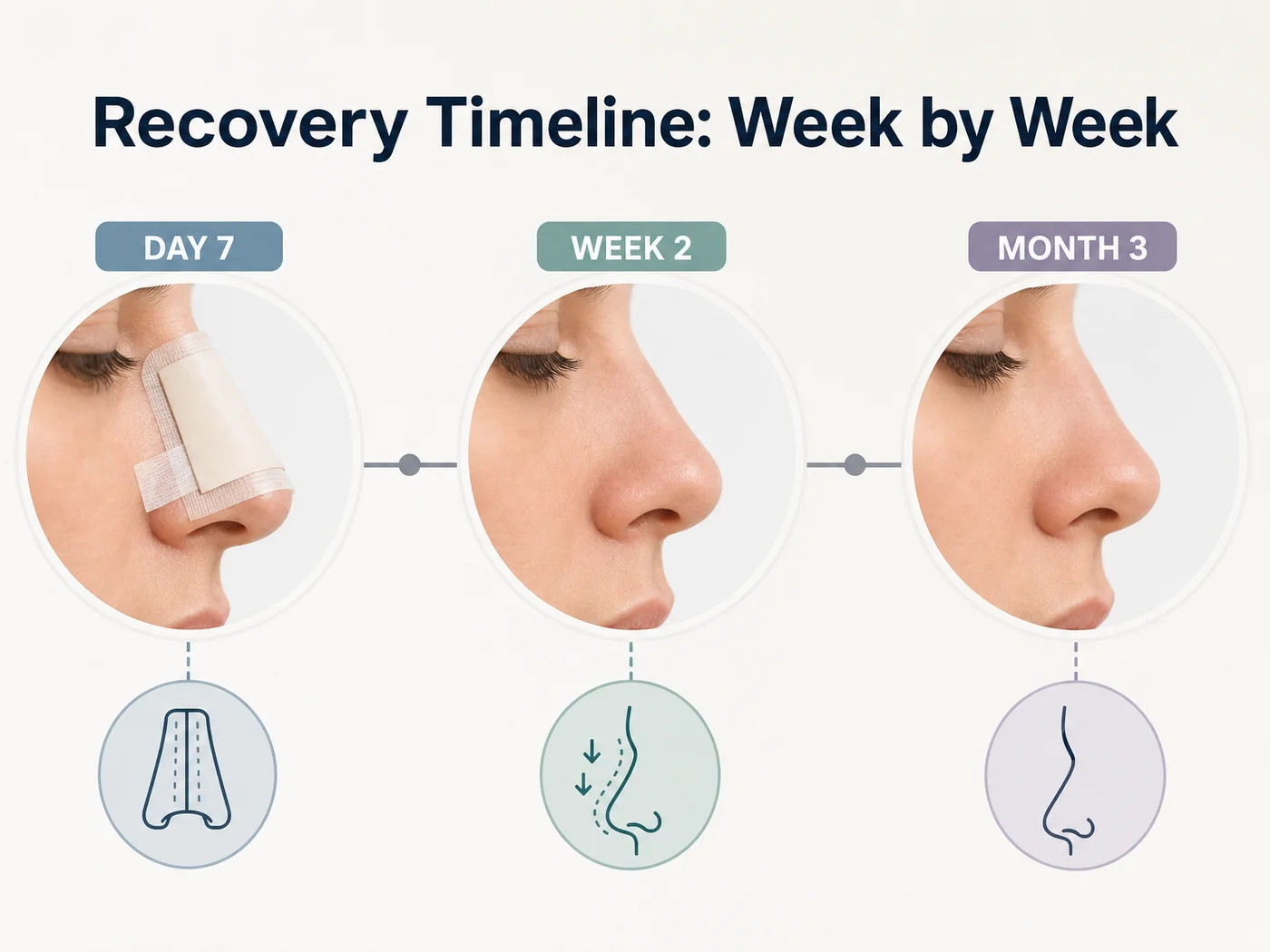
Recovery moves in phases — visible bruising resolves fastest, while final tip definition takes the longest to settle.
Contact sport stays off-limits for six weeks, and direct sun exposure to the nose should be avoided for around six months to prevent scar pigmentation — a more pronounced risk in darker or more sun-reactive skin tones.
How Much Does Ethnic Rhinoplasty Cost in the UK vs Poland?
UK private clinics typically charge £8,000–£15,000 for rhinoplasty surgery alone, with pre-operative imaging, hospital stay, and aftercare billed separately. EU-based specialist clinics working to the same regulatory standard often deliver a broader clinical scope — imaging, inpatient stay, physiotherapy, psychological support — within one confirmed package price.
The headline UK figure understates the real total. A surgeon’s quote of £9,000 rarely includes the pre-operative 3D imaging used to plan grafting, the overnight hospital stay, or the physiotherapy and psychological support that structured aftercare requires.
| UK Private Clinics | KCM Clinic (Poland) | |
|---|---|---|
| Surgery | £8,000–£15,000 | Confirmed at consultation |
| Pre-operative imaging | Often billed separately | Included |
| Hospital stay | Frequently day-case only | Multi-night stay included |
| Physiotherapy and psychological support | Rarely included | Included |
Turkish clinics frequently advertise lower headline prices than either UK or Polish EU-regulated facilities. That gap reflects a genuinely different regulatory environment, not simply lower overheads — EU Medical Devices Regulation governs implant materials, surgical facility standards, and clinical traceability in ways that non-EU regulatory frameworks don’t require in the same form.
KCM Clinic does not publish a fixed rhinoplasty price, because the surgical scope — how much grafting, whether functional correction is also needed — varies by patient anatomy and must be confirmed at consultation, not estimated from a marketing page.
Why Do UK and Canadian Patients Choose KCM Clinic for Ethnic Rhinoplasty?

KCM Clinic’s international patient team coordinates the ethnic rhinoplasty booking pathway from first consultation through discharge.
Poland is an EU member state, which means facility standards, medical device regulation, and surgeon qualification requirements align with the same framework governing hospitals in Germany and France. For UK patients facing multi-year NHS elective waits and Canadian patients facing provincial wait lists, that regulatory parity — combined with a shorter flight than most non-EU medical-tourism destinations — is the practical draw.
KCM’s surgical instrumentation and implant materials are sourced from EU-regulated manufacturers, including Johnson & Johnson and Zimmer Biomet devices used across the hospital’s surgical departments — the same manufacturers supplying UK NHS facilities. Surgeon qualifications are verifiable through EU professional registers rather than self-declared credentials on a clinic website.
The booking pathway is straightforward:
- Submit photos and medical history for an initial remote assessment
- Attend a consultation — in person or video — where anatomy, priorities, and technique are discussed in detail
- Receive a confirmed surgical plan and all-inclusive quote covering surgery, hospital stay, and aftercare
- Travel to Jelenia Góra for pre-operative imaging, surgery, and recovery support before discharge
KCM’s international patient team coordinates each stage in English, German, or Arabic, and the clinic holds the BookingsMed 2024 Excellence in International Patient Service award for exactly this kind of cross-border coordination. Patients weighing cosmetic surgery against cosmetic surgery abroad more broadly find the same EU-regulated, all-inclusive model applies across KCM’s plastic surgery portfolio.
Pro tip: Ask directly at consultation how many ethnic rhinoplasty cases the assigned surgeon has planned in the past year — case-specific experience with your anatomy type matters more than overall rhinoplasty volume.
Book Your Ethnic Rhinoplasty Consultation at KCM Clinic
Ethnic rhinoplasty outcomes depend on a surgeon who plans around your specific anatomy rather than a fixed template — and on aftercare that doesn’t stop the moment you leave the operating theatre. KCM Clinic provides both within an EU-regulated, all-inclusive framework.
Request an ethnic rhinoplasty consultation at KCM Clinic
Frequently Asked Questions About Ethnic Rhinoplasty
What is ethnic rhinoplasty?
Ethnic rhinoplasty is nose surgery planned around a patient’s specific ethnic anatomy, aiming to refine shape or improve function while preserving culturally significant features. It uses the same surgical techniques as standard rhinoplasty, applied with different structural priorities — often building rather than reducing.
Will ethnic rhinoplasty change how my nose reflects my heritage?
Not if the surgery is planned correctly. The explicit goal is to change what the patient wants changed — bridge height, tip shape, symmetry — while deliberately preserving the width, character, or profile that reads as ethnically distinct. That balance depends on a detailed pre-operative consultation, not a template.
How long until swelling goes down after ethnic rhinoplasty?
Visible bruising typically clears within two weeks and social presentability returns around the same time. Because thicker skin — common across many ethnic nasal profiles — takes longer to settle, final tip definition can continue refining for three to six months after surgery.
Is ethnic rhinoplasty more expensive than standard rhinoplasty?
Not inherently. Pricing depends on surgical complexity — how much cartilage grafting or structural building is needed — rather than the patient’s ethnicity itself. UK private clinics typically charge £8,000–£15,000 for surgery alone, with imaging and aftercare often billed separately.
How does ethnic rhinoplasty cost in Poland compare with Turkey?
Turkish clinics often advertise lower headline prices, reflecting a different regulatory framework rather than simply lower overheads. EU-based clinics like KCM operate under EU Medical Devices Regulation, which governs implant materials and facility standards to the same level required in Germany or France.
What happens to ethnic rhinoplasty results years later?
Results are structural and permanent — bone and cartilage changes don’t reverse. Natural ageing may cause minor softening of the nasal tip over decades, but the core surgical outcome, including preserved ethnic features, remains stable for life in the large majority of cases.