

Non Invasive Rhinoplasty: How It Works, Cost, and Who It Suits
Physician-reviewed patient education from KCM Clinic — medically reviewed by Dr. hab. n. med. Stanisław Kwiek, Specialist Neurosurgeon, KCM Clinic.
Most patients who search for non invasive rhinoplasty aren’t looking for a cheaper version of surgery. They’re looking for a way to avoid the operating table entirely, and assuming the two procedures are interchangeable if the price and downtime line up. They aren’t. Non-invasive rhinoplasty is a genuine clinical tool for a specific set of concerns — not a scaled-down substitute for a scalpel.
Key Takeaways
- Non-invasive rhinoplasty reshapes the nose using injectable dermal filler, with no incisions, general anaesthesia, or recovery downtime.
- Visible change appears within 24–72 hours of the appointment and typically holds for 6–12 months before the filler gradually breaks down.
- UK pricing for non invasive rhinoplasty typically runs £1,000–£3,000 per session, against £8,000–£15,000 or more for surgical rhinoplasty.
- It cannot reduce the size of the nose, correct a deviated septum, or resolve breathing problems — those changes require surgical rhinoplasty.
- Mild bruising and swelling are common; serious complications such as vascular injury are rare when an experienced injector uses hyaluronic acid filler.
Contents
- What Is Non Invasive Rhinoplasty?
- How Does Dermal Filler Rhinoplasty Work?
- How Much Does Liquid Rhinoplasty Cost?
- How Long Do Non-Invasive Nose Job Results Last?
- Is Non Invasive Rhinoplasty Safer Than Surgical Rhinoplasty?
- Who Is a Good Candidate for Non-Invasive Nose Contouring?
- What Are the Risks and Side Effects of Dermal Filler Nose Jobs?
- Can Non Invasive Rhinoplasty Fix All Nose Shapes?
- Why Choose KCM for Non-Invasive Nose Contouring?
What Is Non Invasive Rhinoplasty?
Non-invasive rhinoplasty reshapes the external contour of the nose using injectable dermal filler, without cutting, general anaesthesia, or a recovery period. An injector places small, precise amounts of filler under the skin to smooth a dorsal bump, lift a drooping tip, or correct minor asymmetry — building the desired profile in a single appointment.
It goes by several names depending on who’s describing it: liquid rhinoplasty, non-surgical nose job, dermal filler nose job, or a temporary nose job. All refer to the same injectable technique. What separates it from surgical rhinoplasty is mechanical, not cosmetic — filler adds volume in targeted spots, while surgery removes or restructures cartilage and bone.
That distinction matters more than most marketing copy admits. A filler injector can camouflage a bump by building up the tissue around it. A surgeon can actually take the bump away. Patients who understand which mechanism they need before booking tend to end up far happier with the result.
Worth knowing: Because filler only adds volume, it works by illusion rather than reduction — a nose that looks smaller after treatment usually got there through better proportion and symmetry, not less tissue.
How Does Dermal Filler Rhinoplasty Work?
A dermal filler nose job starts with a physical assessment of nasal anatomy and skin thickness, followed by targeted injections of hyaluronic acid gel along the bridge or tip, shaped by hand until the profile reads as straight and symmetrical. The whole appointment typically runs 20 to 30 minutes.
The consultation is where most of the clinical judgement happens. A qualified injector examines bone structure, cartilage support, and how thick or thin the overlying skin is, because all three affect how filler will sit and how long it will hold. Patients with thicker skin generally need more product to show visible change; thinner skin shows results with less.
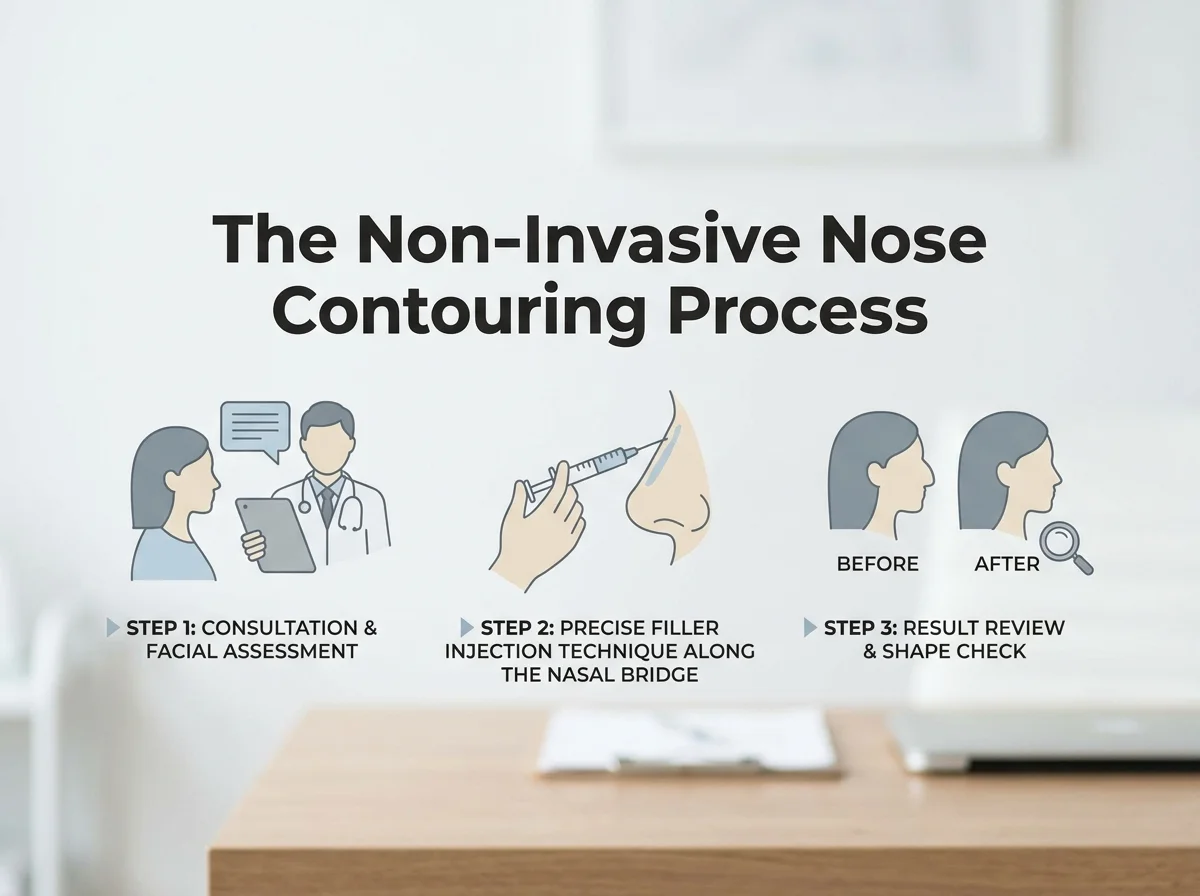
Assessment, injection, and review — the three stages of a single dermal filler rhinoplasty appointment.
Once the plan is set, a topical numbing cream is applied and the injector works in small increments — often 0.1ml at a time — checking the profile from multiple angles between each pass. Premium hyaluronic acid formulations are the standard choice in the nasal area specifically, because they’re enzymatically reversible if the result needs adjusting.
That reversibility is a genuine safety feature, not marketing language. If a patient is unhappy, or if a complication is suspected, a clinician can dissolve the filler with hyaluronidase within days rather than living with a permanent outcome.
- Consultation and facial assessment (10–15 minutes)
- Topical anaesthetic application
- Filler injection in small increments with continuous shape-checking
- Immediate result review and minor touch-ups if needed
How Much Does Liquid Rhinoplasty Cost?
Non-invasive rhinoplasty in the UK typically costs £1,000–£3,000 per session, compared with £8,000–£15,000 or more for surgical rhinoplasty once anaesthesia, hospital stay, and aftercare are factored in. The gap looks steep until it’s set against permanence: surgical results don’t need repeating, while filler needs topping up roughly once a year.
| Non Invasive Rhinoplasty | Surgical Rhinoplasty | |
|---|---|---|
| Typical UK cost | £1,000–£3,000 | £8,000–£15,000+ |
| Appointment length | 20–30 minutes | 1.5–3 hours |
| Result | Temporary, 6–12 months | Permanent |
For a full breakdown of ongoing cost over multiple years, our guide to non-surgical rhinoplasty cost and recovery covers the annualised comparison in more detail. Patients weighing surgery instead should also see current rhinoplasty pricing in Poland, since KCM Clinic offers both routes under one roof.
Bottom line: A single non-invasive session costs a fraction of surgical rhinoplasty upfront, but repeated touch-ups over several years can eventually approach the cost of one permanent surgical result.
How Long Do Non-Invasive Nose Job Results Last?
Most hyaluronic acid fillers used for non invasive rhinoplasty last 6 to 12 months before the body gradually metabolises them, with visible change appearing within 24 to 72 hours of the injection. The nose tends to hold filler slightly longer than looser-skinned areas of the face, since the skin there sits close against cartilage rather than moving freely over it.

Initial swelling settles within days; the final shape is usually visible by week two.
Early swelling can make the result look slightly overfilled for the first 48 hours, which is why most clinics schedule a review appointment two to three weeks out rather than judging the outcome on the day. By that point, the tissue has settled and the true contour is visible.
Denser filler types, such as calcium hydroxylapatite-based products, can push toward the longer end of that range. They also carry a higher risk of vascular complications when used in the nose specifically, which is why hyaluronic acid remains the more common choice among UK and EU practitioners for this particular treatment area.
Is Non Invasive Rhinoplasty Safer Than Surgical Rhinoplasty?
Non-invasive rhinoplasty avoids the risks that come with general anaesthesia and open surgery, but it carries its own narrow risk profile — the nasal area has a denser blood supply than most injection sites, so technique and injector experience matter more here than almost anywhere else on the face. Neither procedure is risk-free; they carry different kinds of risk.
Surgical rhinoplasty involves the standard risks of any operation under general anaesthesia: bleeding, infection, and a multi-month recovery before the final shape settles. Filler avoids those specific risks entirely. What it introduces instead is the possibility of a needle entering a blood vessel during injection — a rare event, but one that requires an injector trained specifically in nasal anatomy to manage correctly.
Reality check: The rarity of serious complications with dermal filler rhinoplasty depends almost entirely on who’s holding the needle. This is not a procedure where the cheapest available appointment is a reasonable way to save money.
Who Is a Good Candidate for Non-Invasive Nose Contouring?
Good candidates for non invasive rhinoplasty have minor cosmetic concerns — a dorsal bump, mild asymmetry, or a drooping tip — rather than structural problems, and are comfortable repeating treatment every 6 to 12 months. Patients wanting a smaller nose or a permanent result are better served by surgery from the outset.
The clinical decision usually comes down to what the patient is actually trying to change:
- Good fit: smoothing a small bump, lifting a drooping tip, correcting minor asymmetry, or trialling a straighter profile before committing to surgery
- Good fit: patients who can’t take extended time off work or aren’t ready for a permanent decision
- Poor fit: anyone wanting the nose narrower or smaller, since filler cannot remove tissue
- Poor fit: patients with a deviated septum or breathing difficulty, which filler does not touch
- Poor fit: significant structural asymmetry that needs cartilage repositioning, not surface volume
A short consultation is usually enough to sort a patient into one category or the other. Anyone with more general questions about cosmetic versus reconstructive procedures will find the same logic applies across most facial treatments — additive techniques suit surface concerns, structural techniques suit everything underneath.
What Are the Risks and Side Effects of Dermal Filler Nose Jobs?
Mild bruising, swelling, and tenderness at the injection site are the most common side effects, usually resolving within a week. Serious complications — infection, filler migration, or vascular injury — are uncommon but not impossible, and the nasal area is one of the higher-risk injection zones on the face because of its blood vessel density.
The specific risk clinicians train for is vascular occlusion: filler accidentally entering a blood vessel, which can restrict blood flow to surrounding skin. It’s rare, and the reason experienced injectors work in small increments while checking blanching and capillary refill between each pass rather than injecting the full volume at once.
- Bruising and mild swelling (common, resolves in days)
- Temporary redness at injection points (common)
- Asymmetry requiring a touch-up (occasional)
- Vascular occlusion or filler migration (rare, managed by prompt hyaluronidase dissolution)
Common mistake: Booking based on price alone. The materials used are only half the safety equation — the injector’s specific experience with nasal anatomy is the other half, and it’s the harder one to shortcut.
Can Non Invasive Rhinoplasty Fix All Nose Shapes?
No. Non-invasive rhinoplasty can camouflage a bump, lift a tip, or balance mild asymmetry, but it cannot reduce nose size, narrow wide nostrils, or correct a deviated septum — those changes require removing or restructuring tissue, which only surgery can do. Matching the concern to the right technique is the single biggest factor in patient satisfaction.
| Nose concern | Non-invasive filler | Surgical rhinoplasty |
|---|---|---|
| Dorsal bump | Can camouflage | Can remove |
| Drooping tip | Can lift | Can reposition |
| Nose too large or wide | Cannot reduce | Can reduce |
| Deviated septum / breathing | No effect | Can correct |
| Minor asymmetry | Can balance | Can balance |
| Post-surgical dip or dent | Can fill | Can revise |
Patients whose primary concern sits in the left column of that table are typically well served by filler. Anyone whose main concern sits in the “surgical rhinoplasty” column should book a surgical consultation directly rather than trying filler first and hoping it’s enough — it usually isn’t, and the extra appointment adds cost without changing the outcome.
Why Choose KCM for Non-Invasive Nose Contouring?
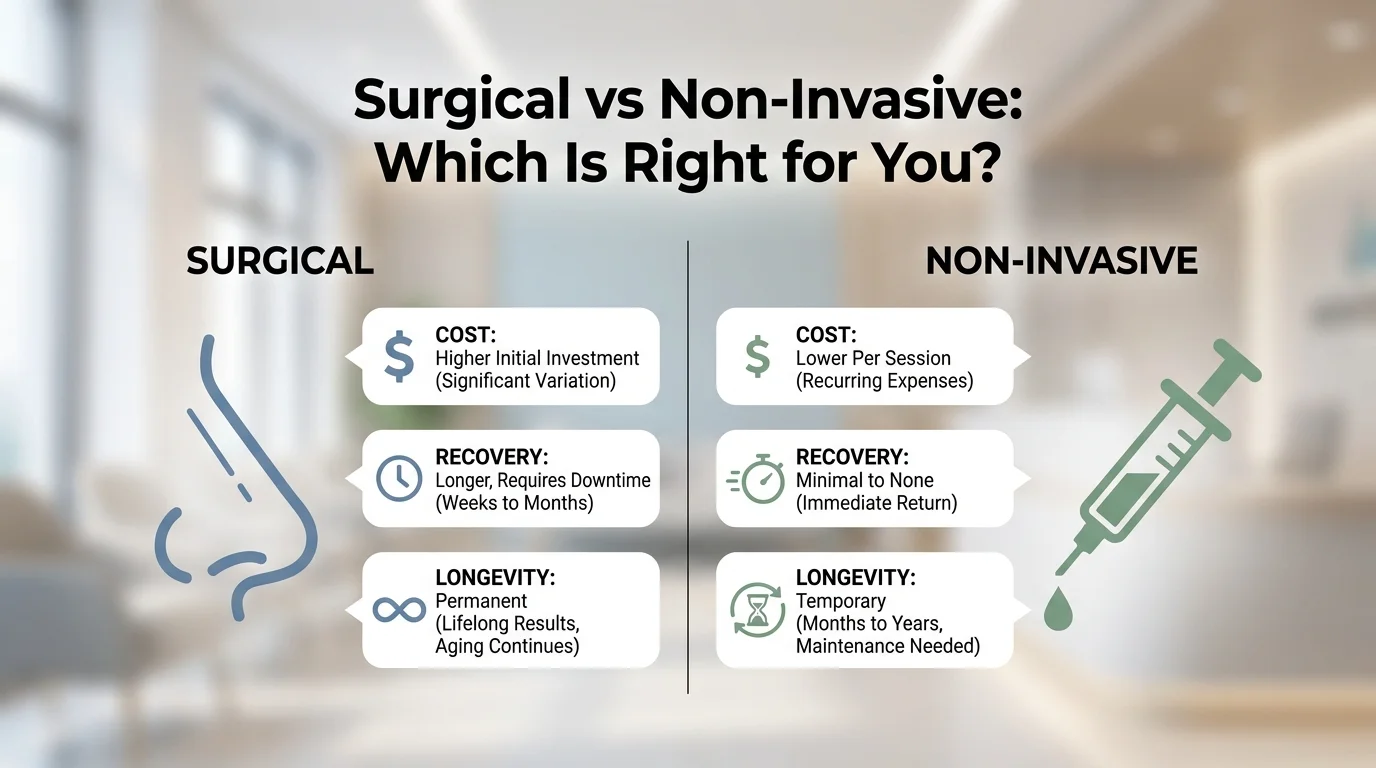
Choosing between filler and surgery starts with matching the technique to the concern — not the other way round.
KCM Clinic offers both non-invasive and surgical rhinoplasty under the same roof, which means the consultation isn’t steering patients toward whichever service the clinic happens to sell. Injectors assess nasal anatomy first and recommend filler, surgery, or a combination based on what will actually address the concern.
KCM operates within the EU Medical Devices Regulation — the same regulatory framework that governs clinics in Germany and France — so filler products, sterility standards, and practitioner qualifications meet a consistent bar rather than varying by country. For UK and Canadian patients used to itemised private pricing, KCM’s non invasive rhinoplasty appointments are quoted as a single figure that includes the consultation, the procedure, and a follow-up review.
Patients who try filler first and later decide they want a permanent result already have a surgical team on file, so moving from a trial to full surgical rhinoplasty in Poland doesn’t mean starting the clinic search over. The same continuity applies across KCM’s other cosmetic procedures, including blepharoplasty in Poland and broader cosmetic surgery abroad packages for patients considering more than one treatment.
Book a Non Invasive Rhinoplasty Consultation at KCM Clinic
Matching the right technique to your specific concern starts with an assessment, not a price list. KCM Clinic’s consultation covers both non-invasive and surgical options, so you leave with a plan built around your anatomy rather than a single service being upsold.
Book a non invasive rhinoplasty consultation at KCM Clinic
Frequently Asked Questions About Non Invasive Rhinoplasty
What is the least invasive rhinoplasty option available?
Dermal filler rhinoplasty is the least invasive option, since it involves only injections and no cutting or anaesthesia beyond a topical numbing cream. Thread lifts are sometimes marketed as an alternative, but they carry more variable results and are less established for nasal contouring specifically.
What can I get instead of a surgical nose job?
For minor bumps, asymmetry, or tip position, dermal filler rhinoplasty is the main non-surgical alternative. It won’t reduce nose size or fix breathing problems, so patients with those concerns still need surgical rhinoplasty rather than an injectable substitute.
Does non invasive rhinoplasty hurt?
Most patients describe brief, sharp pinches during injection rather than significant pain, and topical numbing cream is applied beforehand to reduce discomfort. Mild soreness at injection points can persist for a day or two afterward.
How many sessions of dermal filler rhinoplasty do I need?
Most patients achieve their desired result in a single session, with an optional touch-up two to three weeks later once swelling has fully settled. Ongoing maintenance sessions every 6 to 12 months are needed to preserve the result once the initial filler metabolises.
Can non invasive rhinoplasty be combined with other treatments?
Yes. It’s commonly paired with treatments like jawline or chin filler to balance overall facial proportion, since a straighter nasal profile can shift how other features read. Combination planning is usually discussed during the initial consultation.
What happens if I don’t like the results?
Hyaluronic acid filler can be dissolved with hyaluronidase within days if the result isn’t right, which is one reason it’s the standard choice for nasal treatment over denser, non-reversible alternatives. This reversibility is a meaningful safety margin surgical rhinoplasty doesn’t offer.