

Most people who’ve already decided on laser eye surgery vs PRK aren’t really asking which one works better — both do. They’re asking which one fits their cornea, their job, and how many weeks they can tolerate blurry vision before it settles.
Key Takeaways
- LASIK uses a corneal flap and reshapes the underlying stroma; PRK removes and reshapes the surface epithelium directly — PRK is technically less invasive but requires longer recovery due to epithelial regrowth.
- LASIK visual recovery takes 3–7 days to functional normalcy; PRK requires 1–3 months for full clarity, making LASIK the faster choice for active patients or those unable to pause work long-term.
- Both procedures achieve equivalent final refractive outcomes — 20/20 or better in 90%+ of appropriate candidates — using FDA-approved excimer laser technology and advanced diagnostic imaging.
- PRK may be the safer choice for thin corneas, high prescriptions, or contact-sport athletes; LASIK suits patients with thicker corneas who want a rapid return to normal activities.
- KCM Clinic performs both procedures with wavefront and topographic diagnostic imaging, EU-standard surgical protocols, and structured pre- and post-operative aftercare.
Contents
- Laser Eye Surgery vs PRK: How Do LASIK and PRK Differ?
- Laser Eye Surgery vs PRK: Which Procedure Suits Your Cornea?
- How Long Is Recovery After LASIK Surgery Compared to PRK?
- How Much Does LASIK Cost vs PRK in Europe?
- Who Should Choose PRK Instead of LASIK?
- Can I Return to Work and Sports After LASIK or PRK?
- How Accurate Is LASIK vs PRK for Correcting Myopia, Hyperopia, and Astigmatism?
- Why Choose KCM Clinic for LASIK or PRK?
Laser Eye Surgery vs PRK: How Do LASIK and PRK Differ?
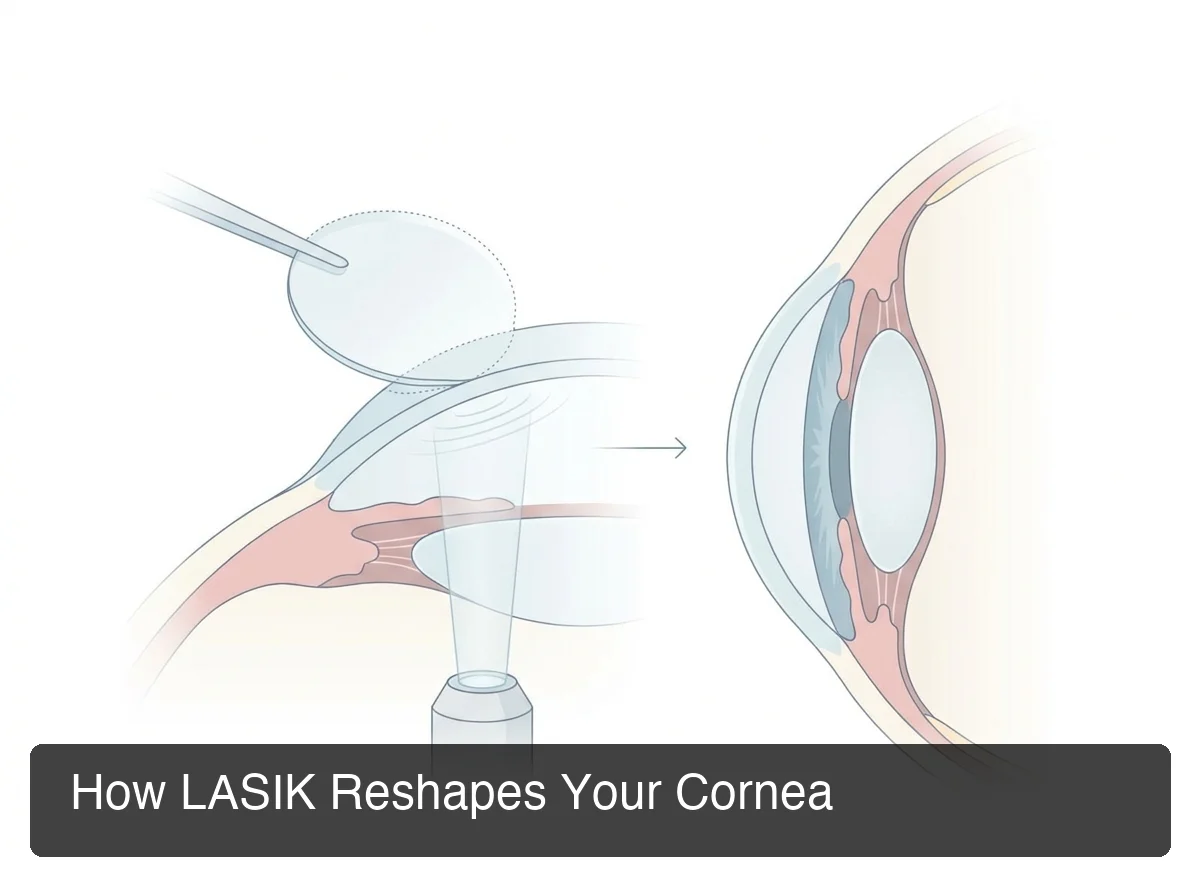
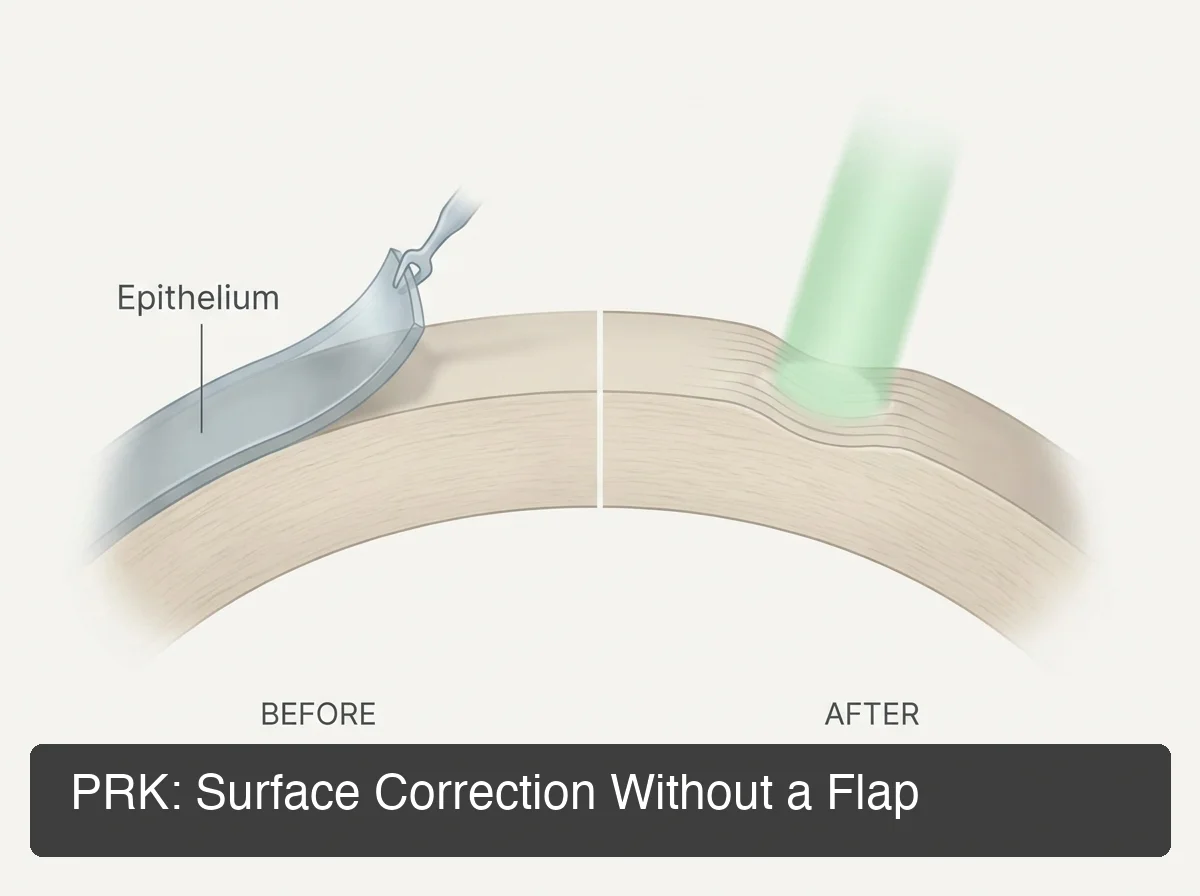
LASIK and PRK both reshape the cornea with an excimer laser to correct how light focuses on the retina, but they reach that layer differently. LASIK cuts a thin corneal flap with a mechanical microkeratome or femtosecond laser, lifts it, reshapes the stroma underneath, then replaces the flap. PRK skips the flap entirely and removes the surface epithelium directly before reshaping.
That flap is the entire distinction. Once it’s created, LASIK surgery and PRK use the same laser, the same targeting software, and often the same surgeon in back-to-back appointments — vision correction surgery outcomes converge from there.
The epithelium — the eye’s outermost layer — regenerates on its own within days after PRK. That regrowth is what drives PRK’s longer recovery window compared to LASIK, where the flap is repositioned and heals largely undisturbed. Neither approach is more “advanced” than the other; they’re two routes to the same destination, chosen based on the eye in front of the surgeon.
Worth knowing: The laser reshaping step itself — the part that actually corrects your prescription — is identical in LASIK and PRK. What differs is only how the surgeon accesses the corneal surface first.
Laser Eye Surgery vs PRK: Which Procedure Suits Your Cornea?
Corneal thickness is usually the deciding factor. LASIK’s flap removes tissue that PRK leaves intact, so patients with thinner corneas, higher prescriptions, or irregular corneal topography are frequently steered toward PRK to preserve structural integrity and reduce long-term ectasia risk.
A pre-operative assessment measures corneal thickness (pachymetry), curvature (topography), and higher-order aberrations (wavefront analysis) before either procedure is offered. Those three scans — not patient preference — determine eligibility first.
Here’s how the two procedures compare across the factors patients ask about most:
| Factor | LASIK | PRK |
|---|---|---|
| Corneal tissue removed | Flap + reshaped stroma | Surface epithelium + reshaped stroma |
| Best for | Thicker corneas, standard prescriptions | Thin corneas, higher prescriptions, contact sports |
| Functional vision recovery | 3–7 days | 1–3 months |
| Discomfort in first 72 hours | Mild, usually managed with drops | More noticeable, due to healing epithelium |
| Final visual outcome | 20/20 or better in 90%+ of candidates | 20/20 or better in 90%+ of candidates |
| Flap-related complication risk | Present, though rare | None — no flap created |
Neither column is objectively “better.” A patient who qualifies for both is choosing between a faster recovery and a marginally lower structural risk profile — a genuinely close call that a surgeon should walk through case by case, not a marketing decision.
How Long Is Recovery After LASIK Surgery Compared to PRK?
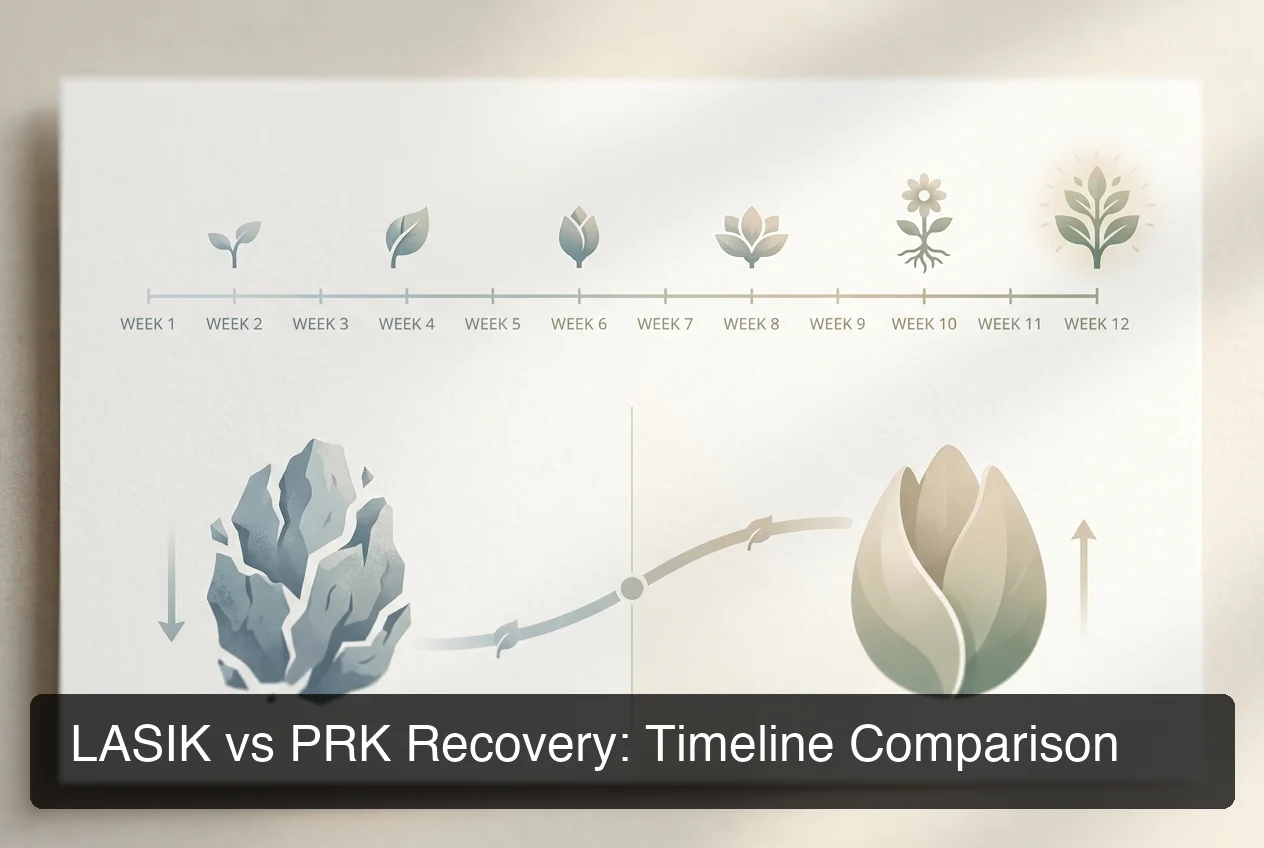
LASIK surgery recovery reaches functional vision in 3 to 7 days because the repositioned flap protects the stroma while it heals. PRK recovery time stretches to 1–3 months for full visual stability, since the eye must regrow its entire epithelial surface before vision fully sharpens and stabilises.
Both timelines describe stages, not a single cutoff. LASIK patients often see clearly enough to drive within 24–48 hours, though full stromal healing continues for months underneath a normal-looking surface.
PRK follows a slower, more visible arc:
- Days 1–5: A bandage contact lens protects the healing epithelium; vision is blurry and light-sensitive.
- Weeks 1–4: Epithelium closes over fully; vision sharpens but can still fluctuate day to day.
- Months 1–3: Fine visual detail and night-vision quality continue improving toward the final result.
Bottom line: If you can’t take more than a week off work or away from screens, that alone often settles the LASIK-vs-PRK question before corneal anatomy even enters the conversation.
How Much Does LASIK Cost vs PRK in Europe?
LASIK and PRK are usually priced similarly at the same clinic, since the laser technology, diagnostic imaging, and surgeon time are nearly identical — the cost difference tends to sit in follow-up visits, as PRK’s longer healing arc typically means more post-operative check-ins.
UK private laser eye surgery pricing is charged per eye and varies by clinic, technology tier, and whether pre-operative diagnostics and aftercare are bundled in or billed separately. That itemisation is where costs quietly climb.
A package that bundles diagnostic scans, both procedures’ aftercare visits, and any touch-up allowance into one quote is easier to budget against than a per-visit UK private structure. When comparing laser eye surgery cost across providers, ask specifically what’s included in the headline figure — not just what the surgery itself costs.
Who Should Choose PRK Instead of LASIK?
Patients with thin corneas, very high prescriptions, certain corneal irregularities, or jobs and hobbies with a high risk of eye trauma are frequently better suited to PRK, since there’s no flap to dislodge and no reduction in remaining stromal tissue.
Contact-sport athletes are the clearest example. A LASIK flap, even years after surgery, remains a structurally distinct layer that a blunt impact can theoretically displace. PRK leaves no such seam.
Surgeons also lean toward PRK for patients with:
- Corneal thickness below the threshold considered safe for flap creation
- Signs of early keratoconus or irregular topography on wavefront analysis
- A history of dry eye severe enough that flap-related nerve disruption is a concern
- Occupations — military service, boxing, rugby — with elevated risk of blunt eye trauma
None of these are automatic disqualifiers for LASIK; they’re flags a surgeon weighs during the diagnostic consultation, not a checklist patients apply to themselves.
Can I Return to Work and Sports After LASIK or PRK?
Most LASIK patients return to desk-based work within 2–3 days and non-contact exercise within a week; PRK patients typically need 1–2 weeks before office work feels comfortable and 4–6 weeks before resuming higher-impact activity, since the eye is more light-sensitive during epithelial healing.
Swimming, contact sports, and anything with dust or debris exposure should wait longer for both procedures — generally 4 weeks for LASIK and up to 3 months for PRK, on your surgeon’s specific guidance. Screen-heavy jobs may need extra lubricating drops in the first fortnight regardless of which procedure you had.
How Accurate Is LASIK vs PRK for Correcting Myopia, Hyperopia, and Astigmatism?
Both LASIK and PRK correct myopia, hyperopia, and astigmatism with comparable precision, because the underlying excimer laser reshaping is identical in both procedures — accuracy depends far more on the diagnostic mapping beforehand than on which access method the surgeon uses.
Wavefront-guided and topography-guided planning let the laser account for astigmatism and irregular corneal shape rather than applying a generic correction. That’s the step that most affects sharpness of the final result, not the LASIK-versus-PRK choice itself.
Higher degrees of myopia or astigmatism can push a borderline case toward PRK simply because there’s more tissue to reshape relative to what a thin cornea can safely spare under a flap.
Why Choose KCM Clinic for LASIK or PRK?
KCM Clinic performs both LASIK and PRK using FDA-approved excimer laser platforms paired with topography and wavefront diagnostic imaging, so candidacy is decided on measured corneal data rather than a generic protocol — the same diagnostic-first approach behind KCM’s comprehensive surgical services across specialties.
As an EU member-state hospital, KCM Clinic operates under the same surgical and device regulations as Germany, France, or Sweden — a different regulatory tier to destinations outside the EU. Every LASIK and PRK patient goes through pre-operative pachymetry, topography, and wavefront mapping before a procedure is recommended, not after.
Aftercare doesn’t stop at discharge. Post-operative follow-up is scheduled at set intervals through the healing window — critical for PRK patients, whose recovery unfolds over months rather than days. Patients weighing this decision often research surgical decision-making abroad more broadly, and the same diagnostic-first standard applies whether the procedure is refractive, orthopaedic, or reconstructive — see KCM’s approach to comparison of popular surgical procedures for how that plays out elsewhere in the hospital.
Get Started with KCM Clinic
Choosing between LASIK and PRK starts with a proper diagnostic scan, not a preference. Book a consultation to have your corneal thickness, topography, and prescription assessed, and get a clear recommendation based on your own eyes.
Book a Free Consultation with KCM Clinic
FAQ
Which is better, LASIK or PRK?
Neither is universally better — both achieve equivalent final visual outcomes for suitable candidates. LASIK offers faster visual recovery; PRK avoids creating a corneal flap, which can matter for thin corneas or contact-sport athletes. The right choice depends on corneal thickness, prescription, and lifestyle, decided after diagnostic imaging.
Can PRK correct astigmatism as well as LASIK?
Yes. PRK uses the same wavefront- and topography-guided excimer laser as LASIK to correct astigmatism, so accuracy is comparable between the two. The main difference is recovery time, not correction precision — astigmatism outcomes depend more on pre-operative mapping than on which procedure is used.
Why do some surgeons recommend PRK over LASIK for certain patients?
Surgeons favour PRK when corneal thickness is borderline for safe flap creation, when topography shows irregularities, or when a patient’s occupation or sport carries a high risk of eye trauma. PRK avoids the flap entirely, removing that specific structural risk regardless of how many years pass after surgery.
Is PRK more painful than LASIK?
PRK typically involves more discomfort in the first 48–72 hours because the epithelium is healing over an exposed surface, whereas LASIK’s repositioned flap covers the treated area immediately. Both are manageable with prescribed drops and a bandage contact lens; neither is described as pain-free.
Can I have LASIK or PRK on both eyes during the same appointment?
Most surgeons treat both eyes in the same session for both LASIK and PRK, since the procedure per eye takes only minutes. Some surgeons stagger PRK by a short interval for higher-prescription cases to manage recovery more comfortably — your surgeon will confirm this during the pre-operative consultation.
Do LASIK and PRK results last permanently?
The corneal reshaping from both procedures is permanent, and most patients maintain 20/20 vision or better for life. Natural age-related changes to the eye, such as presbyopia or cataracts, can still affect vision later on, but these are unrelated to the original refractive correction.