

LASIK Eye Surgery Video: What Actually Happens, Step by Step
Physician-reviewed patient education from KCM Clinic.
Search “LASIK eye surgery video” and the results are almost entirely footage — real-time procedures, animated cornea diagrams, patient walkthroughs. That instinct to watch before booking is a reasonable one: LASIK eye surgery video content shows exactly what a laser does to your eye in a way no written description quite manages, which is precisely why so many patients search for it before they search for a clinic.
Key Takeaways
- LASIK is an outpatient refractive surgery that reshapes the cornea using an excimer laser to correct myopia, hyperopia, and astigmatism in a single 15-minute procedure.
- Recovery is rapid — most patients experience improved vision within 24 hours and reach full visual stability within 1–3 months.
- LASIK has a 96% success rate (achieving target vision within ±0.5 diopter) and is safe when performed by qualified surgeons using modern technology; complications are rare and often correctable.
- UK private LASIK costs £2,500–£4,000 per eye; KCM Clinic’s all-inclusive package (surgery, pre-op assessment, hospital stay, physiotherapy, international transfer) provides comparable quality at significantly lower cost.
- Video documentation and patient education reduce anxiety and help you understand exactly what happens during surgery — a major factor in patient satisfaction.
Contents
- What Is LASIK Eye Surgery and How Does It Work?
- Why Watch a LASIK Eye Surgery Video Before Your Procedure?
- What Does a LASIK Eye Surgery Video Actually Show You, Step by Step?
- What Can You Expect During Your LASIK Appointment?
- How Long Is LASIK Recovery, and When Will Your Vision Stabilize?
- Is LASIK Safe? What Are the Risks and Side Effects?
- Who Is a Good Candidate for LASIK Eye Surgery?
- How Does LASIK Cost Compare Between UK Private Clinics and KCM Clinic?
- Why Do UK and Canadian Patients Choose KCM Clinic for LASIK Eye Surgery?
What Is LASIK Eye Surgery and How Does It Work?
LASIK (laser-assisted in situ keratomileusis) is an outpatient refractive surgery that uses an excimer laser to reshape the cornea, correcting myopia, hyperopia, and astigmatism so light focuses properly on the retina. The surgeon creates a thin corneal flap, folds it back, reshapes the underlying tissue with computer-guided laser pulses, then repositions the flap without stitches.
The entire procedure takes roughly 10 to 15 minutes per eye, most of which is preparation. The laser itself is active for well under a minute per eye, tracking eye movement thousands of times a second to keep the ablation precisely centred.
Two technologies do the work: a femtosecond laser creates the corneal flap, and an excimer laser removes microscopic layers of tissue to correct the refractive error. Modern platforms combine both in a single suite, which is part of why LASIK has become the most-performed elective refractive procedure worldwide.
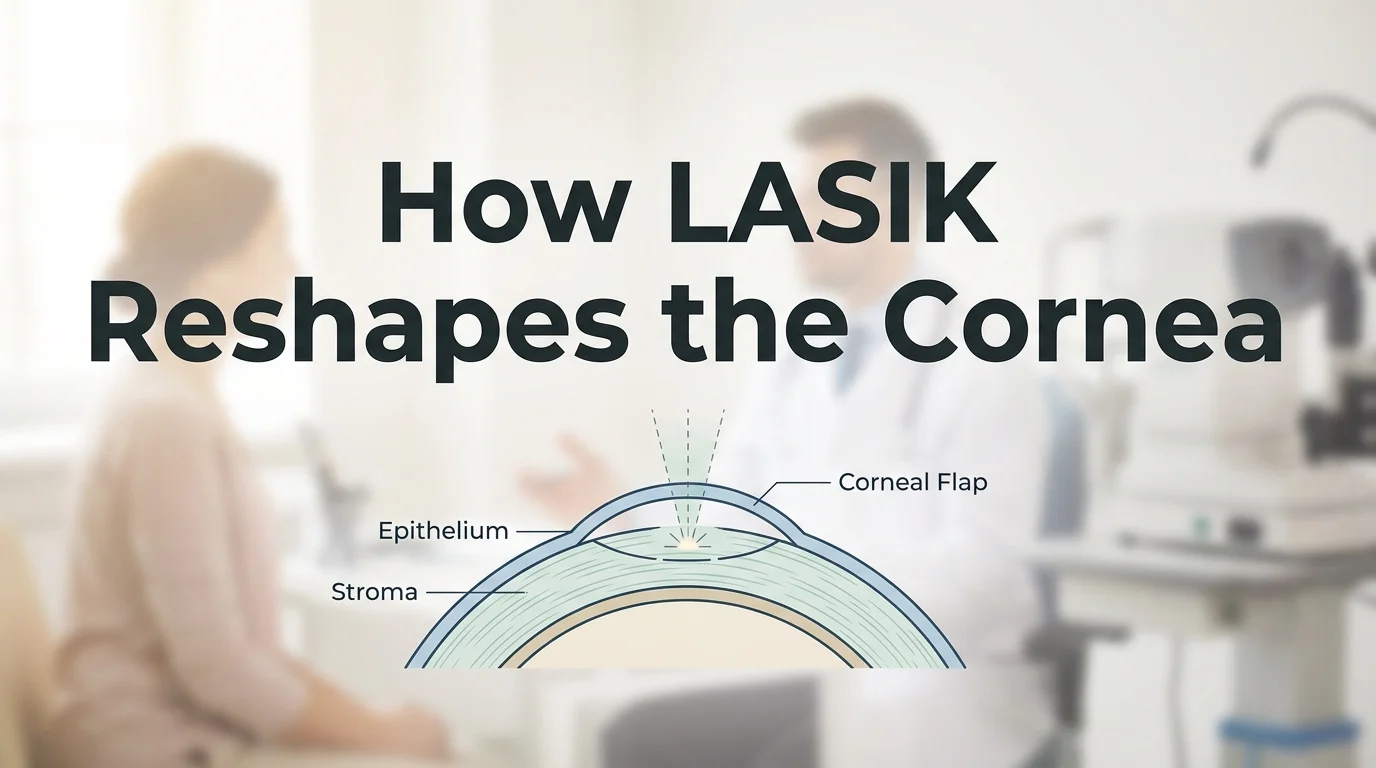
The excimer laser reshapes the stroma beneath the flap — the flap itself is never removed, only lifted and replaced.
Why Watch a LASIK Eye Surgery Video Before Your Procedure?
A LASIK eye surgery video removes the uncertainty that written descriptions can’t — it shows the actual laser positioning, the flap movement, and the pacing of the procedure, which is what most pre-surgery anxiety is actually about. Patients rarely fear the concept of LASIK; they fear not knowing what will happen to their eye in real time.
That’s borne out in the search data. Watch a LASIK procedure on Mayo Clinic’s own patient-education video, or one of the widely viewed real-time walkthroughs on YouTube, and the anxiety response tends to shift from abstract to specific — which is easier to manage.
Worth knowing: Most LASIK videos show the numbing drops and eyelid speculum first, which patients often find more uncomfortable to anticipate than the laser itself. In practice, patients report the speculum as odd rather than painful.
What Does a LASIK Eye Surgery Video Actually Show You, Step by Step?
A typical LASIK eye surgery video walks through five stages: numbing drops, flap creation, laser reshaping, flap repositioning, and a brief recovery check — the whole sequence usually runs under 15 minutes on screen. Watching each stage in order is the fastest way to build an accurate mental model of the surgery.
- Numbing drops and positioning. Anaesthetic eye drops are applied, and a speculum holds the eyelids open. There is no needle and no general anaesthetic.
- Flap creation. A femtosecond laser creates a thin, hinged flap in the corneal surface, exposing the tissue underneath.
- Laser reshaping. The excimer laser removes precisely calculated amounts of corneal tissue, guided by your pre-op measurements and real-time eye tracking.
- Flap repositioning. The surgeon folds the flap back into place, where it adheres naturally within minutes — no stitches required.
- Immediate recovery check. The surgeon confirms flap position and clear vision before you’re moved to a short observation period.
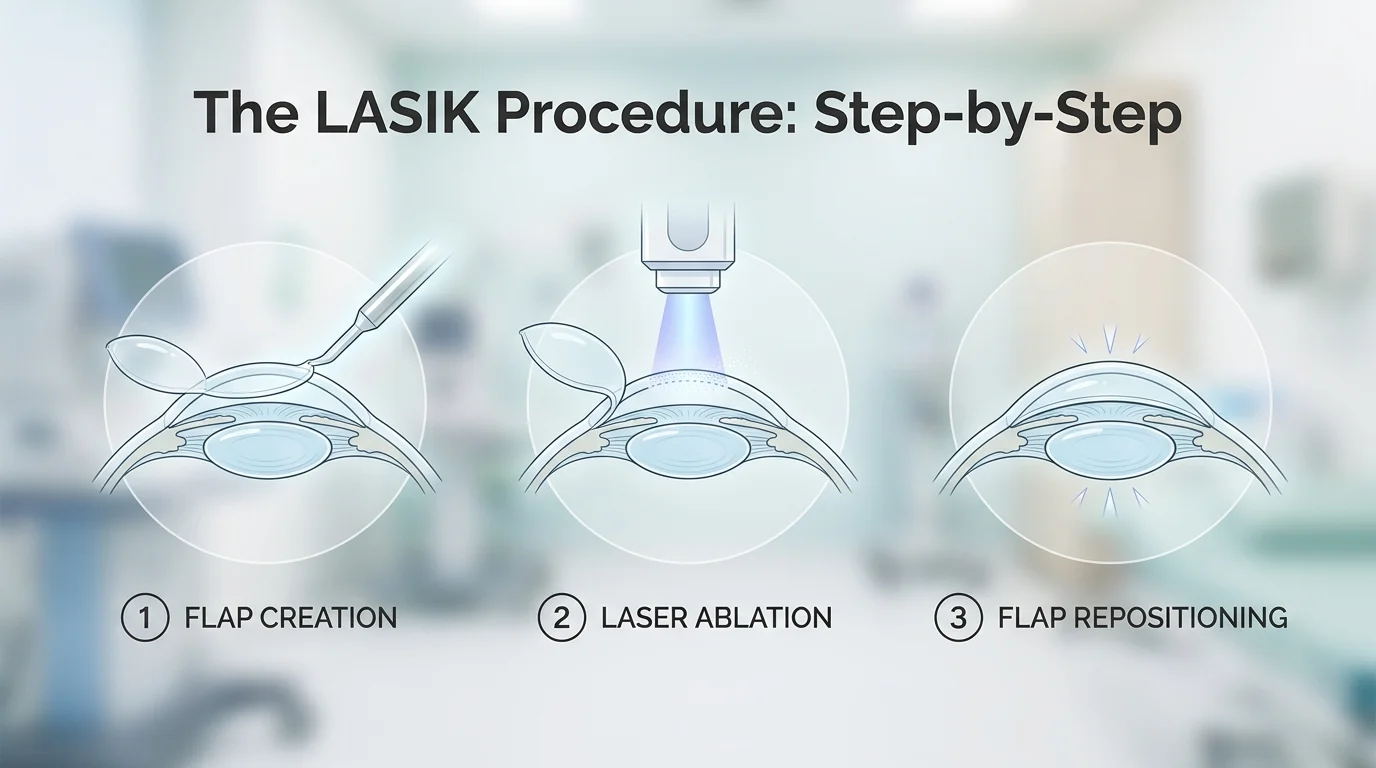
Each stage in the sequence above maps directly to what you’ll see in most procedure walkthroughs.
Reading that sequence and watching it are different experiences. If you haven’t already, Mayo Clinic’s own patient video and the walkthroughs published by major LASIK providers cover this same five-stage sequence in real time, which is worth watching once before your consultation.
What Can You Expect During Your LASIK Appointment?
You’ll arrive with dilated pupils already assessed at your pre-op consultation, so the surgery-day visit is largely procedural. Numbing drops go in first, followed by a brief wait for them to take effect.
The laser portion, as covered above, lasts under a minute per eye. Most clinics keep patients for 15 to 30 minutes of observation afterward, checking that the flap has settled and vision is tracking as expected before discharge.
You won’t be able to drive yourself home — corneal flap swelling and light sensitivity make this a same-day companion requirement, not an optional precaution. Sunglasses and a follow-up appointment for the next morning are standard.
How Long Is LASIK Recovery, and When Will Your Vision Stabilize?
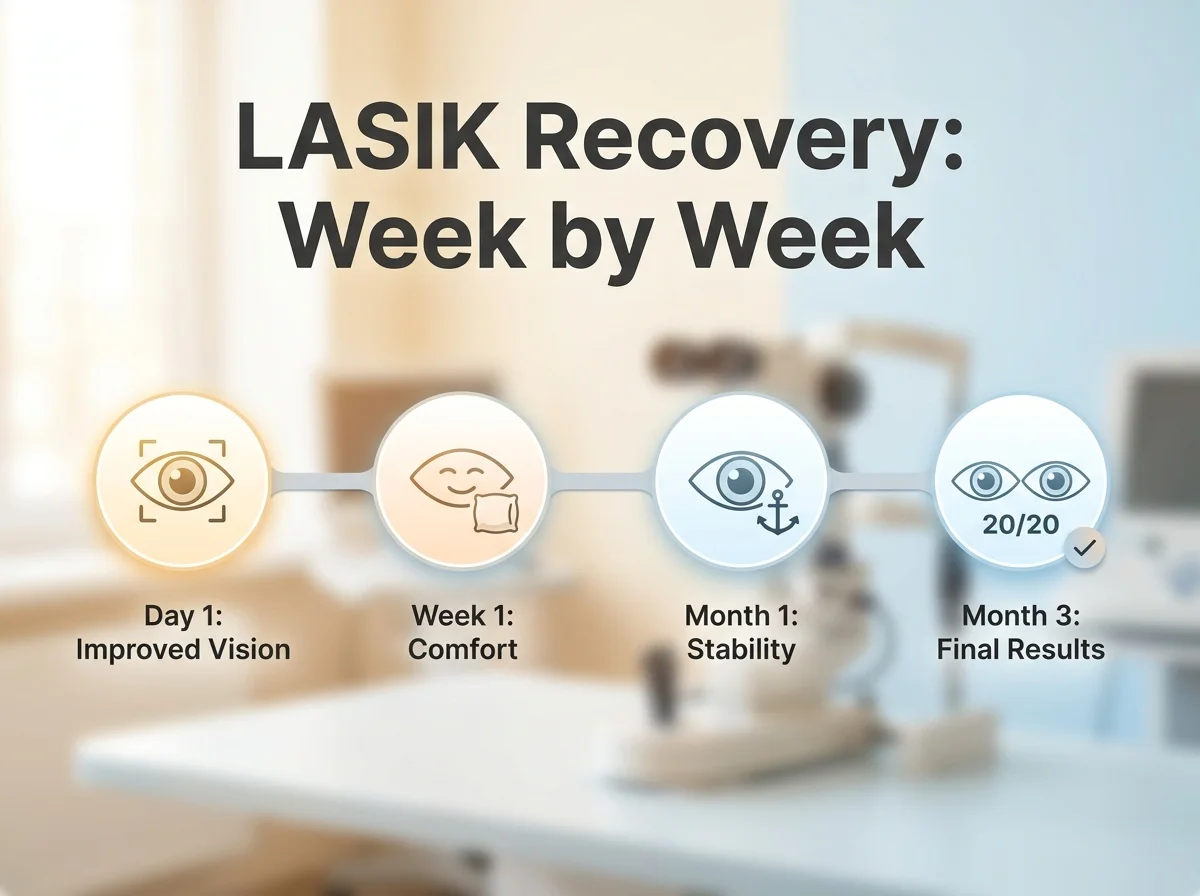
Most LASIK patients notice meaningfully improved vision within 24 hours, reach comfortable day-to-day function within a week, and hit full visual stability somewhere between one and three months as corneal healing completes. The early improvement is dramatic; the final stretch is about fine-tuning.
- Day 1: Vision is noticeably sharper, though slightly hazy or glare-prone, especially at night.
- Week 1: Most patients return to normal daily activities, screens included, though eye strain is still common.
- Month 1: Vision typically stabilizes to within a small margin of the final result; dry eye symptoms usually continue to improve.
- Month 3: Corneal healing is generally complete, and the refractive result is considered final.
Because the flap heals without sutures, strenuous activity, swimming, and eye rubbing are restricted for the first few weeks — a rule patients sometimes underestimate. For a fuller picture of what structured post-operative care looks like across eye procedures generally, the same principles of protecting the healing surface and attending scheduled reviews apply to LASIK as much as they do to cataract surgery.
Is LASIK Safe? What Are the Risks and Side Effects?
LASIK carries a 96% success rate for achieving target vision within ±0.5 diopter, and serious complications are rare when performed by an experienced surgeon on a well-selected candidate — the more common side effects are temporary dry eye, glare, and halos around lights. These usually resolve within the first few months as the cornea finishes healing.
Less common but recognised risks include under- or over-correction requiring a touch-up procedure, flap complications, and persistent dry eye in a small percentage of patients. Night-vision disturbances are the side effect patients report most, and they tend to fade as neural adaptation catches up with the eye’s new optical shape.
Reality check: No refractive procedure is risk-free, and any clinic promising a guaranteed outcome should raise questions. What a reputable programme can promise is a thorough pre-op screening designed to identify who is, and isn’t, a good candidate before surgery ever happens.
LASIK is not interchangeable with every refractive technique. Patients with thinner corneas are sometimes better suited to PRK than LASIK, since PRK doesn’t require a corneal flap — a distinction worth discussing at consultation rather than assuming.
Who Is a Good Candidate for LASIK Eye Surgery?
Good candidates are over 18, have had a stable eyeglass or contact lens prescription for at least a year, and have corneas thick enough to safely support flap creation. A comprehensive pre-op assessment — corneal topography, pupil measurement, tear film evaluation — determines eligibility far more reliably than age or prescription strength alone.
Pregnancy, certain autoimmune conditions, uncontrolled diabetes, and unusually thin or irregular corneas are common reasons a surgeon might recommend an alternative procedure or a delay. This is exactly the kind of judgment call that belongs in a proper consultation, not a self-assessment based on an online quiz.
How Does LASIK Cost Compare Between UK Private Clinics and KCM Clinic?
UK private LASIK typically runs £2,500–£4,000 per eye, and that figure is usually just the surgery — pre-op consultation, follow-up appointments, and any touch-up procedure are frequently billed separately. KCM Clinic structures its LASIK programme differently: pre-op consultation, the surgery itself, hospital stay, post-operative physiotherapy, aftercare coordination, and international patient transfers are bundled into a single package rather than itemised as they proceed.
By the numbers: À la carte UK pricing means patients often don’t know their total cost until aftercare is complete. An all-inclusive structure fixes that number before you travel.
| Typical UK Private Clinic | KCM Clinic (All-Inclusive) | |
|---|---|---|
| Surgery | Billed separately | Included |
| Pre-op consultation | Often billed separately | Included |
| Hospital stay | N/A (day case) | Included where applicable |
| Post-op physiotherapy | Rarely offered | Included |
| Aftercare coordination | Patient self-manages | Dedicated coordination |
| International transfers | Not applicable | Included for overseas patients |
| Regulatory standard | UK/CQC | EU — same framework as Germany |
The comparison matters most for patients weighing NHS waiting times against private cost. Elective surgery waits on the NHS commonly extend well into the second year, which is the exact gap that pushes UK self-funders toward private options in the first place — whether that’s domestic or abroad.
Why Do UK and Canadian Patients Choose KCM Clinic for LASIK Eye Surgery?
Recovery doesn’t end at the laser — it’s the follow-up structure that determines how smoothly the weeks after surgery go.
KCM Clinic is a private multidisciplinary hospital in Jelenia Góra, Poland, operating under EU regulatory standards — the same framework that governs surgical care in Germany, France, and Sweden. For UK and Canadian patients frustrated by NHS and provincial wait lists, that regulatory parity is what makes travelling for surgery a reasonable decision rather than a risky one.
The all-inclusive model covers the full episode of care: pre-op assessment, surgery, hospital stay, physiotherapy, aftercare coordination, and transfers for international patients, all arranged by a dedicated international patient team working in English. It’s the same structure that underpins KCM’s broader approach to cosmetic and elective surgery for international patients — the surgery itself is only one part of what a patient is actually booking.
Refractive correction sits alongside a wider set of eye procedures international patients travel for, including laser eye surgery for cataract co-management in patients who need both corrected. Coordinated aftercare across procedures — rather than a single isolated appointment — is what most self-funding patients say they were missing from domestic private options.
Arrange a LASIK Consultation at KCM Clinic
If you’ve watched the videos and understand the procedure, the next step is a proper pre-op assessment to confirm candidacy and give you a fixed, all-inclusive price. Speak to KCM Clinic’s international patient team about scheduling a LASIK consultation.
Arrange a LASIK consultation at KCM Clinic
Frequently Asked Questions About LASIK Eye Surgery
How painful is LASIK eye surgery?
LASIK itself isn’t painful — numbing drops eliminate sensation during the laser stages. Most patients describe pressure or mild discomfort rather than pain, and any soreness typically appears a few hours later as the anaesthetic wears off, resolving within a day or two.
What do your eyes look like immediately after LASIK?
Eyes are often slightly red, watery, and light-sensitive for the first few hours, with vision noticeably clearer but not yet sharp. Mild haziness or glare, especially around lights at night, is common in the first 24 to 48 hours and improves steadily.
How long does the LASIK laser itself take?
The full appointment takes 15 to 30 minutes including preparation and observation, but the laser is only active for under a minute per eye. Most of the appointment time goes to numbing, positioning, and post-procedure checks, not the laser itself.
Is LASIK or PRK better if I have thin corneas?
PRK is often preferred over LASIK for thinner corneas because it doesn’t require cutting a corneal flap, removing one variable from the safety calculation. A surgeon determines this during pre-op corneal topography — it isn’t something to assume beforehand.
What happens to your eyes years after LASIK?
Most patients retain their corrected vision long-term, though natural age-related changes like presbyopia still occur regardless of LASIK. A small percentage experience gradual regression and may need a touch-up procedure years later, which is discussed at your original consultation.
Does KCM Clinic offer all-inclusive LASIK packages for international patients?
Yes — KCM Clinic bundles pre-op consultation, surgery, hospital stay, post-operative physiotherapy, aftercare coordination, and international transfers into a single package. This differs from typical UK private clinics, which usually itemise these costs separately.