


Recovery from Spine Surgery: A Week-by-Week Guide to What Happens Next
The first question almost every spine surgery patient asks isn’t about the operation itself — it’s what happens the moment they wake up. That gap is where most recovery guides fall short: generic timelines with no sense of who is actually watching over the first hours and weeks.
Key Takeaways
- Most spine surgery patients begin walking within 24–48 hours after discharge, signalling safe mobilisation and reduced DVT risk.
- Full recovery from spine surgery spans 6–12 weeks for a return to most daily activities; heavy lifting, contact sports, and high-impact exercise need 3–6 months.
- Multi-disciplinary support — neurologist, physiotherapist, and pain specialist working together — accelerates healing and lowers complication rates.
- Daily physiotherapy from as early as day 3 post-op is critical for regaining strength and mobility; outpatient sessions typically continue for 8–12 weeks.
- Complications such as nerve irritation, temporary weakness, or infection are managed through active monitoring and early intervention, not prolonged bed rest.
Contents
- What Happens Immediately After Spine Surgery?
- How Long Does Recovery from Spine Surgery Take?
- What Does Physical Therapy Involve After Spine Surgery?
- What Complications Should You Watch For After Spine Surgery?
- How Is Pain Managed During Recovery from Spine Surgery?
- What Role Does a Specialist Play in Spine Surgery Recovery?
- When Can You Return to Normal Activities After Spine Surgery?
- Can You Work While Recovering from Spine Surgery?
Recovery also depends heavily on which procedure was performed. A patient recovering from a straightforward microdiscectomy follows a different curve to someone recovering from multi-level fusion. If you’re still weighing which procedure fits your diagnosis, our guide to slipped disk treatment options, from conservative care to endoscopic surgery covers that decision in full before you reach the recovery stage covered here.
What Happens Immediately After Spine Surgery?
In the first hours after spine surgery, you’re moved to a recovery room where vital signs, wound status, and neurological function are checked at short, regular intervals. Most patients are helped to sit up and take a few supported steps within 24 hours — early movement is encouraged specifically because it reduces the risk of blood clots and chest infections, not despite the surgery you’ve just had.
By day one, pain is managed with a structured medication schedule rather than “as needed” dosing, which keeps discomfort predictable enough to allow movement. Nursing and neurological reviews continue daily, checking wound healing, leg strength, and sensation against your pre-operative baseline.
Day three is typically when supervised physiotherapy begins in earnest — not gentle stretching, but controlled, assessed mobilisation with a physiotherapist present throughout.
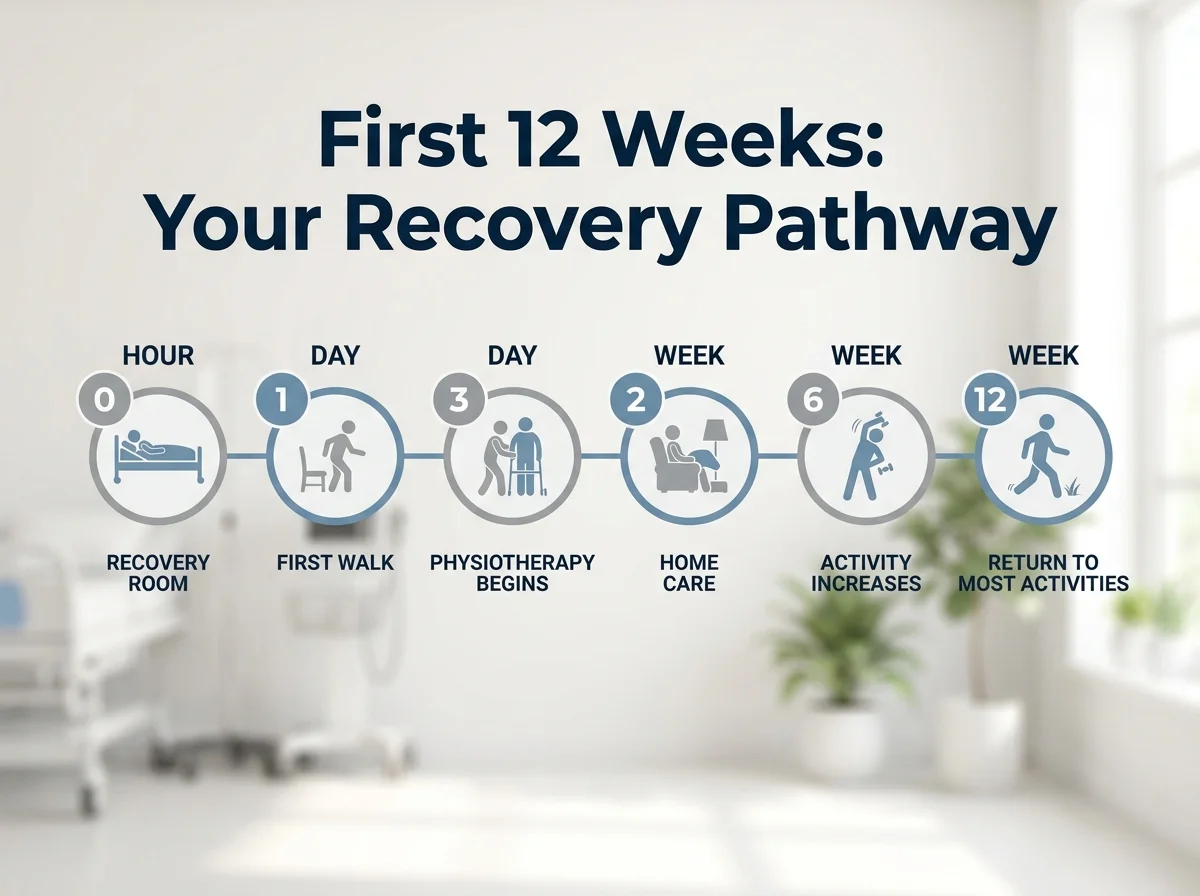
Worth knowing: Discharge isn’t based on the calendar. Most protocols require you to demonstrate unaided walking over a set distance — commonly around two kilometres — before you’re cleared to leave hospital.
How Long Does Recovery from Spine Surgery Take?
Recovery from spine surgery typically takes 6 to 12 weeks for a return to most daily activities, though the exact timeline depends on which procedure you had. Minimally invasive discectomies recover fastest; multi-level fusions take considerably longer because bone needs time to fuse, not just soft tissue to heal.
The table below reflects typical ranges reported across UK, US, and European post-operative guidance for the three most common procedure types.
| Procedure | Hospital Stay | First Assisted Walk | Light Daily Activity | Full Recovery |
|---|---|---|---|---|
| Endoscopic / microdiscectomy | Day case–1 night | Within hours | 1–2 weeks | 4–6 weeks |
| Laminectomy | 1–2 nights | Day 1 | 2–4 weeks | 6–8 weeks |
| Spinal fusion (1–2 level) | 2–3 nights | Day 1–2 | 4–6 weeks | 3–6 months |
Laminectomy recovery sits in the middle of that range: most patients manage light housework by week two to four, with fuller function returning by week six to eight. Fusion is the outlier, since the spine needs months, not weeks, to stabilise fully — driving and lifting restrictions are usually longer as a result.
What Does Physical Therapy Involve After Spine Surgery?
Physical therapy after spine surgery starts with short, supervised walks and progresses through core-stabilisation exercises, posture retraining, and graded strength work over 8 to 12 weeks. Nothing is left to guesswork — every stage is assessed before the next one begins.
A typical progression looks like this:
- Days 1–7: assisted walking, breathing exercises, and gentle range-of-motion work under direct supervision
- Weeks 2–4: core-stabilisation exercises and posture correction, still closely monitored
- Weeks 4–8: progressive strengthening, balance work, and light functional tasks (stairs, light chores)
- Weeks 8–12: return-to-activity conditioning, tailored to your job or sport
Skipping stages is the single most common cause of setbacks. A physiotherapist who hasn’t seen your operative notes can’t safely judge when to progress you — which is why continuity between surgeon, physiotherapist, and patient matters more than any individual exercise.
What Complications Should You Watch For After Spine Surgery?
The complications to watch for after spine surgery are nerve irritation, temporary leg weakness, wound infection, and deep vein thrombosis (DVT) — all of which are manageable when caught early through active monitoring rather than left to resolve on their own. None of these are common, but all are worth knowing the warning signs for.
Red flags that warrant same-day medical review include:
- New or worsening numbness, tingling, or weakness in the legs
- Fever, or redness and discharge around the wound
- Calf swelling or pain, particularly on one side
- Loss of bladder or bowel control (a genuine emergency)
If you have osteoporosis, your surgical team will typically adjust your post-operative protocol — reduced early loading and a longer stabilisation phase protect healing bone. Our guide on osteoporosis diagnosis and treatment explains how bone health interacts with spinal stability in more detail.
Reality check: Most “complications” flagged in recovery are actually expected healing symptoms — mild swelling, transient numbness, fatigue — not the emergencies patients fear. Daily specialist review exists precisely to tell the two apart.
How Is Pain Managed During Recovery from Spine Surgery?

Pain after spine surgery is managed through a structured medication schedule combined with early, supervised movement, rather than the extended bed rest older recovery advice still recommends. Movement itself reduces stiffness-related pain, which is why physiotherapy starts within days, not weeks.
At KCM Clinic, this looks specific rather than generic: a neurologist reviews every spine surgery patient daily from day one, monitoring for DVT, nerve irritation, and infection before symptoms become obvious on their own. On-site physiotherapy begins from day three under direct supervision, and discharge isn’t scheduled by the calendar — it requires demonstrating unaided ambulation over roughly two kilometres, confirming you’re genuinely ready to continue recovery at home.
That combination — a specialist watching the neurological picture while a physiotherapist manages the physical one — is what separates “follow up with your GP” advice from active, monitored recovery.
What Role Does a Specialist Play in Spine Surgery Recovery?
A specialist’s role in spine surgery recovery is to catch the small, early warning signs — a change in reflexes, a slightly slower gait, a subtle drop in sensation — that a patient or a general practitioner might not recognise as significant. This is the difference between reactive care and preventive care.
Multi-disciplinary post-operative teams typically include:
- A neurosurgeon who reviews imaging and surgical outcomes against the recovery plan
- A neurologist conducting daily reviews in the first week
- A physiotherapist managing graded mobilisation
- A pain specialist adjusting medication as movement increases
The same logic applies across major orthopaedic surgery, not just spine procedures. Our guide to knee replacement surgery recovery covers a strikingly similar model — early mobilisation, supervised physiotherapy, and specialist monitoring — if you’re weighing recovery from joint surgery alongside spine surgery.
When Can You Return to Normal Activities After Spine Surgery?
Most patients return to light daily activities — walking, light housework, short car journeys — within 2 to 4 weeks, with fuller activity resuming by weeks 6 to 12 depending on procedure type. Driving is usually cleared once you can perform an emergency stop without hesitation and are off strong opioid painkillers, typically around 2 to 4 weeks.
Heavy lifting, contact sports, and high-impact exercise are the last things to return, generally not before 3 to 6 months. Bending and twisting under load — the exact motions that caused many patients’ original disc problems — need the longest, most cautious reintroduction of all.
Common mistake: Feeling good at week four isn’t the same as being structurally healed. Fusion sites in particular can feel pain-free long before the bone has fully consolidated.
Can You Work While Recovering from Spine Surgery?
Returning to work after spine surgery is realistic within 2 to 6 weeks for desk-based roles and 8 to 12 weeks for physically demanding jobs, though your surgeon’s clearance should always take priority over a generic timeline. A phased return — reduced hours, then full duties — tends to produce better outcomes than an abrupt switch back to a full workload.

For UK and Canadian patients weighing surgery abroad, the practical question is usually simpler: how much time do I need to build into travel and aftercare before resuming work at home? A well-run recovery protocol front-loads the intensive monitoring — daily neurological review, early physiotherapy — into the first two weeks specifically so patients can travel home with a clear, documented plan rather than an open-ended “see how you feel” instruction.
Get Started with KCM Clinic
If you’re weighing spine surgery abroad, the recovery protocol matters as much as the operation itself. KCM Clinic’s multi-disciplinary approach — daily neurologist review from day one, physiotherapy from day three, and clear discharge criteria — is built specifically to give international patients a documented, monitored recovery plan before they travel home.
Learn more about KCM Clinic’s spine surgery recovery programme
Frequently Asked Questions
Can you live a normal life after back surgery?
Yes — the large majority of patients return to a full range of daily activities, including work and light exercise, within 3 months. Heavy lifting and high-impact sports typically need longer, but permanent activity restriction is uncommon after a well-managed recovery.
How long after back surgery can you drive?
Most patients are cleared to drive between 2 and 4 weeks after surgery, once they’re off strong opioid painkillers and can perform an emergency stop without pain or hesitation. Your surgeon confirms readiness at your first follow-up review.
What’s the best way to get in and out of bed after spinal surgery?
Log-rolling onto your side first, then pushing up with your arms while keeping your spine straight, protects the surgical site far better than sitting up directly. Physiotherapists teach this technique in the first day or two after surgery.
Is bed rest recommended after spine surgery?
No — modern post-operative protocols favour early, supervised movement over bed rest, since gentle mobilisation reduces stiffness, blood clot risk, and muscle deconditioning. Prolonged bed rest is now considered counterproductive to spine surgery recovery.
Does osteoporosis affect spine surgery recovery time?
Yes — patients with osteoporosis usually follow a modified protocol with reduced early loading and a longer stabilisation phase, since healing bone needs more protection during fusion. Recovery is typically slower but follows the same monitored structure.
How is laminectomy recovery different from spinal fusion recovery?
Laminectomy recovery is generally faster — light activity within 2 to 4 weeks and full recovery by 6 to 8 weeks — because no bone fusion is involved. Spinal fusion recovery takes 3 to 6 months, since the vertebrae need time to fuse solidly together.