

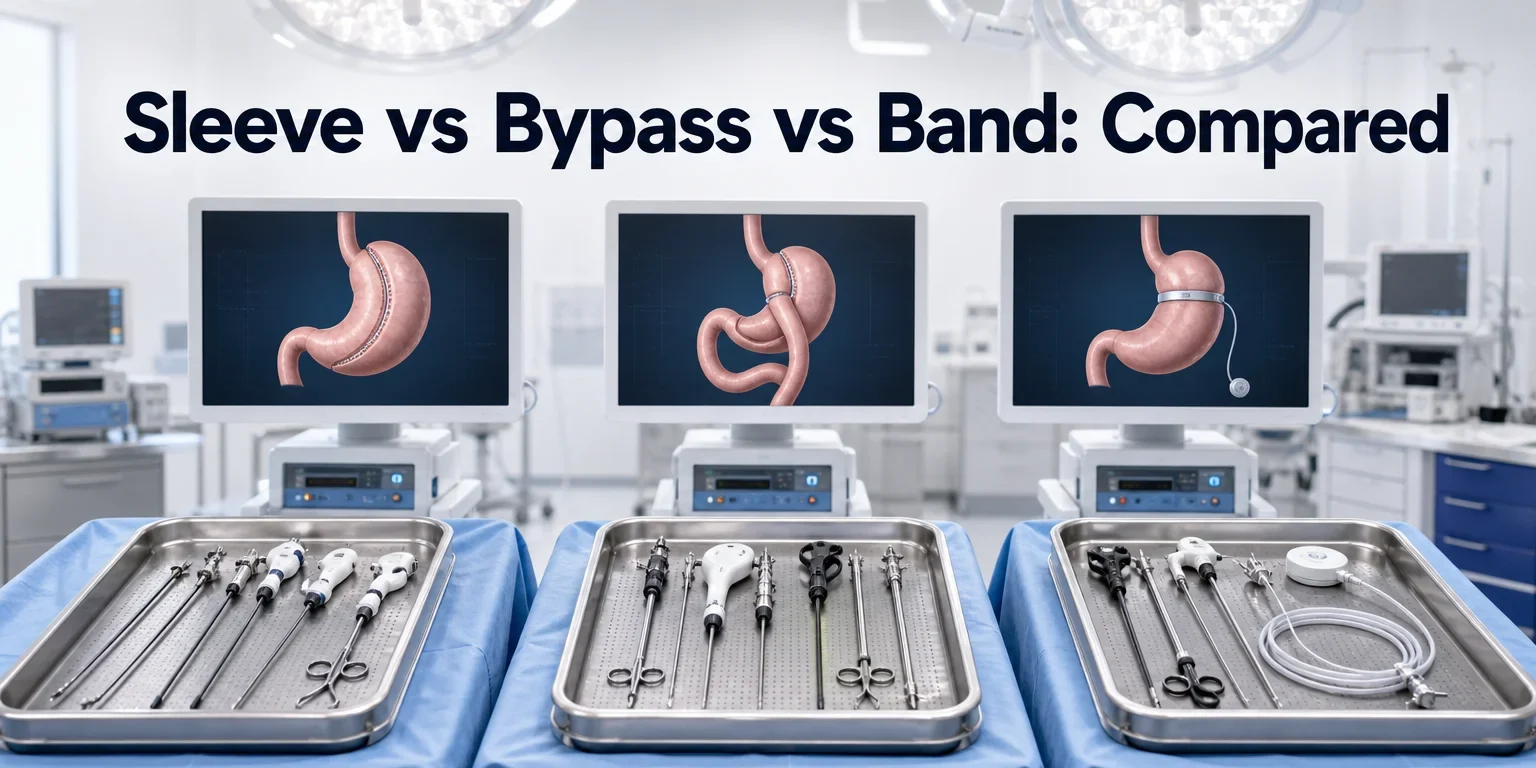
Gastric Sleeve vs Gastric Bypass vs Gastric Band: The Data Compared
In the largest randomised trials, five years after surgery, people who had a gastric bypass had lost roughly 57 to 68% of their excess weight, and people who had a sleeve roughly 49 to 61%. Gastric band results sit lower still in older pooled data. This comparison of gastric sleeve vs gastric bypass vs gastric band sets those numbers beside recovery, complications, reversibility, and cost, so you can weigh them before you speak to a surgeon.
This is physician-reviewed patient education from KCM Clinic. It is general information, not a diagnosis, and your own surgeon decides which procedure is right for you.
Key Takeaways
- A gastric sleeve removes about 75% of the stomach, a bypass reroutes the small intestine, and a gastric band is a reversible silicone ring.
- Bypass gives the highest average weight loss (65-80% of excess weight), then sleeve (50-70%), then band (40-60%).
- Sleeve and bypass patients typically return to normal activity in 2-3 weeks; band patients in 7-10 days.
- The band has the most long-term device problems; bypass and sleeve need lifelong nutritional follow-up.
- The best choice depends on your goals, medical history, and whether reversibility matters to you.
Gastric Sleeve vs Gastric Bypass vs Gastric Band: What Is the Difference?
A gastric sleeve removes about three-quarters of the stomach, leaving a narrow tube. A gastric bypass makes a small stomach pouch and connects it directly to the small intestine, skipping part of the digestive tract. A gastric band is an adjustable silicone ring placed around the upper stomach, with no stomach removed.
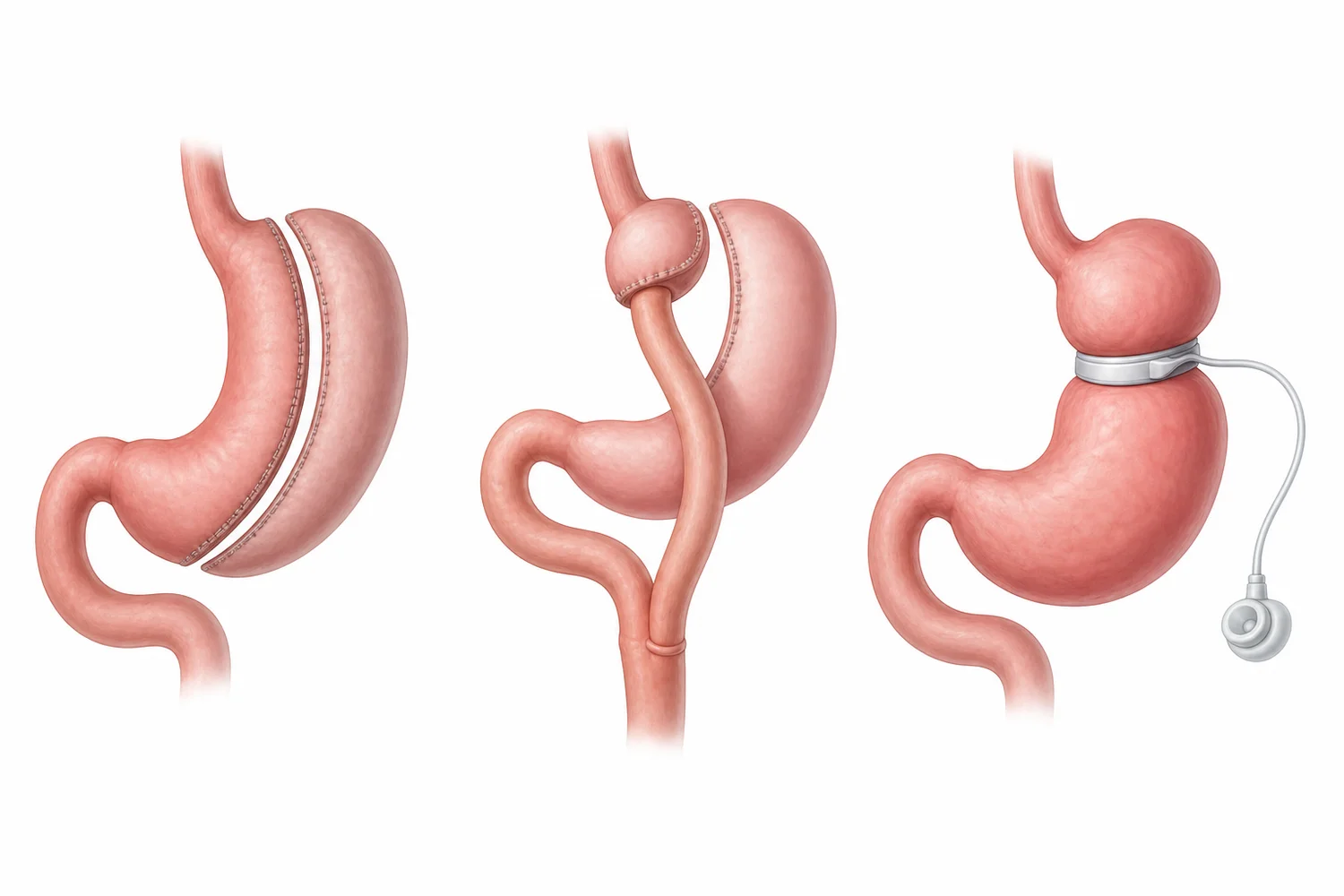
The table below puts the three side by side. Weight-loss figures are percentages of excess weight, meaning the weight above a healthy BMI, not total body weight.
| Gastric sleeve | Gastric bypass | Gastric band | |
|---|---|---|---|
| What changes | About 75% of stomach removed | Small pouch, intestine rerouted | Ring placed around upper stomach |
| Typical excess weight loss | 50-70% | 65-80% | 40-60% |
| Return to normal activity | 2-3 weeks | 2-3 weeks | 7-10 days |
| Reversible? | No | Rarely, and complex | Yes, band can be removed |
| Main long-term issue | Acid reflux in some patients | Nutrient deficiencies, ulcers | Slippage, port and band problems |
By the numbers: Bypass leads on average weight loss, but the gap between bypass and sleeve in randomised trials is smaller than the ranges above suggest.
Gastric Sleeve vs Gastric Bypass vs Gastric Band: Which Produces the Most Weight Loss?
Gastric bypass produces the most weight loss on average, followed by gastric sleeve, then gastric band. In the SM-BOSO and SLEEVEPASS randomised trials, five-year excess weight loss was about 68% and 57% after bypass versus 61% and 49% after sleeve.
A 2004 JAMA meta-analysis by Buchwald and colleagues pooled more than 22,000 patients and reported average excess weight loss of about 62% for bypass and 48% for banding. Newer evidence has shifted the picture since, because the band is now used far less often.
Averages hide a lot, though. Two people with the same operation can finish a long way apart, and the difference usually comes down to diet, activity, and how closely they keep up follow-up appointments.

Does More Weight Loss Mean a Better Outcome?
Not automatically. Bypass tends to improve type 2 diabetes more often than the sleeve, which matters if diabetes is your main driver. But it also asks more of you afterwards, with lifelong supplements and regular blood tests.
Reality check: Surgery changes how much you can eat. It does not choose what you eat, and long-term results follow habits as much as anatomy.
What Is the Recovery Time for Each Surgery Type?
Most sleeve and bypass patients are back to normal daily activity within two to three weeks of laparoscopic surgery. Gastric band patients often return within 7 to 10 days, because the operation is smaller and no stomach is cut or rerouted.
Those are typical ranges, not promises. Your own pace depends on your fitness before surgery, any other conditions, and how your surgeon staged your diet.
What the first weeks usually involve:
- A short hospital stay under surgical and nursing supervision
- A staged diet, moving from liquids to purées to soft foods to normal textures
- Gentle walking from the first days, building up gradually
- Early follow-up with the surgical team, dietitian, and psychologist
Band patients have an extra step later. The band is tightened through a port, usually over several visits, so the “fast recovery” comes with repeat appointments.
How Do Gastric Sleeve, Bypass, and Band Compare on Complications?
All three operations carry risk. Across bariatric surgery overall, the 30-day mortality rate is around 0.1%, according to the American Society for Metabolic and Bariatric Surgery. The pattern of problems differs: the band has the most device-related issues, bypass the most nutritional ones, and the sleeve sits between.
Each carries its own signature risks:
- Sleeve: staple-line leak (rare), and new or worsened acid reflux in some patients
- Bypass: marginal ulcers, dumping syndrome, internal hernia, and deficiencies of iron, vitamin B12, calcium, and vitamin D
- Band: slippage, erosion into the stomach wall, port or tube problems, and removal or conversion to another procedure
The band’s long-term record is the weakest of the three. Many long-term series report that a considerable share of bands are eventually removed or revised, which is why the NIDDK notes it is now performed far less often than the sleeve or bypass. For a bypass-specific view, see our guide on gastric bypass vs bariatric surgery.
Common mistake: Skipping supplements and blood tests after bypass or sleeve. Deficiencies build quietly, and lifelong follow-up is part of the operation, not an optional extra.
What Does Each Surgery Cost?
Gastric band usually has the lowest upfront price and bypass the highest, but upfront price is a poor guide. Repeat band adjustments, revisions, supplements, and follow-up all add cost, so ask what is included before comparing quotes.
We are not going to quote a figure here, because prices vary by hospital, surgeon, and what the package covers. A fair comparison asks what the quote actually includes: pre-operative assessment, surgery, hospital stay, dietetics, psychology, physiotherapy, and aftercare.
KCM Clinic’s bariatric packages are all-inclusive across those elements. In the UK, NHS access to bariatric surgery is guided by NICE criteria, typically a BMI of 40 or above, or 35 or above with a related condition, and waiting times for elective surgery commonly extend well beyond a year.
Can You Reverse Gastric Sleeve, Bypass, or Band Surgery?
Only the gastric band is designed to be reversed: it can be removed, and the stomach generally returns to its normal shape. A sleeve cannot be reversed because stomach tissue is permanently removed. A bypass can sometimes be revised, but reversal is complex and uncommon.
Revision is more common than reversal. A band that has failed is often removed and replaced with a sleeve or bypass, and some sleeve patients later convert to a bypass, for example for reflux or inadequate weight loss.
If reversibility matters to you, say so at your first consultation. It shapes the whole decision, and it is a fair reason to weigh the band even though its average results are lower.

Choosing the Right Surgery for Your Goals
The right surgery depends on your target weight loss, your medical history, how well you can sustain dietary change, and whether reversibility matters. Bypass suits higher BMI and diabetes or reflux. Sleeve balances results with simpler follow-up. Band suits people who prioritise reversibility.
A few questions help narrow it down:
- How much weight do you need to lose? Higher targets favour bypass or sleeve.
- Do you have reflux? Existing reflux often points away from the sleeve.
- Do you have type 2 diabetes? Bypass tends to give stronger metabolic improvement.
- Can you commit to lifelong supplements and check-ups? Bypass asks the most.
- Is reversibility important? Only the band offers it.
At KCM Clinic, a multidisciplinary team of surgeons, dietitians, psychologists, and physiotherapists assesses you before anyone recommends a procedure. We are an EU hospital in Jelenia Góra, Poland, working under the same regulatory framework as Germany or Sweden, and we use 3D laparoscopic technology. The right operation is the one that fits your biology, not the one with the biggest headline number.
If you are still comparing options, our guides on gastric band vs gastric bypass and gastric sleeve vs gastric bypass vs duodenal switch go deeper on individual trade-offs. For sleeve-specific recovery and long-term results, read our gastric sleeve surgery overview.
Get Started with KCM Clinic
If you want to discuss which procedure fits your health and goals, our international patient team can arrange a consultation in English, German, or Arabic. Your surgeon will talk through the options with you before any decision is made.
Book a Bariatric Consultation with KCM Clinic
FAQ
What is better, a gastric sleeve or a band?
Sleeve usually produces greater average weight loss and has a lower rate of device-related problems. The band is reversible and has a faster initial recovery, but it often needs repeat adjustments and is more likely to be removed or revised over time.
How long does each surgery take to recover from?
Sleeve and bypass patients typically return to normal activity in two to three weeks. Band patients often manage it in 7 to 10 days. Individual recovery depends on your health, fitness, and your surgeon’s guidance.
Which weight loss surgery is the safest?
All three have low serious-complication rates in experienced hands, with overall 30-day mortality around 0.1%. The band has fewer early surgical risks but more long-term device problems. Your own safety profile depends on your health, so discuss it with your surgeon.
What is KCM Clinic’s approach to choosing a procedure?
We assess you through a multidisciplinary team, including surgeons, dietitians, psychologists, and physiotherapists, before recommending anything. The aim is to match the operation to your medical history, goals, and ability to maintain long-term habits, not to promote one procedure.
Is bariatric surgery covered by the NHS?
NHS access follows NICE criteria, typically a BMI of 40 or above, or 35 or above with a weight-related condition, and eligibility is assessed locally. Waiting times can be long. Many UK patients therefore consider private treatment, including in the EU.