

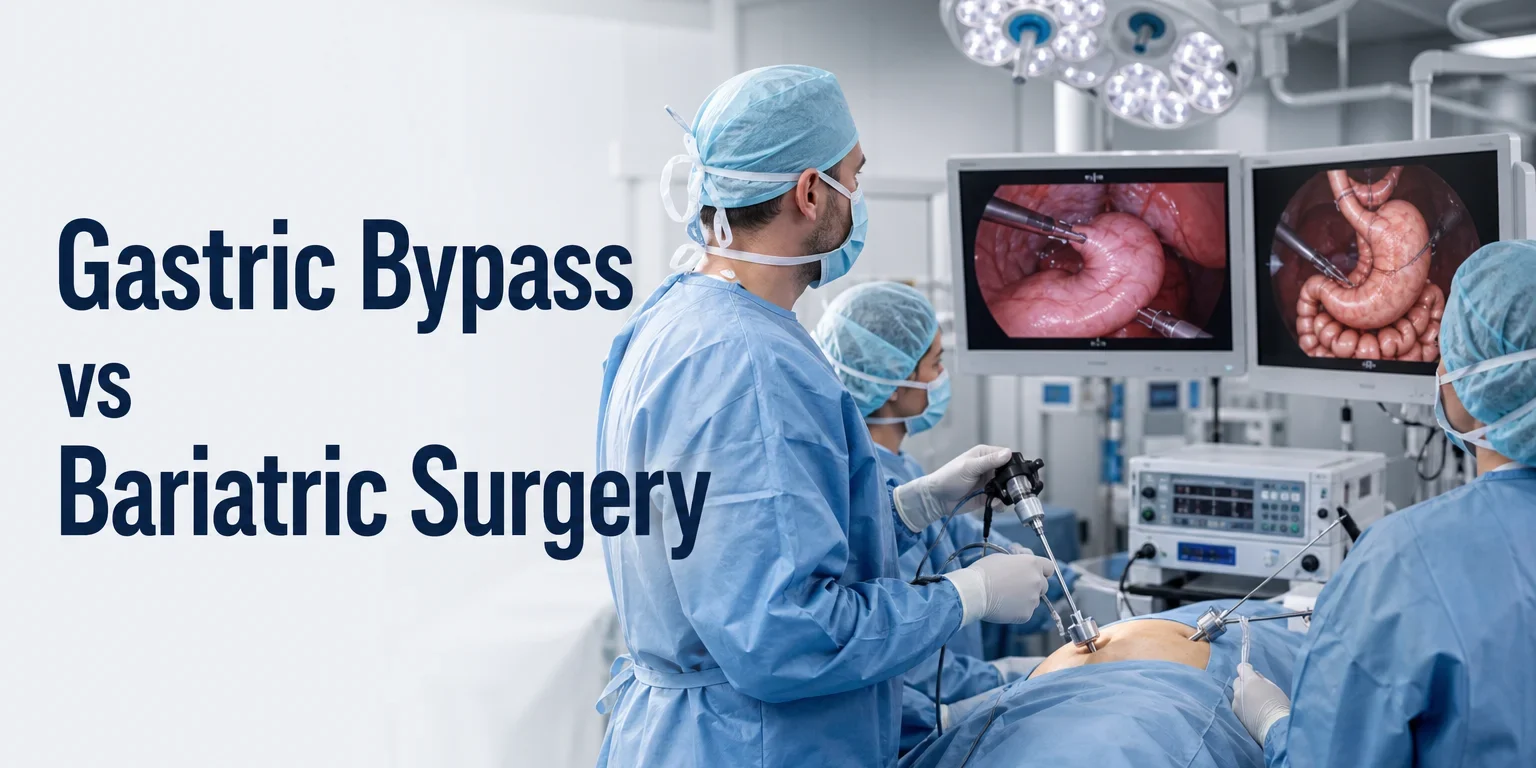
Gastric Bypass vs Bariatric Surgery: What Is the Difference?
Someone has told you gastric bypass might suit you, and now every search brings up a different word: sleeve, band, duodenal switch, bariatric. Gastric bypass vs bariatric surgery is not really a contest, because bypass is one of several bariatric operations. This guide explains where it sits, how it compares, and what to ask before you decide.
This is physician-reviewed patient education from KCM Clinic. It is general information, not a diagnosis, and your own surgeon decides which procedure is right for you.
Key Takeaways
- Bariatric surgery is the umbrella term for weight-loss operations. Gastric bypass is one of them, alongside gastric sleeve, gastric band, and duodenal switch.
- Gastric bypass makes a small stomach pouch and reroutes the small intestine, so you eat less and absorb fewer nutrients.
- Published studies commonly report greater average weight loss after bypass than after a sleeve, but it demands stricter lifelong supplements and follow-up.
- Results depend on your BMI, medical history, and commitment to long-term dietary and lifestyle change.
- KCM Clinic’s all-inclusive bariatric packages cover consultation, surgery, hospital stay, dietetics, psychology, physiotherapy, and aftercare.
Contents
- What Is Bariatric Surgery, and How Does Gastric Bypass Fit In?
- Gastric Bypass vs Bariatric Surgery: What Is the Difference?
- Gastric Bypass vs Bariatric Alternatives: How Effective Is Each?
- Is Gastric Bypass the Right Choice for Your Weight-Loss Goals?
- What Are the Long-Term Results of Gastric Bypass vs Other Bariatric Surgery?
- How Much Does Gastric Bypass Cost, and What Is Included?
- Why Choose KCM Clinic for Bariatric Surgery?
- FAQ
What Is Bariatric Surgery, and How Does Gastric Bypass Fit In?
Bariatric surgery is the name for operations that help people with obesity lose weight by changing the stomach, the intestine, or both. Gastric bypass is one type. It creates a small stomach pouch and connects it to a lower section of the small intestine, skipping the rest.
Surgeons usually describe bariatric operations by how they work. Some restrict how much you can eat. Others also reduce how many nutrients you absorb, and most change gut hormones that govern hunger and blood sugar.
The four operations you will meet most often are:
- Gastric bypass (Roux-en-Y): small pouch plus rerouted intestine.
- Gastric sleeve: about three-quarters of the stomach removed, leaving a narrow tube.
- Gastric band: an adjustable ring placed around the upper stomach.
- Duodenal switch: a sleeve combined with a long intestinal bypass.
Bypass has been performed for decades and is among the most thoroughly studied. That track record is one reason surgeons often recommend it for people with reflux or type 2 diabetes.
Gastric Bypass vs Bariatric Surgery: What Is the Difference?
Gastric bypass differs from other bariatric operations in how much it changes your anatomy. A sleeve only shrinks the stomach, a band squeezes it from outside, while bypass shrinks the stomach and reroutes the intestine. That makes bypass restrictive and partly malabsorptive.
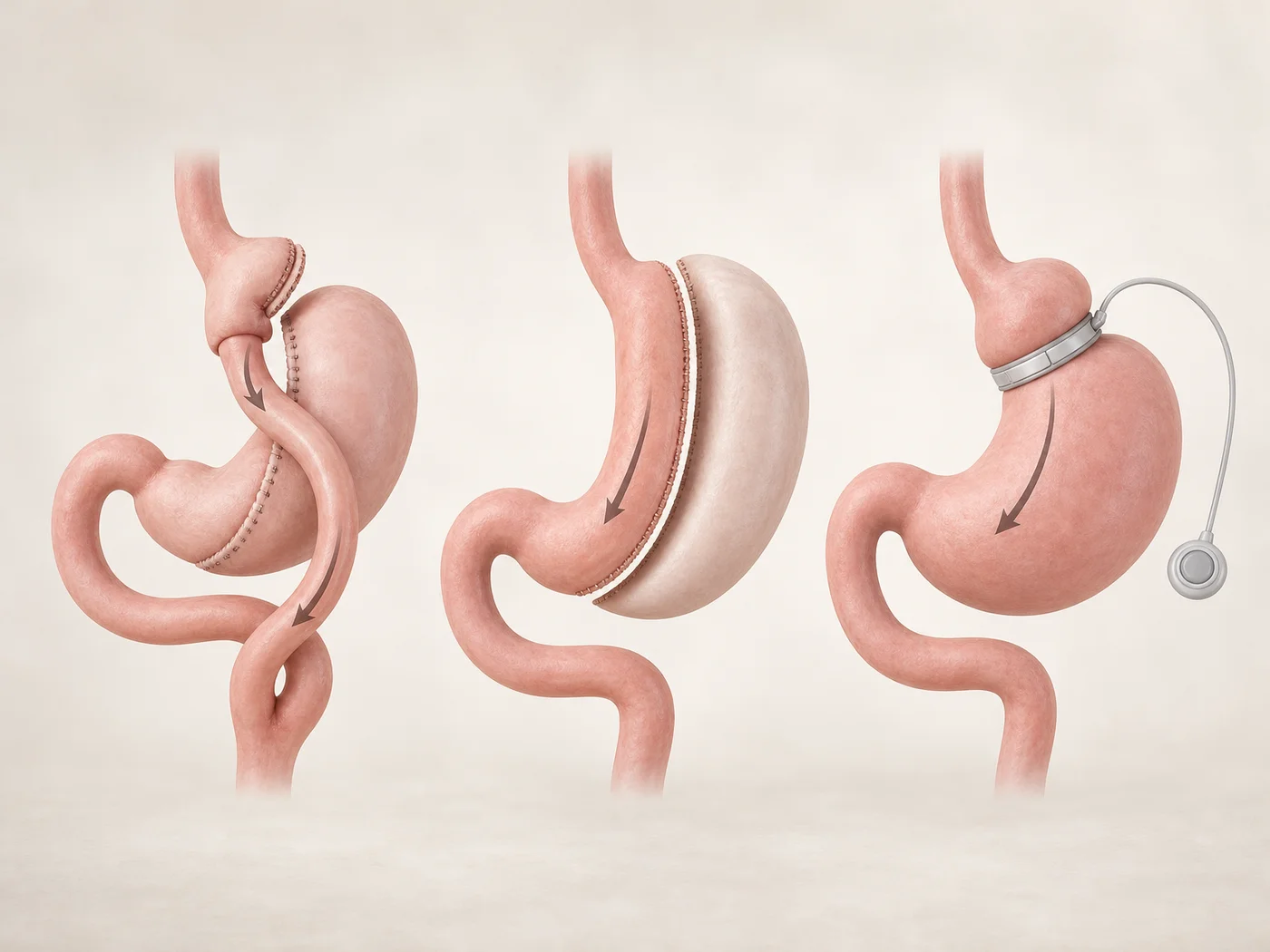
The table below sets the main options side by side. Ranges are broad literature averages for orientation only, not predictions for any individual.
| Gastric bypass | Gastric sleeve | Gastric band | |
|---|---|---|---|
| What changes | Small pouch plus rerouted gut | Stomach reduced to a tube | Ring around upper stomach |
| Main mechanism | Restriction, reduced absorption, hormonal change | Restriction, hormonal change | Restriction only |
| Stomach removed? | No | Yes, permanently | No |
| Typical excess-weight loss | ~60-80% | ~50-70% | Generally lower and slower |
| Nutritional risk | Moderate; lifelong supplements | Lower | Lowest |
| Reflux | Often improves | Can worsen | Variable |
The band has fallen out of favour in many countries because of slippage, port problems, and weaker long-term results. If you are weighing it, our comparison of gastric band vs gastric bypass sets out the trade-offs in detail.
The short version: the more an operation reroutes your gut, the more weight it tends to remove, and the more lifelong monitoring it asks of you.
For the three-way picture that includes the duodenal switch, see gastric sleeve vs gastric bypass vs duodenal switch.
Gastric Bypass vs Bariatric Alternatives: How Effective Is Each?
Studies commonly report average excess-weight loss of about 60-80% after gastric bypass and 50-70% after a gastric sleeve. Bypass often produces slightly faster early loss, but the gap narrows with time. Individual results vary widely and regain can occur after any operation.
Excess weight means the kilograms above a weight your surgeon considers healthy for your height, not your total body weight. If your healthy weight would be 70 kg and you weigh 130 kg, your excess is 60 kg, and 70% excess-weight loss would be roughly 42 kg.
Two factors move those numbers more than the choice of operation. One is how closely you follow dietary guidance. The other is whether you keep attending follow-up appointments for years.
Bypass tends to do more for type 2 diabetes and reflux than a sleeve does. That is a medical reason to choose it, not a cosmetic one.
Reality check: the procedure with the larger average is not automatically the better one for you. The best operation is the one your health can tolerate and your habits can sustain.
Is Gastric Bypass the Right Choice for Your Weight-Loss Goals?
Gastric bypass may suit you if you have a high BMI, type 2 diabetes, or reflux, and you can commit to lifelong supplements and check-ups. It may suit you less if you cannot maintain follow-up or have conditions that make rerouting the gut risky. Your surgeon decides after assessment.
Before recommending anything, a bariatric team weighs several things:
- BMI and weight history. A higher BMI often points towards bypass over a sleeve.
- Reflux (GORD). Existing reflux is a common reason to avoid a sleeve.
- Type 2 diabetes. Bypass tends to have a stronger effect on blood sugar.
- Previous abdominal surgery. Scar tissue can change what is technically safe.
- Ability to commit. Vitamin B12, iron, calcium, and multivitamin supplements are lifelong after bypass.
Many people ask whether injections could come first. Our guide to GLP-1 vs bariatric surgery explains where drugs make sense, where they stall, and when surgery becomes the more realistic option.
KCM Clinic also offers the Allurion Programme, a swallowable gastric balloon, as a non-surgical step for people who are not ready for an operation. Your consultation will cover whether that route is worth considering at all.
What Do Patients Worry About Most?
Patient forums are full of the same questions: how painful recovery is, whether hair thins, whether loose skin follows, and whether you can ever eat normally again. These are fair concerns, and a good clinic answers them before you book rather than after.
Hair thinning and loose skin are well-documented after rapid weight loss of any kind. Your dietitian can reduce the nutritional causes, but nobody should promise you that they will not happen.
What Are the Long-Term Results of Gastric Bypass vs Other Bariatric Surgery?
Over five to ten years, gastric bypass generally maintains substantial weight loss, with some regain common. Sleeve results are similar early on but regain and reflux appear more often over time. Bypass patients face vitamin deficiencies and internal hernias, so lifelong follow-up matters.

Recovery comes in stages. Many people return to desk work within a few weeks, and surgeons commonly quote around four to six weeks before resuming full normal activity. Food progresses from liquids to purées to soft textures to normal meals on a timetable your dietitian sets.
Weight loss then continues for a year or two. After that, the work shifts from losing weight to keeping it off.
What this means for you: the operation is the start of a long relationship with your care team, not a one-off event. Choose a provider whose aftercare you trust.
For what the research shows at five and ten years, read our deep dive on the long-term effect of gastric bypass.
How Much Does Gastric Bypass Cost, and What Is Included?
The cost of gastric bypass depends on the hospital, the surgeon, the country, and above all what the price covers. Comparing quotes only works if you know whether consultation, hospital stay, dietetics, psychology, physiotherapy, and aftercare are included or billed separately.
We do not publish a figure in this article, because a number without a clear itinerary would mislead you. KCM Clinic’s pricing is set out on its website and confirmed by the patient team after your records are reviewed.
What matters more than the headline figure is the list of what sits behind it. At KCM Clinic, bariatric packages are all-inclusive:
- Pre-operative consultation and assessment
- The surgical procedure itself
- Hospital stay
- Dietetics counselling
- Psychological support
- Physiotherapy
- Ongoing aftercare, plus transfers
Fragmented pricing is where unexpected costs usually appear. Ask every provider, in writing, what happens and who pays if you need a follow-up appointment or a complication is treated.

Why Choose KCM Clinic for Bariatric Surgery?
KCM Clinic is a private, multidisciplinary hospital in Jelenia Góra, Poland, which began as an obesity-treatment clinic. As an EU member state, Poland works under the same regulations as Germany and France, and the clinic offers all-inclusive bariatric packages with one coordinated team.
Operations use 3D laparoscopic technology, which remains uncommon in Europe. Because KCM performs more than one bariatric operation, your history guides the recommendation rather than a single flagship procedure.
An international patient team coordinates care in English, German, and Arabic, so you are not managing logistics alone. The clinic received the BookingsMed 2024 Excellence in International Patient Service award. Timelines can be short: one patient testimonial describes a Thursday consultation, Saturday surgery, and Monday discharge.
Worth knowing: KCM is an elective hospital. It does not provide emergency care, so every case begins with a proper assessment of whether surgery is appropriate for you.
Specific eligibility criteria are set by the surgeon, which is why we do not give a single BMI cut-off here.
Get Started with KCM Clinic
If you are comparing gastric bypass with other bariatric options, a consultation with the bariatric team turns general information into a recommendation for your own body. Bring your medical history and your questions.
Book a Bariatric Consultation with KCM Clinic
FAQ
Is gastric bypass the same as bariatric surgery?
No. Bariatric surgery is the broad category of weight-loss operations. Gastric bypass is one specific procedure within it, alongside gastric sleeve, gastric band, and duodenal switch. Each works differently, so the right choice depends on your health and goals.
Which is better, gastric bypass or gastric sleeve?
Neither is better for everyone. Bypass often suits people with reflux, type 2 diabetes, or higher BMI, while a sleeve is simpler with lower nutritional risk. Your surgeon recommends one after assessing your history, weight, and ability to attend follow-up.
How long does recovery from gastric bypass take?
Recovery is gradual. Many people return to desk work within a few weeks, and surgeons commonly quote around four to six weeks before normal activity resumes. Diet progresses from liquids to normal textures over several weeks, and your surgical team clears you for travel.
Is gastric bypass reversible?
In theory, yes, because the stomach is not removed. In practice, reversal is a complex operation that is rarely performed. A sleeve cannot be reversed at all, so any bariatric operation should be considered a long-term commitment.
What are the main risks of gastric bypass?
As a major abdominal operation, it carries risks of bleeding, infection, blood clots, and leaks along staple lines. Longer term, patients can develop vitamin and mineral deficiencies or internal hernias. Lifelong supplements and regular blood tests reduce these risks.
What is included in KCM Clinic’s bariatric package?
Packages include pre-operative consultation, the surgery, hospital stay, dietetics counselling, psychological support, physiotherapy, and ongoing aftercare, plus transfers. An international patient team coordinates everything in English, German, or Arabic, so one team stays responsible for your care.