

Gastric Sleeve vs Gastric Bypass vs Duodenal Switch: Which Fits You?
Gastric sleeve vs gastric bypass vs duodenal switch comes down to how much each operation changes your stomach and your intestine. A gastric sleeve shrinks the stomach only, a gastric bypass shrinks it and reroutes the gut, and a duodenal switch does a sleeve plus a longer intestinal bypass. The right one depends on your BMI, your other conditions, and how much follow-up you can commit to for life.
Published studies commonly place average excess-weight loss at roughly 50-70% after a sleeve, 60-80% after a bypass, and 75-85% after a duodenal switch. Those are group averages, not promises, and individual results vary widely.
This is physician-reviewed patient education from KCM Clinic, reviewed by Dr Stanisław Kwiek, MD, PhD. It is general information, not a diagnosis, and your own surgeon decides what suits you.
Gastric Sleeve vs Gastric Bypass vs Duodenal Switch: What Is the Difference?
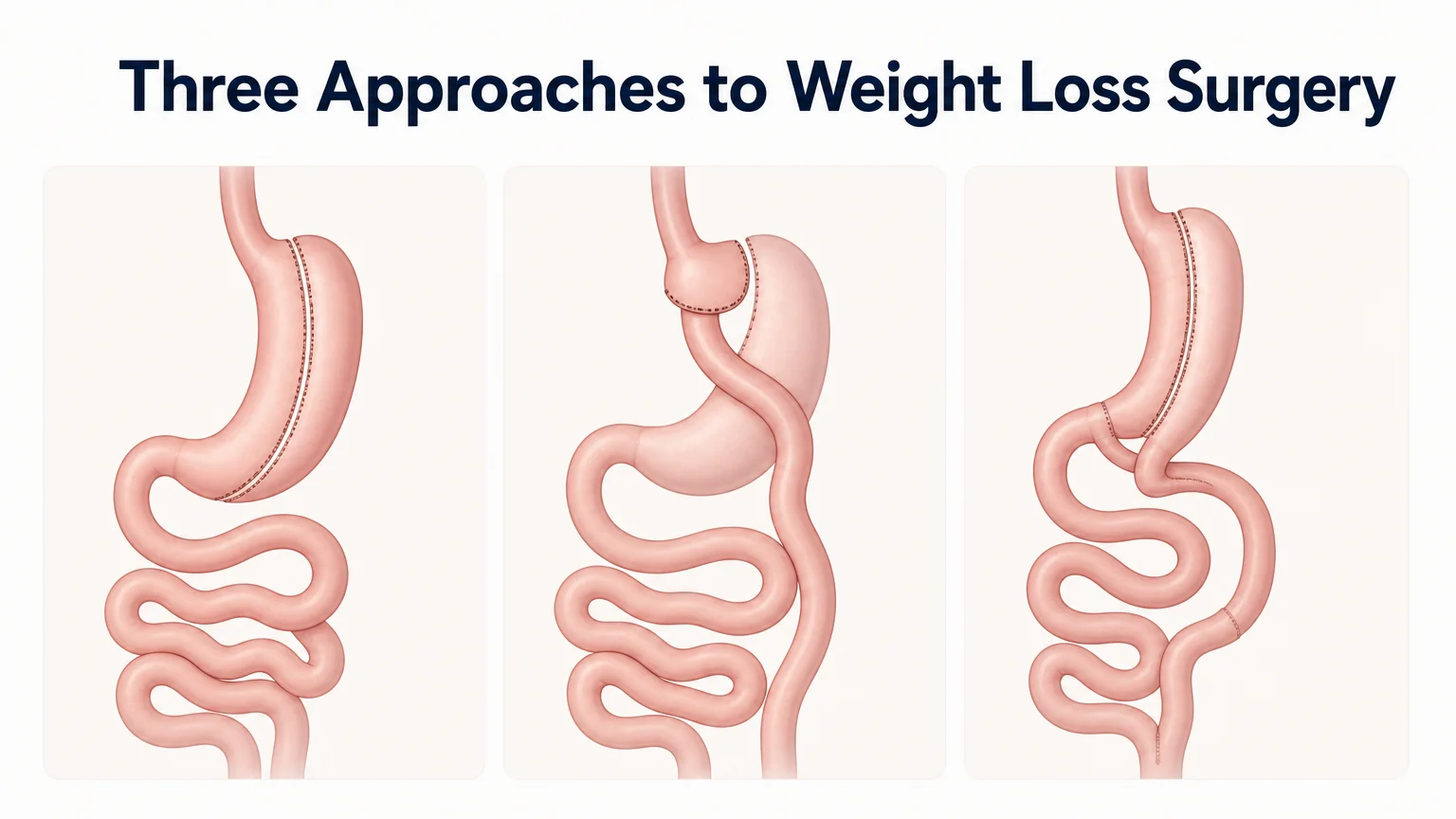
A gastric sleeve removes about 75-80% of the stomach, leaving a narrow tube. A gastric bypass makes a small stomach pouch and connects it to the small intestine, skipping the first section. A duodenal switch combines a sleeve with a much longer intestinal bypass, so food and digestive juices meet late.
| Gastric sleeve | Gastric bypass (Roux-en-Y) | Duodenal switch | |
|---|---|---|---|
| What changes | Stomach reduced to a tube | Small pouch plus rerouted gut | Sleeve plus long intestinal bypass |
| Main mechanism | Restriction, hormonal change | Restriction, reduced absorption, hormonal change | Restriction, strongest reduced absorption |
| Reversible? | No (stomach removed) | Partly, technically demanding | Rarely |
| Typical excess-weight loss | ~50-70% | ~60-80% | ~75-85% |
| Nutritional risk | Lower | Moderate | Highest |
| Reflux | Can worsen | Often improves | Can worsen |
Ranges are broad literature averages for orientation only.
The short version: the more a procedure reroutes your gut, the more weight it tends to take off, and the more lifelong monitoring it demands.
Many readers also meet the adjustable band in this comparison. We cover that one separately in gastric band vs gastric bypass.
Key Takeaways
- A sleeve reduces stomach volume only; bypass also reroutes digestion; a duodenal switch adds the longest intestinal bypass.
- Average excess-weight loss in the literature rises from sleeve to bypass to duodenal switch, but individual results vary.
- Nutritional risk and the need for lifelong monitoring rise in the same order.
- Reflux, diabetes, BMI, and previous surgery decide the recommendation, not which procedure is newest.
- Revision between procedures is possible but more demanding than a first operation.
How Much Weight Can You Lose With Each Procedure?
Averages across studies suggest about 50-70% of excess weight lost after a sleeve, 60-80% after a gastric bypass, and 75-85% after a duodenal switch. Excess weight means the kilograms above a healthy-BMI weight, not total body weight. Regain is possible after every operation.
Take a person whose healthy weight would be 70 kg and who weighs 130 kg. Their excess is 60 kg, so 70% excess-weight loss means about 42 kg lost.
Two things move these numbers more than the choice of operation. One is eating habits and activity after surgery. The other is whether you keep attending follow-up.
For a closer look at how the sleeve behaves over the years, read our gastric sleeve surgery guide.
Gastric Sleeve vs Gastric Bypass vs Duodenal Switch: Matching Surgery to Patient
Match the operation to the patient, not the other way round. A sleeve suits many people with a BMI in the 30s and 40s and no significant reflux. Bypass is often favoured with reflux, type 2 diabetes, or higher BMI. A duodenal switch is generally kept for very high BMI.
Surgeons weigh the following before recommending anything:
- BMI and body-fat distribution. Higher BMI pushes the decision towards bypass or duodenal switch.
- Reflux (GORD). Existing reflux is a common reason to avoid a sleeve.
- Type 2 diabetes. Bypass and duodenal switch tend to have stronger effects on blood sugar.
- Previous abdominal surgery. Scar tissue can change what is technically safe.
- Ability to take supplements and attend follow-up for life. This matters most for the malabsorptive options.
Common mistake: choosing the operation with the biggest numbers. The best procedure is the one you can sustain, and that your risk profile can tolerate.
If you are weighing injections first, GLP-1 vs bariatric surgery explains where each makes sense.
Long-Term Outcomes and Complication Rates
All three are major abdominal operations with real risks: bleeding, leaks along staple lines, infection, and blood clots. Over the long term, sleeve patients face reflux and some regain, bypass patients face vitamin deficiencies and internal hernias, and duodenal switch patients face the greatest nutritional risk.
Nutritional follow-up is not optional after the rerouting procedures. Bypass patients need lifelong vitamin B12, iron, calcium, and multivitamin supplements. Duodenal switch patients need the closest monitoring, including regular blood tests, because absorption of fat-soluble vitamins and protein can fall.
Our deep dive, long-term effect of gastric bypass, covers what the research shows at five and ten years.
Why KCM Clinic Offers All Three Options
KCM Clinic began as an obesity-treatment clinic and is now a private, multidisciplinary hospital in Jelenia Góra, Poland, an EU member state. Because the team does not have a single flagship operation to sell, the conversation starts with your history rather than with a procedure.
Operations are performed laparoscopically, using 3D laparoscopic technology, which remains uncommon in Europe. Packages are all-inclusive, covering consultation, surgery, hospital stay, dietetics, psychology, physiotherapy, aftercare, and transfers, coordinated by an international patient team that works in English, German, and Arabic.
Specific candidacy criteria are set by the surgeon after assessment, which is why we do not publish a one-size BMI cut-off here.
How Does Gastric Sleeve Compare to Bypass in Recovery Time?
Hospital stay for both a sleeve and a bypass is typically two to three days. Most people return to desk work within roughly two to four weeks, with bypass often at the longer end. Duodenal switch recovery is usually longer because the operation is more complex.
Expect a staged return to food: liquids, then purées, then soft food, then normal textures over several weeks. Your dietitian sets the timetable.
Flying home is a practical question for international patients. Your surgical team gives clearance based on your own recovery, so plan flexibility into travel dates.
Which Procedure Offers the Most Permanent Results?
No bariatric operation is a cure; each manages a chronic condition. The duodenal switch typically gives the most durable weight loss because its effect does not depend on stomach size alone, but it carries the highest nutritional burden. Bypass is well studied over decades.
A sleeve is irreversible because part of the stomach is removed. Bypass can be reversed in theory, though reversal is complex and uncommon.
Permanence also depends on you. Sustained results in every study track with long-term diet, activity, and follow-up.
Can You Switch From One Procedure to Another Later?
Yes, in some cases. A sleeve can be converted to a bypass or duodenal switch if weight returns or reflux becomes troublesome. Revision surgery is more demanding than a first operation, so many surgeons plan with that possibility in mind.
This is one reason a sleeve is sometimes treated as a first stage. Revisions have higher complication risks than primary operations, so they need a team with experience of both.

Get Started with KCM Clinic
If you are comparing gastric sleeve, bypass, and duodenal switch, a consultation with the bariatric team is the step that turns general information into a recommendation for you. Bring your medical history and questions.
Book a Bariatric Consultation with KCM Clinic
FAQ
Which is better, gastric sleeve or duodenal switch?
Neither is better for everyone. A sleeve is simpler with lower nutritional risk and suits many moderate-BMI patients. A duodenal switch usually produces greater weight loss but needs closer lifelong monitoring, so it is generally reserved for very high BMI or severe metabolic disease.
Is gastric bypass or sleeve better for reflux?
Bypass is often preferred when reflux is significant, because a sleeve can worsen it in some people. Your surgeon will assess symptoms and may order tests before recommending one.
What is the safest weight loss surgery?
Sleeve gastrectomy generally has the lowest complication and nutritional risk of the three major operations. Safety still depends on your health, weight, and the surgical team’s experience, so “safest” differs per patient.
Do I need vitamins for life after each operation?
After bypass and duodenal switch, yes, supplements and blood tests are lifelong. After a sleeve, supplements are still commonly advised, particularly vitamin B12, because the reduced stomach changes absorption.
How do I choose between the three procedures?
Start with a consultation covering your BMI, reflux, diabetes status, previous surgery, and ability to attend follow-up. A multidisciplinary team then recommends one option and explains the trade-offs.