

Half Knee Replacement: Recovery, Cost, and Long-Term Data Compared to Total Knee Replacement
Only one of the knee’s three compartments has to be damaged for half knee replacement to work. Replace that section, leave the healthy two-thirds of the joint alone, and most patients are back on their feet in four to six weeks rather than the eight to twelve a full replacement typically demands.
Key Takeaways
- Half knee replacement (unicompartmental) is appropriate only when osteoarthritis is confined to a single knee compartment; multi-compartment damage needs total knee replacement instead.
- Recovery is typically 4–6 weeks for partial replacement versus 8–12 weeks for total replacement, with less bone removed and a shorter procedure.
- Costs generally run 20–30% lower than total knee replacement, reflecting reduced operative time and a smaller implant.
- Long-term implant survival at 10+ years is comparable between the two procedures when patient selection is correct.
- A small proportion of partial replacements progress to full replacement later if arthritis spreads — pre-operative imaging and assessment are what rule this in or out.
What Is a Half Knee Replacement and How Does It Differ From a Total Knee Replacement?
A half knee replacement — also called a partial or unicompartmental knee replacement — resurfaces only the damaged compartment of the knee, leaving healthy bone, cartilage, and ligaments in the other compartments untouched. A total knee replacement resurfaces all three compartments and typically sacrifices the anterior cruciate ligament. The choice between them comes down to how much of the joint the arthritis has actually reached.
The knee has three compartments: medial (inner), lateral (outer), and patellofemoral (behind the kneecap). Osteoarthritis rarely damages all three evenly. When it stays confined to one, a partial replacement can address the problem without touching the rest of the joint.
| Factor | Half (Partial) Knee Replacement | Total Knee Replacement |
|---|---|---|
| Bone removed | Single compartment only | All three compartments |
| ACL preserved | Usually yes | Usually no |
| Typical operating time | Shorter | Longer |
| Typical recovery | 4–6 weeks | 8–12 weeks |
| Typical cost vs total | 20–30% lower | Baseline |
| Best suited to | Single-compartment osteoarthritis | Multi-compartment osteoarthritis |
By the numbers: A partial replacement removes roughly a third of the bone a total replacement does, which is why the procedure is shorter and the joint tends to feel closer to natural afterwards.
Who Is a Good Candidate for Half Knee Replacement?
Good candidates have osteoarthritis confined to one compartment, an intact ACL, and reasonable knee alignment — confirmed through imaging rather than symptoms alone. Age and activity level matter less than the actual pattern of joint damage visible on a scan. Someone in their 40s with single-compartment wear can be a better candidate than someone in their 70s with damage across all three.

At KCM Clinic, candidacy isn’t decided from a symptom questionnaire. Weight-bearing X-rays and a biomechanical assessment of alignment and ligament stability determine which compartments are actually affected before any procedure is recommended — the same diagnostic standard applied across total knee replacement evaluations at the hospital.
Bone quality also factors into the assessment. Patients with underlying osteoporosis treatment needs may require additional pre-operative planning to confirm the remaining compartments can support an implant securely, regardless of which one is arthritic.
Patients who are not good candidates include those with:
- Rheumatoid or inflammatory arthritis (affects the whole joint, not one compartment)
- A torn or absent ACL
- Significant knee deformity or instability
- Arthritis confirmed across two or more compartments on imaging
How Much Does Half Knee Replacement Cost Compared to a Total Knee Replacement?
Half knee replacement typically costs 20–30% less than a total knee replacement, driven by shorter operating time, a smaller implant, and a shorter hospital stay rather than a lower standard of care. For UK and Canadian patients weighing private surgery against a long public wait, that gap is a real factor — but it’s a by-product of the smaller procedure, not the reason to choose it.
Patients researching private knee replacement cost UK options often assume “partial” automatically means “budget.” It doesn’t. The saving exists because less is being replaced, not because less care is involved — the same surgical team, imaging protocol, and implant manufacturers are used for both procedures at KCM Clinic.
Worth knowing: Choosing partial replacement to save on cost only works if the anatomy supports it. A patient with multi-compartment arthritis who has a partial replacement anyway typically ends up needing a second, more complex operation later.
What Is the Recovery Time After Partial Knee Replacement?
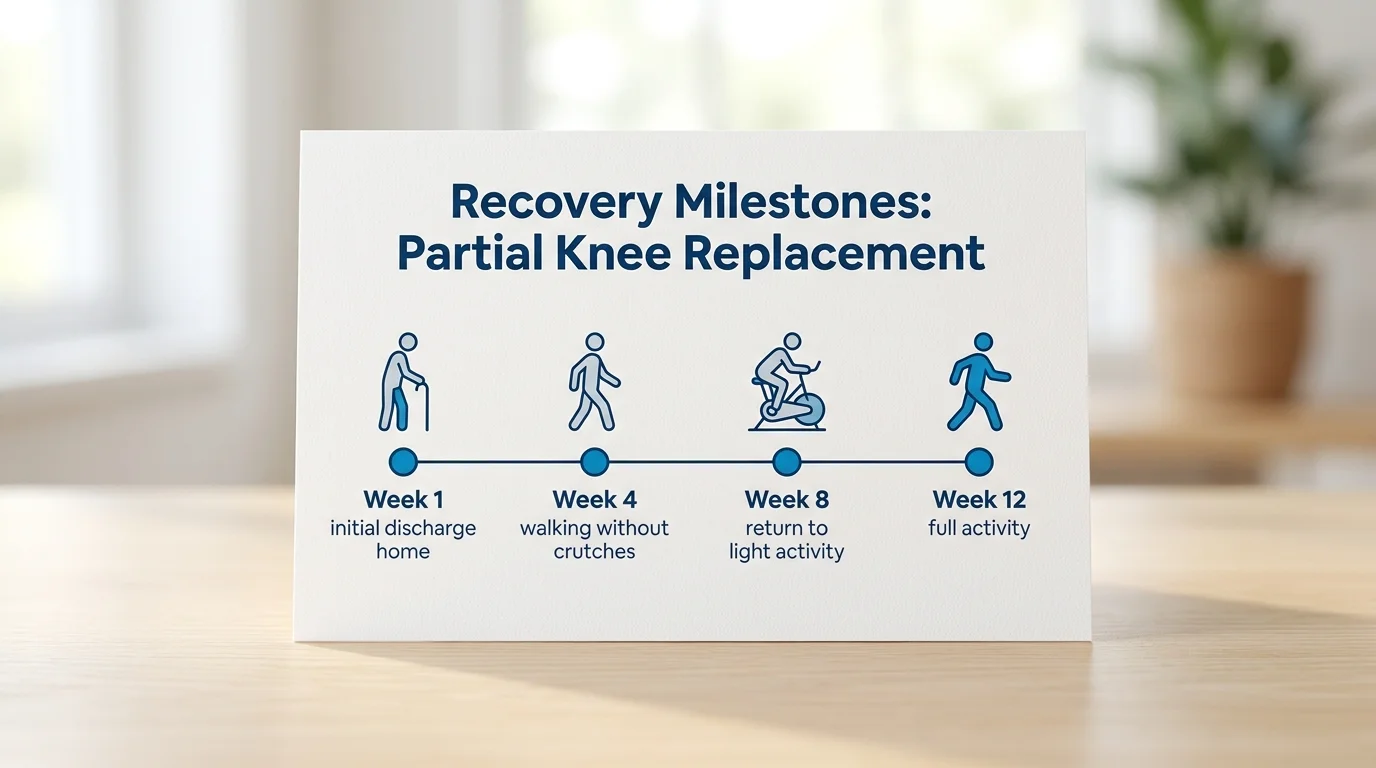
Most partial knee replacement patients walk with support within a day or two, come off crutches by around week four, and resume light daily activity by week eight — roughly half the timeline of a total knee replacement. Because less bone and soft tissue is disturbed, the early rehabilitation phase moves faster.
Physiotherapy typically starts the day after surgery, focused first on regaining a full range of motion, then on building strength for walking and stairs. Recovery timeline for half versus full replacement is one of the most consistent differences patients notice: total knee replacement recovery routinely runs into the third month before similar milestones are reached.
- Days 1–3: walking with a frame or crutches, hospital discharge
- Weeks 2–4: crutches phased out, gait normalises
- Weeks 4–8: light daily activity, driving typically resumes
- Weeks 8–12: return to most normal activity, including low-impact sport
Not every recovery follows this exact pace. Bone quality, pre-operative fitness, and how consistently physiotherapy is followed all shift the timeline in either direction — the same structured, milestone-based approach KCM uses for recovery from spine surgery anchors partial knee rehabilitation too.
How Long Do Partial Knee Replacements Last Before Revision Surgery Is Needed?
At 10 years, implant survival for well-selected partial knee replacement patients is broadly comparable to total knee replacement, though registries consistently show a somewhat higher revision rate for partial implants overall — almost entirely concentrated in patients who were borderline candidates to begin with. Correct patient selection at the outset is the single biggest factor in long-term outcome, more than the implant brand or surgical technique.
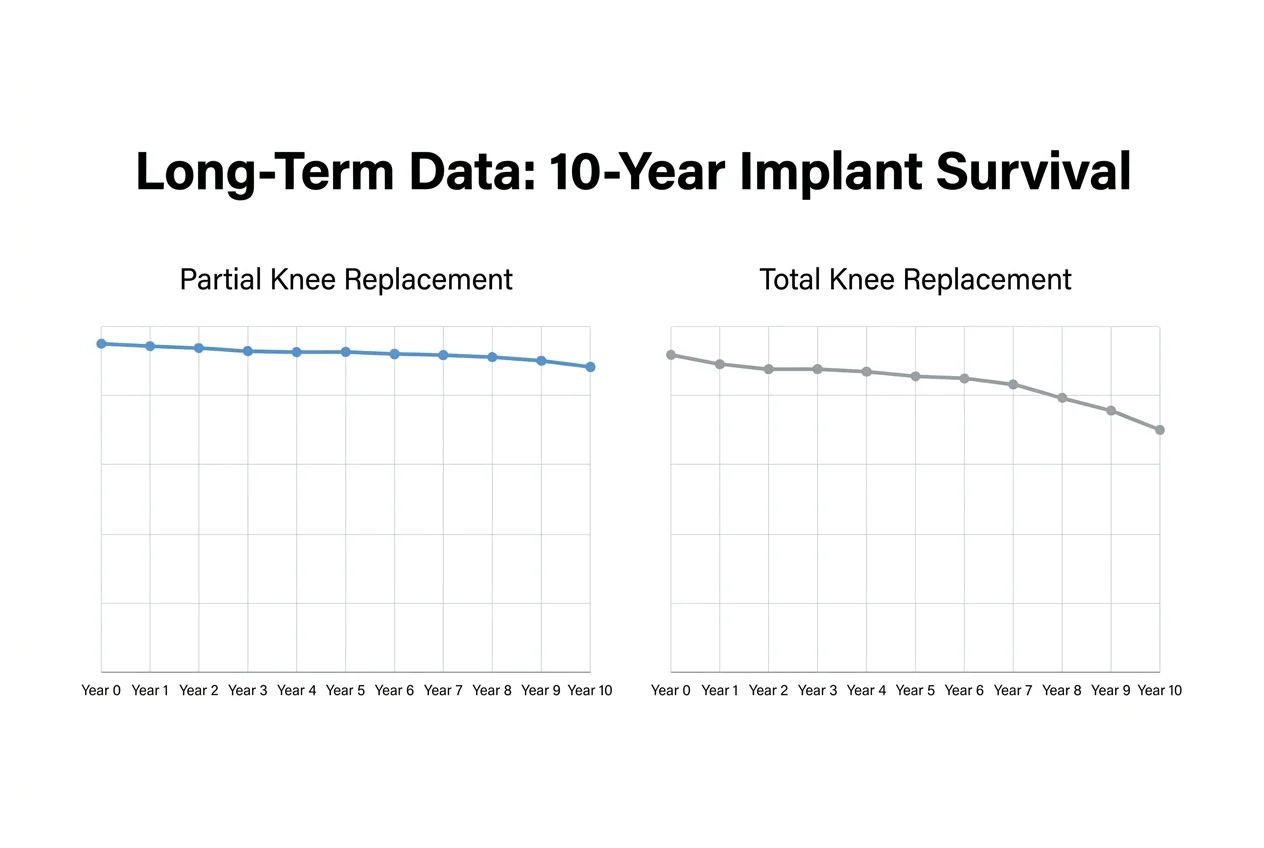
KCM Clinic uses Zimmer Biomet and Stryker unicompartmental implant systems — the same manufacturers used in the hospital’s total knee replacement programme — chosen for their long track record in orthopaedic registries across the EU. As an EU member state, Poland operates under the same medical device and clinical governance regulations as Germany or France, not a separate lighter-touch standard.
Reality check: A small percentage of partial replacements are later converted to total replacement if arthritis develops in the remaining compartments over time. This isn’t a failure of the original surgery — it’s the natural progression of osteoarthritis in a joint that already had disease in one part.
What Are the Risks and Complications of Partial Knee Replacement Surgery?
Partial knee replacement carries the same general surgical risks as any joint replacement — infection, blood clots, stiffness — generally at rates equal to or lower than total knee replacement, since less tissue is disturbed. Complication rates are not zero; they are simply proportional to the smaller scope of the operation.
The most common issue reported by patients isn’t a complication in the surgical sense — it’s residual awareness that the knee “isn’t quite the same” in the first few months, which typically resolves as physiotherapy progresses. Persistent pain beyond three months, or a sense the joint is loosening, warrants review rather than a wait-and-see approach.
Why Choose KCM Clinic for Half Knee Replacement?
KCM Clinic rules a patient in — or out — of half knee replacement using weight-bearing imaging and a biomechanical assessment, not a consultation form. That diagnostic step matters more here than in almost any other orthopaedic decision, because operating on the wrong candidate means a second surgery later.
Every unicompartmental procedure uses Zimmer Biomet or Stryker implants, the same systems used across the hospital’s wider orthopaedic programme, within a Polish hospital governed by the same EU regulatory framework as Germany or the Netherlands. Aftercare is arranged as one package — pre-op consultation, comprehensive health screening, surgery, hospital stay, and physiotherapy — rather than assembled separately once you arrive.
Book a Free Consultation with KCM Clinic to have your imaging reviewed and find out whether partial or total replacement fits your knee.
Frequently Asked Questions About Half Knee Replacement
What are the success rates and long-term outcomes for half knee replacement?
Well-selected partial knee replacement patients report high satisfaction and function comparable to total knee replacement, with 10-year implant survival broadly similar between the two. Outcomes depend heavily on whether the arthritis genuinely stayed confined to one compartment at the time of surgery.
Is half knee replacement right for you if you have osteoarthritis in multiple knee compartments?
No. Half knee replacement only addresses the compartment it resurfaces, so damage in a second or third compartment will keep causing pain regardless of surgery. Multi-compartment arthritis needs a total knee replacement to treat the joint as a whole.
Can a partial knee replacement be converted to a full replacement later?
Yes, if arthritis develops in a previously healthy compartment years after the original surgery. This is a planned-for possibility rather than a failure, which is why pre-operative imaging and periodic review matter for anyone choosing the partial route.
How soon can you return to walking and driving after partial knee replacement?
Most patients walk unaided within two to four weeks and resume driving once they can comfortably perform an emergency stop, typically around week four to six. Full return to normal daily activity generally follows by week eight, faster than the total knee replacement timeline.